


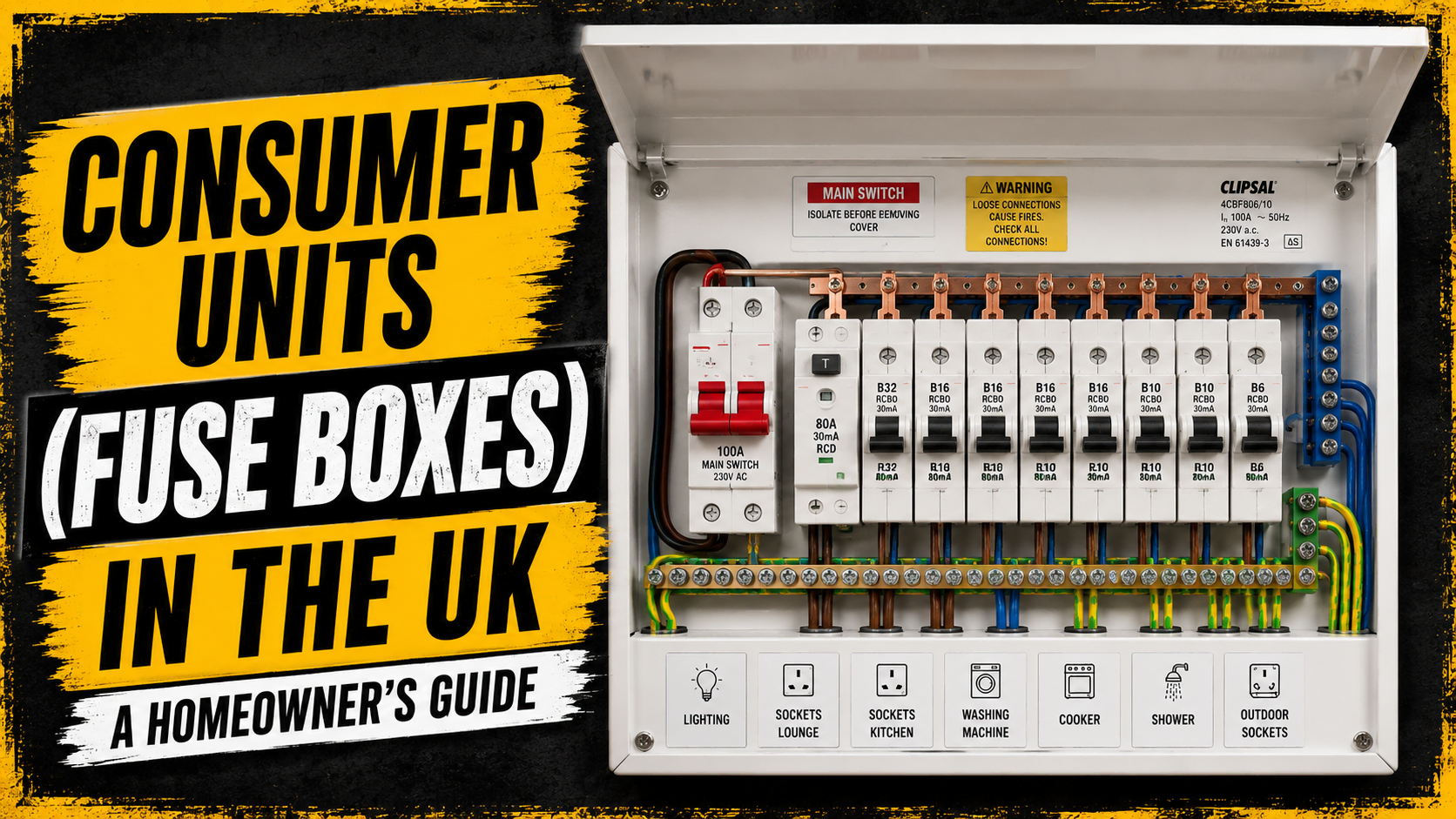

A consumer unit is the box in your home that controls and protects every circuit you have lights, sockets, the cooker, all of it. Most people still call it a fuse box. The rewirable fuses that gave it that name were phased out decades ago, in favour of circuit breakers. You probably walk past yours most days without a second thought. That’s fine, right up until a breaker starts tripping, a survey flags it, or you plan work that touches the electrics.
This page covers what a consumer unit does, the types you’ll find in UK homes, and the rules that apply to them. It also covers honest signs yours might need replacing, and what really affects the cost. We’ve written it the way we’d explain it, standing at your own consumer unit. It’s the conversation our electricians have with homeowners across Hounslow and West London most weeks.
Quick facts before you read on:
- A consumer unit is the modern replacement for the old fuse box. It protects every circuit in your home.
- UK law has required a metal (non-combustible) case for consumer units fitted since 1 January 2016.
- Swapping a consumer unit is notifiable work under Part P. It must be certified by a registered electrician, or reported to Building Control.
- Frequent tripping, a burning smell, or a board still fitted with rewirable fuse wire are all reasons to get it checked.
- Cost depends on your circuit count, the board type you need, and whether you also need rewiring. See our full cost breakdown for the detail.
What Is a Consumer Unit?
A consumer unit is the point where your home’s power supply splits into separate, protected circuits for lighting, sockets, and bigger appliances. It’s usually a grey or white metal box in a hallway, cupboard, or garage, with a row of switches inside. Every UK home needs one. It’s the single point that lets you, or an electrician, cut power to just one part of the house the kitchen ring main, say. You don’t need to switch off the whole home to do it.
Is a Consumer Unit the Same Thing as a Fuse Box?
Broadly, yes. “Consumer unit” is simply the current, correct term for what most people still call a fuse box. The name changed because the parts inside it did. Older fuse boxes used rewirable fuse wire that had to be replaced by hand once it blew. Modern consumer units use circuit breakers and RCDs instead. These trip, and you just switch them back on. They’re also far better at catching the kind of fault that causes an electric shock, not just an overload.
| Old Fuse Box | Modern Consumer Unit | |
| Fuse/breaker type | Rewirable fuse wire | MCBs (switch-and-reset breakers) |
| Shock protection | Usually none | RCD or RCBO on every circuit |
| Enclosure | Often wood or bakelite | Metal, required since 2016 |
| After a fault | Fuse wire replaced by hand | Breaker switched back on |
If your home still has a wooden or bakelite box with fuse wire inside, you’re looking at older-generation kit, not a modern consumer unit. We’ve covered the practical differences in full, in our comparison of old fuse boxes and modern consumer units. That page also covers how to tell which one you’ve actually got.
Why Your Consumer Unit Matters More Than You’d Think
Your consumer unit is the safety net between your home’s wiring and whatever fault happens inside it. A modern one, fitted with RCD or RCBO protection, is built to cut a faulty circuit fast. In most cases, that’s fast enough to stop a serious shock, not just cause a nuisance trip.
That protection isn’t automatic on every board. Older units without RCD protection don’t offer the same safeguard. Neither do units where a fuse or breaker has been swapped for the wrong rating. Insurers increasingly expect a compliant consumer unit as standard, and some will ask about it if you ever make an electrical claim.
An RCD is a bit like a seatbelt for your wiring. It’s invisible day to day, and it’s the one thing doing real work at the exact moment something goes wrong.
Types of Consumer Units You’ll Come Across
Most consumer units fitted in the UK today are metal boards. They come with either a single RCD, a dual RCD, or a full high-integrity layout, where every circuit gets its own RCBO. Which one suits a home mostly comes down to its size, and how the circuits get used.
Metal vs Plastic Enclosures
Since 1 January 2016, any consumer unit fitted in a home has needed a metal case, unless it sits inside a metal cabinet or cupboard. The rule followed evidence that plastic-cased boards could let a fire spread faster than it should. An older plastic-cased board isn’t automatically unsafe just for being plastic. But it won’t meet current rules once it’s replaced or extended.
Single, Dual, and High-Integrity (Triple RCD) Boards
A single-RCD board protects everything through one device, so a fault anywhere can trip the whole house. A dual-RCD board splits your circuits across two RCDs, so a fault in one part of the house doesn’t take out the rest. A high-integrity board goes further still: it gives every circuit its own RCBO, so only the faulty circuit trips, and everything else stays live.
Flats and smaller homes often only need a compact board. We cover sizing on our page on small consumer units. Wiring a shed, garden office, or garage separately usually means its own sub-unit, fed from the main board. See our dedicated page for sheds, garages, and outbuildings.
What’s Inside a Consumer Unit?
Open a modern consumer unit and you’ll typically find a main switch and a row of MCBs, one per circuit. You’ll also find RCDs or RCBOs, giving shock protection. Together, these let the unit cut off one faulty circuit, instead of cutting all the power in the house.
The Main Switch
The main switch does exactly what it sounds like. It cuts power to the whole property in one go. It’s the switch an electrician uses before working on the board. It’s worth knowing where yours is, before you ever need it in an emergency.
MCBs, RCDs, and RCBOs, in Plain English
An MCB (miniature circuit breaker) protects your wiring from overload and short circuits. It trips if too much current tries to flow through it. An RCD (residual current device) protects people, not just wiring. It watches for current leaking somewhere it shouldn’t through a person, say and cuts power in a fraction of a second. An RCBO does both jobs in one device, per circuit, so only the affected circuit trips instead of everything sharing that RCD.
We’ve gone into full depth on when each type gets used, in our breakdown of consumer unit breakers. It also covers why most modern installs favour RCBOs per circuit.
Signs Your Consumer Unit Needs Replacing
A handful of signs come up again and again in the properties we’re called out to across Hounslow and West London:
- Frequent, unexplained tripping
- A burning smell near the unit
- Buzzing or crackling sounds from inside the box
- Visible scorch marks or heat damage
- No RCD protection anywhere on the board
- Rewirable fuse wire still in use
- A plastic-cased board that’s 15 or more years old
A burning smell, visible scorching, or a unit that’s warm to the touch is different from normal wear. If you notice any of these, switch off at the main isolator, if it’s safe to reach. Then call an electrician straight away, rather than waiting for a booked visit.
We’ve covered every one of these signs in more depth on our page on signs you need a consumer unit upgrade. It explains what each one actually means.
UK Consumer Unit Regulations You Should Know About
Consumer units in England and Wales must meet BS 7671, the IET Wiring Regulations, and, for most work, Part P of the Building Regulations too. Between them, these set out how the unit gets installed, tested, and in almost every case certified by a registered electrician.
BS 7671 and the Current Edition
BS 7671 is the UK’s national wiring standard, published jointly by the Institution of Engineering and Technology (IET) and the British Standards Institution (BSI). It’s currently in its 18th Edition. As of 15 April 2026, the current version is BS 7671:2018+A4:2026 known in the trade as the Orange Book. The older version stays valid until 15 October 2026, so you may see electricians reference either one during this switch-over period. Amendment 4 mostly touches things like battery storage and network earthing, rather than consumer units directly. Even so, it’s a good reminder that BS 7671 is a living standard: it gets updated, not written once and left alone.
Part P and Notifiable Work
Swapping a consumer unit counts as notifiable work under Part P of the Building Regulations. That means it must either get self-certified by an electrician on a government-backed competent person scheme. Or it needs reporting to your local Building Control team before work starts. Approved Document P sets out the detail straight from government, if you’d like to see the source for yourself.
The Metal Enclosure Rule
We touched on this above, under enclosure types. It’s worth repeating, though, because it’s a rule, not just good practice. Consumer units fitted in homes since 1 January 2016 must have a metal case. That applies no matter which competent person scheme the installer belongs to.
For the full picture, see our full page on UK consumer unit regulations. It covers how Part P affects selling a home, and what changes if you’re renting one out.
How Does Wiring Connect to a Consumer Unit?
Every circuit in your home runs back to the consumer unit as a loop. It connects to a shared busbar inside the unit, then out through its own dedicated breaker. That breaker is sized to match what the circuit carries. That’s why a cooker circuit and a lighting circuit use different breakers, even though they sit side by side in the same box.
We’re covering this so you know what’s happening behind the cover, not as a step-by-step for doing it yourself. Changing wiring at the consumer unit is notifiable work under Part P. It needs test gear and certification that go well beyond a weekend job. If you’d like the fuller technical picture, we’ve covered it separately in how consumer unit wiring actually works. That page also covers how ring mains and radial circuits differ.
How Much Does a Consumer Unit Upgrade Cost?
There’s no single fixed price for a consumer unit upgrade, because the job depends on the property. What we can tell you is what actually drives the cost up or down. That way, you know what you’re paying for before anyone picks up a screwdriver.
The main factors are:
- The number of circuits in the property
- Whether you need a single, dual, or high-integrity board
- Metal vs plastic case a rule in most cases, not a choice
- How easy it is to reach the current unit
- Whether you also need rewiring alongside the board
- Testing and certification, which should always be part of the job
As a rough steer: a small flat with a handful of circuits is usually the simplest job. A bigger house, or one that also needs extra circuits or an EV charger alongside the board, sits at the upper end.
We quote after a short visit, not over the phone, so the price you get is fixed. It won’t change once someone’s actually opened the cupboard. For the full breakdown of what typically affects price, see our full cost breakdown. Or book a consumer unit inspection directly, if you’d rather just get a number for your own home.
How to Choose a Consumer Unit Installer
Not every installer can legally self-certify a consumer unit upgrade. Before you book anyone, it’s worth checking for a few specific things:
- An ECS card (Electrotechnical Certification Scheme, issued through the Joint Industry Board) the photo ID that proves qualifications and a passed safety check
- A City & Guilds qualification, or equal NVQ, in electrical installation
- A place on a government-backed competent person scheme, such as NICEIC, NAPIT, or ELECSA. This is what lets an electrician self-certify notifiable work straight to Building Control, instead of you needing a separate application
- Proof of public liability cover
- A DBS check, since the work happens inside your home
- Confirmation they’ll issue a BS 7671 certificate once the job’s done
Handy Electric Pro’s electricians hold ECS and JIB cards, are City & Guilds qualified, DBS-checked, and fully insured. We’ve carried out consumer unit upgrades and rewiring across Hounslow, Richmond, Twickenham, Isleworth, Brentford, and the wider West London area since 2023. We’re rated 5.0 out of 5 across 136 Google reviews. Every consumer unit we fit gets tested and signed off with a BS 7671 certificate before we leave.
Frequently Asked Questions
What is a consumer unit?
A consumer unit is the box that splits your home’s power supply into separate, protected circuits for lighting, sockets, and bigger appliances. It’s the modern replacement for what people used to call a fuse box, using circuit breakers instead of rewirable fuse wire.
Is a consumer unit the same as a fuse box?
Broadly, yes. “Consumer unit” is just the current name for the same job a fuse box used to do, with far better protection built in. For the full side-by-side comparison, including how to tell which one you’ve actually got, see our comparison of old fuse boxes and modern consumer units.
How long does a consumer unit last?
There’s no fixed legal lifespan. Most electricians treat 20 to 30 years as a fair working figure, depending on use and build quality. Age isn’t the only thing that matters, though. A 10-year-old board with no RCD protection can be more of a worry than a well-specified board twice its age.
What’s the difference between an MCB, RCD, and RCBO?
An MCB protects your wiring from overload. An RCD protects people from electric shock. An RCBO does both jobs for a single circuit. We’ve covered each in full, including which combination suits which property, in our breakdown of consumer unit breakers.
Do I need a certificate after a consumer unit upgrade?
Yes. A registered electrician should give you an Electrical Installation Certificate, confirming the work meets BS 7671. They should also notify Building Control, either directly or through their competent person scheme, since this is notifiable work under Part P.
Is a consumer unit upgrade notifiable work?
Yes. In England and Wales, swapping a consumer unit is always notifiable under Part P of the Building Regulations, no matter the property’s age or size. It has to be self-certified by a registered electrician, or reported to Building Control before work starts.
Ready for a Consumer Unit Upgrade in Hounslow or West London?
A consumer unit is the single most important safety device in your home’s electrics. The rules around it exist for a real reason modern boards genuinely do protect people better than the fuse boxes they replaced. If you’ve spotted any of the signs above, or you’d just like an expert opinion either way, that’s a conversation worth having. A qualified electrician can talk it through with you.
Handy Electric Pro will survey your property, give you a fixed quote before any work starts, and issue your BS 7671 certificate once it’s done.
Book a consumer unit inspection with Handy Electric Pro no obligation, and no pressure either way.
Book Online