


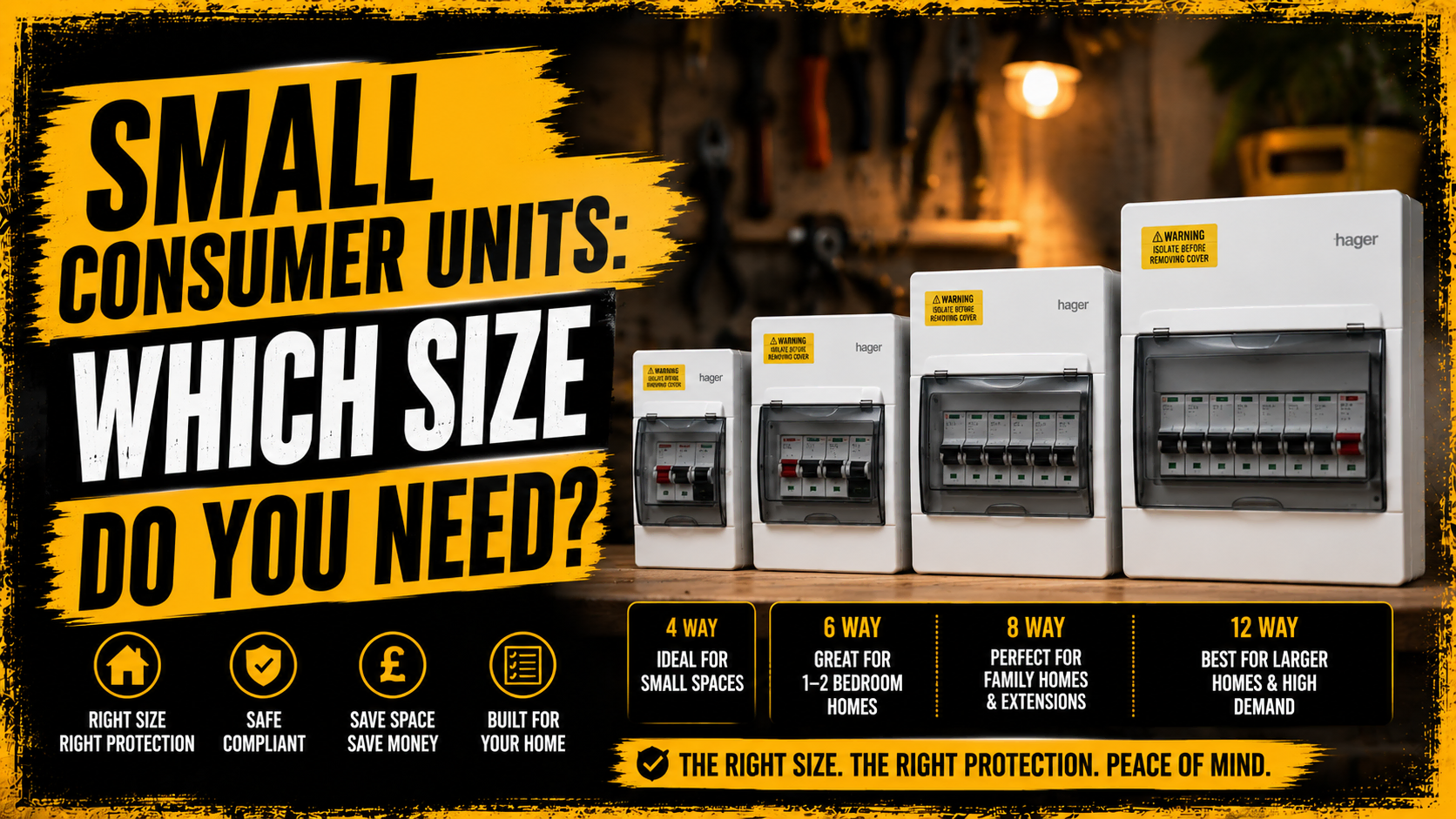

Most full-size homes need somewhere between 8 and 12 ways. Garages, sheds, and garden offices typically need far fewer, often just 2 to 6. “Ways” simply means the number of circuit slots on the board, and getting the count right matters more than it might seem: too few, and you’re stuck the moment you add anything new; too many, and you’re paying for capacity you’ll never use.
What Does “Ways” Actually Mean?
Each “way” on a consumer unit is one slot for one circuit breaker, protecting one circuit. A 6-way consumer unit has six of these slots, meaning it can protect up to six separate circuits, each with its own MCB or RCBO. Lighting, sockets, a cooker, an immersion heater each of these would typically get its own way.
It isn’t a measure of physical size or how much power the board can handle overall. It’s simply a count of how many separate circuits it can protect independently. A board with more ways can do more, and separate more, than one with fewer, which is really the whole story behind sizing one correctly.
Small Consumer Unit Sizes at a Glance
| Size | Typical use |
| 2-way | A single small circuit shed lighting, an isolated outbuilding |
| 4-way | Garage, workshop, or an extension’s extra circuits |
| 6-way | Garden office, summer house, or a flat |
| 8-way | A 2-bedroom home |
| 10-way | A 3-bedroom home |
| 12-way | A 4-bedroom home |
| 14-way+ | Larger homes, or any property with several higher-demand circuits |
These are starting points, not fixed rules. What actually gets wired to each circuit matters more than square footage alone.
Which Size Do You Need for Your Property?
| Property | Recommended ways |
| Garage or shed | 4 |
| Garden office or summer house | 6 |
| Flat or 1-bed home | 6 |
| 2-bed house | 8 |
| 3-bed house | 10 |
| 4-bed house | 12 |
| Large home (5+ bedrooms) | 14+ |
| Extension (additional circuits only) | 4 |
The table gives a rough steer, but the honest answer depends on what’s actually being wired. A garden office with just lighting and a couple of sockets needs a lot less than one with electric heating, internet, and a kettle running at the same time. Use the calculator below for a closer starting estimate, then we’ll confirm the real number on a free survey.
Consumer unit sizing
What size do you actually need?
Ways you’d likely use Spare capacity
This is a starting estimate, not a fixed spec. The exact number depends on your actual circuits which is exactly what we check on a free survey.
Small vs Standard Consumer Unit
| Small consumer unit | Standard consumer unit | |
| Ways | Typically 2–6 | Typically 8–14+ |
| Common use | Garage, shed, garden office, sub-board | Main property, full house |
| Enclosure | Smaller, sometimes surface-mounted | Larger, usually the main board |
| Protection | Same devices (MCB, RCD, RCBO), just fewer of them | Same devices, more of them |
Beyond the number of ways, there's no real technical difference. A small consumer unit uses exactly the same protective devices as a standard one, just fewer of them, in a smaller enclosure.
Don't Undersize It Planning Ahead
It's tempting to buy exactly what you need today, but a consumer unit isn't something most people replace often, and adding capacity later is rarely as simple as it sounds.
An EV charger, for instance, needs its own dedicated circuit. If there's no spare way on your board when you come to add one, that's a bigger, more disruptive job than if the capacity had been built in from the start. The same goes for solar panels, a home office with real power demands, or a workshop with power tools. If any of that is even a possibility in the next few years, it's worth building in one or two spare ways now rather than opening the board back up later. If an EV charger is specifically on the horizon, that's worth flagging to us up front it's exactly the kind of circuit planning we factor into a consumer unit survey.
Common Sizing Mistakes
A few patterns worth avoiding:
- Buying the exact number of ways needed today, with nothing spare
- Assuming a bigger board always costs proportionally more the labour and testing cost is often similar regardless of size
- Treating a garage or outbuilding board as an afterthought, when it often ends up running more than originally planned (lighting, then sockets, then a compressor, then an EV charger)
- Planning only for what's needed right now, not what's realistically coming in the next five years
What About the Protection Devices Themselves?
Whatever size consumer unit you end up with, the actual protection MCBs, RCDs, RCBOs works exactly the same way regardless of how many ways the board has. Our consumer unit breakers guide covers what each of these devices does, and why most modern boards now give every circuit its own RCBO, if you want the full picture before deciding on a size.
Every consumer unit we fit, whatever the size, is installed by ECS/JIB-certified, City & Guilds-qualified electricians, fully insured and DBS-checked.
Frequently Asked Questions
What does "ways" mean on a consumer unit?
Each way is one slot for one circuit breaker, protecting one circuit. A 6-way board can protect up to six separate circuits.
Is a 4-way consumer unit enough for a garage?
Often, yes lighting, a couple of socket circuits, and maybe a compressor or power tool circuit typically fits comfortably within 4 ways. If an EV charger is a future possibility, it's worth building in an extra way or two.
What size consumer unit do I need for a flat?
Most flats fall in the 6 to 8-way range, depending on how many separate circuits are needed for lighting, sockets, and the kitchen.
Should I buy a bigger consumer unit than I need right now?
Usually, yes, within reason. A couple of spare ways cost very little extra at installation but save a much bigger job later if you add a circuit.
Can I add an EV charger to a small consumer unit later?
Only if there's a spare way available. If the board is already full, adding an EV charger circuit later usually means either a board upgrade or a separate sub-board.
What's the difference between a small and a standard consumer unit?
No real technical difference beyond the number of ways. A small consumer unit uses exactly the same protective devices, just fewer of them, usually in a smaller enclosure.
Can one consumer unit feed a second, smaller one?
Yes, this is a common approach for garages, extensions, and outbuildings a sub-board fed from the main consumer unit, sized for just that area's circuits.
How many spare ways should I leave?
One or two is a reasonable default for most homes, more if you're planning something specific like an EV charger or a loft conversion in the next few years.
Not Sure What Size You Need?
We'll assess your actual circuits and recommend the right unit Get in touch for a free survey and a fixed quote, no obligation either way.
Book Online