


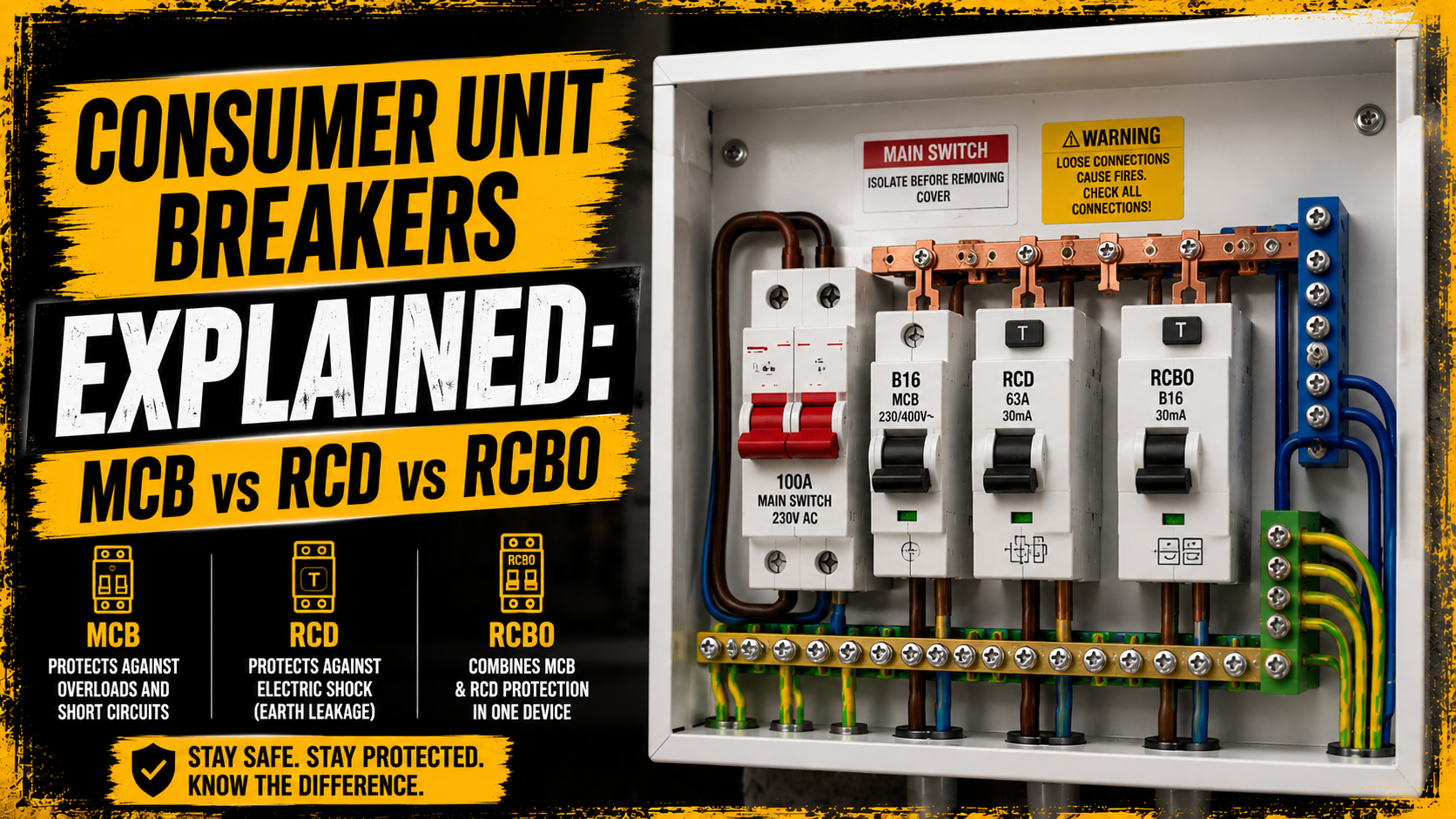

An MCB (miniature circuit breaker) protects your wiring from overload and short circuits, tripping before a cable overheats. An RCD (residual current device) protects people, detecting the tiny current leak that happens during an electric shock and cutting power in milliseconds. An RCBO combines both jobs into a single device, one per circuit which is why most modern consumer units are built around them.
MCB vs RCD vs RCBO: Quick Comparison
| MCB | RCD | RCBO | |
| Protects against overload | Yes | No | Yes |
| Protects against short circuit | Yes | No | Yes |
| Protects against earth leakage (shock risk) | No | Yes | Yes |
| Covers | One circuit | Usually shared across several circuits | One circuit only |
| Resets after tripping | Yes | Yes | Yes |
The short version: an MCB looks after the cable, an RCD looks after the person, and an RCBO does both for one circuit at a time, rather than sharing protection across several.
What Is an MCB?
A miniature circuit breaker trips automatically when a circuit draws more current than it’s rated for, or when a short circuit sends a sudden surge through the wiring. Think of it as protection for the cable itself it doesn’t know or care whether a person is at risk, only whether the wire is about to overheat.
Each MCB is rated in amps typically 6A for a lighting circuit, 32A for sockets sized to match what that specific circuit can safely carry. If it trips, you can usually flip it back once whatever caused the overload is dealt with.
What Is an RCD?
A residual current device works on an entirely different principle. It constantly compares the current flowing out on the live wire against the current returning on the neutral. In normal operation, those two figures match exactly. If they don’t because some of that current has found another path to earth, potentially through a person the RCD trips in a fraction of a second, typically 30 to 40 milliseconds.
That’s fast enough to prevent a fatal shock, which is the entire point of an RCD: it protects people, not wiring. On its own, it does nothing to stop a cable overloading.
What Is an RCBO?
An RCBO is simply an MCB and an RCD built into a single device, giving one circuit both kinds of protection at once. Instead of sharing one RCD across four or five circuits the older, more affordable way of doing it each circuit gets its own dedicated unit.
That difference matters more than it sounds, which brings up the question most homeowners actually want answered.
What Actually Happens When Something Goes Wrong
Take a genuinely common scenario: a bathroom socket develops an earth fault, perhaps from a hairdryer with damp, deteriorating insulation.
With MCB protection only, nothing happens. The MCB has no way to detect current leaking to earth that isn’t its job so the fault stays live and undetected. With a shared RCD, the device does its job and trips, but because that RCD covers several circuits at once, the fault in the bathroom cuts power to everything sharing it, potentially the kitchen, the hallway lights, and the fridge-freezer along with it. With an RCBO fitted on that circuit specifically, only the bathroom socket trips. The rest of the house carries on as normal, and the fault is isolated to exactly where it happened.
That’s the real argument for RCBOs over a shared RCD: not that they’re “safer” in the abstract, but that a fault in one part of the house doesn’t take out the rest of it.
Type A or Type AC Why the RCD Type Actually Matters
Not every RCD is built the same way, and since 2022 this has become a genuinely important distinction rather than a technical footnote.
Type AC RCDs only reliably detect a plain alternating current (AC) leak the kind produced by simple loads like an old-fashioned filament bulb or a basic resistive heater. The problem is that almost nothing in a modern home is that simple anymore. Phone chargers, laptop power supplies, LED drivers, and most appliances with electronic controls produce a different kind of leakage current, pulsating DC, which a Type AC device isn’t designed to reliably pick up.
Type A RCDs detect both. BS 7671 Amendment 2, which came into effect in 2022, addresses this directly: Regulation 531.3.3 restricts Type AC to a narrow set of genuinely simple, non-electronic loads, which rules it out for most domestic circuits today. Type A is now the standard fitted in new consumer units, and it’s specifically required for EV charging circuits, where the charging equipment itself can produce fault currents a Type AC device would miss entirely.
If your consumer unit was fitted or last upgraded before 2022 and you’ve since added an EV charger, a solar inverter, or simply the usual run of modern electronics, it’s worth having the RCD type checked. It’s exactly the kind of thing that shows up on an EICR a Type AC RCD protecting circuits full of modern electronics typically gets coded C3, improvement recommended, which won’t fail a report on its own but is a clear signal worth acting on.
What About SPD and AFDD?
Two other devices increasingly appear alongside RCBOs in modern consumer units, and they do different jobs again.
A surge protection device (SPD) doesn’t protect people or trip on a fault the way an RCD or RCBO does. It protects your electronics from voltage spikes, whether from a lightning strike nearby or a sudden surge on the grid. It’s an add-on to the board rather than a replacement for anything else, and it’s becoming increasingly common given how much sits plugged in across a typical home televisions, routers, smart home hubs, boilers with electronic controls.
An AFDD (arc fault detection device) does something neither an MCB nor an RCD can: it detects arcing, the kind of intermittent sparking that happens at a loose connection or a damaged cable, which can start a fire without ever drawing enough current to trip a standard breaker. AFDDs are increasingly recommended for higher-risk locations under current wiring regulations, though they’re not yet a blanket requirement across every domestic circuit.
How These Fit Inside a Real Consumer Unit
In practice, these devices get arranged inside a consumer unit in one of a few common configurations.
A split-load or dual RCD board splits circuits into two groups, each sharing one RCD the setup described in the fault scenario above, and still common in homes upgraded before RCBOs became the default. A full RCBO board gives every single circuit its own RCBO, so a fault anywhere only ever affects that one circuit. A high-integrity board goes a step further for specific circuits that genuinely shouldn’t lose power unexpectedly a freezer, a burglar alarm, medical equipment giving them independent protection so a fault elsewhere in the house can’t take them down.
Which setup makes sense depends on the property and what’s plugged into it, which is exactly what we look at during a survey rather than assuming. Our complete consumer unit guide covers what else sits inside a modern board beyond these protective devices, if you want the wider picture.
Why Does an RCBO Cost More Than a Shared RCD?
It isn’t pricing for the sake of it. A shared RCD is one component protecting several circuits; an RCBO is effectively an MCB and an RCD combined into a single unit, repeated once for every circuit that needs it. You’re paying for more components doing a more specific job, not the same protection with a bigger margin.
For actual figures for your property, our consumer unit replacement cost guide breaks down what typically drives the price up or down.
Do You Need to Upgrade?
If your consumer unit still uses a single shared RCD across most of the house, or you’re not sure which type of RCD is fitted, that’s not an emergency on its own plenty of dual RCD boards are still doing their job safely. It’s worth knowing about rather than assuming, though, particularly if you’re adding an EV charger or the board has never been properly inspected. If a breaker trips repeatedly rather than just once, that’s usually a sign of a genuine fault rather than simply an older device a different kind of problem to a straightforward upgrade.
Our old fuse box vs consumer unit guide covers the broader question of when it’s time to upgrade the whole board, not just the RCD type.
Every consumer unit we work on whether it’s a straightforward RCBO swap or a full upgrade is checked and signed off by ECS/JIB-certified, City & Guilds-qualified electricians, fully insured and DBS-checked.
Frequently Asked Questions
What’s the difference between an MCB, an RCD, and an RCBO?
An MCB protects wiring from overload and short circuits. An RCD protects people from electric shock by detecting current leaking to earth. An RCBO combines both functions in a single device, protecting one circuit at a time.
Do I need an RCBO on every circuit?
Not strictly, but it’s increasingly the standard on new installations. A shared RCD is still compliant and safe, but a fault on one circuit will trip everything sharing that RCD, rather than just the affected circuit.
Can I replace an MCB with an RCBO?
In most cases, yes, provided there’s room in the consumer unit and the RCBO is compatible with the board exactly the kind of check we do on-site rather than over the phone.
Is a Type A RCD better than Type AC?
For virtually any modern home, yes. Type A detects the pulsating DC leakage produced by most electronic equipment, which Type AC cannot reliably pick up.
Do I need Type A RCDs for an EV charger?
Yes. EV charging circuits are specifically required to have Type A protection as standard, since the charging equipment itself can produce fault currents a Type AC device would miss.
Why does an RCBO cost more than a shared RCD?
An RCBO is effectively an MCB and an RCD combined into one device, fitted individually per circuit, rather than one RCD shared across several circuits.
What is a high-integrity consumer unit?
A board where certain circuits typically a freezer, alarm system, or medical equipment get independent protection so a fault elsewhere in the house can’t cut their power.
Does every circuit need RCD protection?
Under current wiring regulations, the vast majority of domestic circuits require RCD protection in some form, whether that’s a shared RCD or an individual RCBO.
Not Sure What’s in Your Consumer Unit?
If you’re weighing up whether your board needs an RCD type check, an RCBO upgrade, or something more involved, Get in touch for a free survey and a fixed quote no obligation either way.
Book Online