


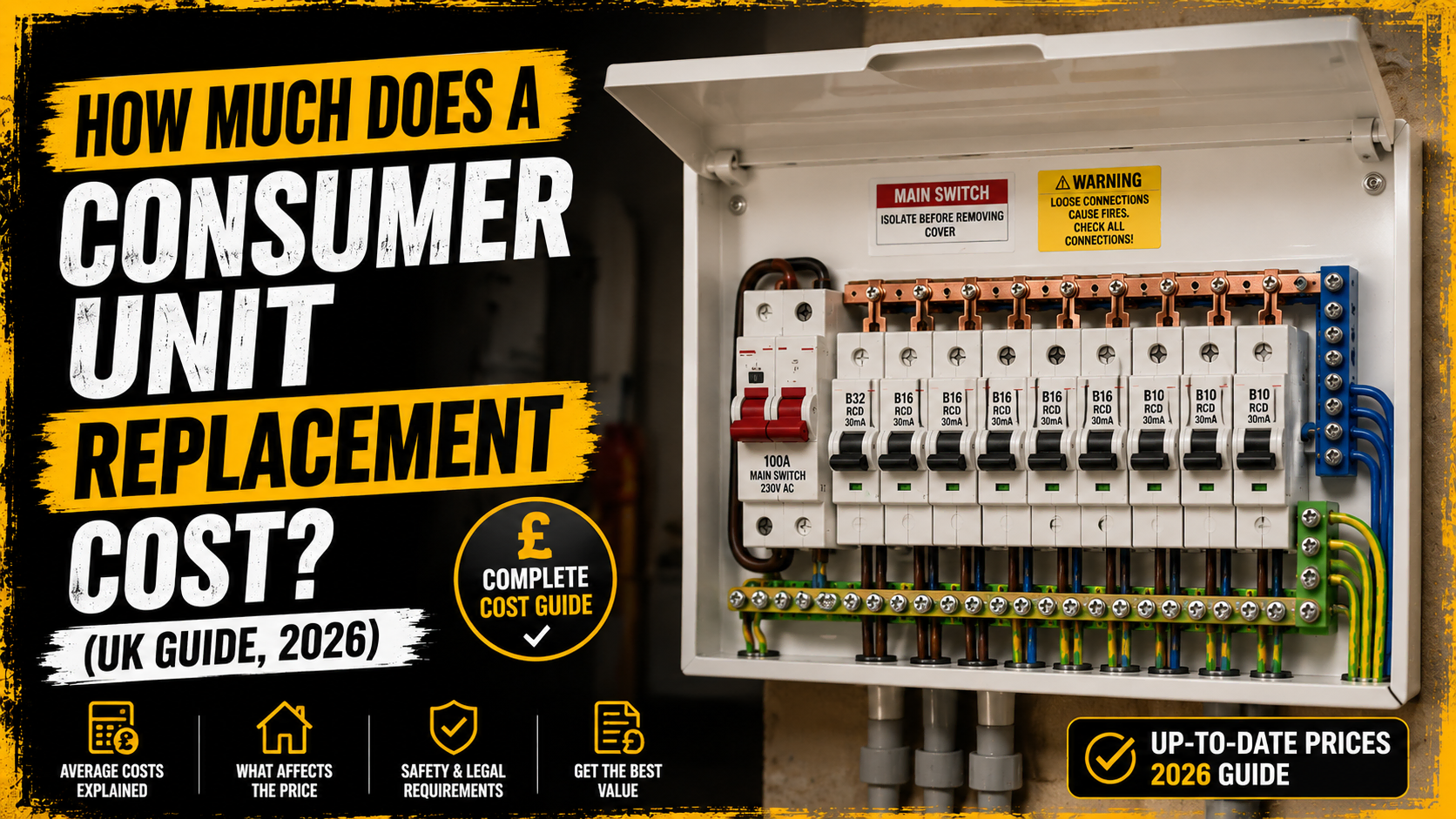

Most straightforward consumer unit replacements in the UK cost somewhere between £450 and £1,400, depending on your property size, the board you choose, and how many circuits need protecting. If you’re in Hounslow or West London, local trade data backs that up closelyrecent figures for the area put the average job at £699, with most quotes falling between £556 and £912.
Ranges like that aren’t much use for budgeting on their own, so here’s the more honest version: nobody can give you an exact number without seeing your current setup first, and any electrician who does is guessing. What we can do is walk you through exactly what pushes the price up or down, so you know what you’re paying for before you ever book a survey.
Quick clarification before the numbers: a fuse box and a consumer unit are the same thing, just from different eras. Older homes have rewirable fuse boxes with fuse wire that needs replacing every time it blows. A modern consumer unit uses circuit breakers and RCDs instead, which trip and reset rather than burn outsafer, faster to fix, and now what all replacement work uses by default.
Cost by board type
The type of board fitted has the single biggest impact on price, more than almost anything else:
| Board type | Typical cost |
| Dual RCD board (like-for-like swap) | £450 – £700 |
| Full RCBO board (10-way) | £700 – £1,200 |
| RCBO board with surge protection (SPD) | £900 – £1,400+ |
A dual RCD board is the simpler, more affordable option. Two RCDs split your circuits into two halves, so a fault on one half trips that half but leaves the other running. It’s a perfectly safe, fully compliant setup, and it’s what most homes had fitted as standard until fairly recently.
A full RCBO board gives every single circuit its own dedicated RCBOa combined breaker that protects against both overload and electric shock in one unit. If one circuit trips, only that circuit goes down; the rest of the house carries on as normal. The components themselves cost more than a shared RCD, which is most of the price differencelabour time is similar either way.
Adding surge protection (SPD) on top protects the electronics in your hometelevisions, boilers, alarm systems, anything with a circuit boardagainst voltage spikes from the grid or a nearby lightning strike. It’s a smaller add-on cost, but one more homes are choosing to include, particularly where there’s a lot of smart-home or AV equipment plugged in.
What affects the price of a consumer unit upgrade
Beyond board type, a handful of things move the number up or down:
- Number of circuits. More circuits means a bigger board, more RCBOs or MCBs, and longer on-site time. A one-bed flat might only need 6–8 ways; a larger family home can run to 12 or more.
- Condition of your existing wiring. If the cables feeding the board are in good shape, the job is a straightforward swap. If testing turns up damaged, undersized, or unearthed wiring, that’s extra workand we’ll always tell you before we do it, not after.
- Access to the current unit. A board that’s easy to reach costs less labour than one tucked behind boxed-in pipework or in a cramped understairs cupboard.
- Metal vs plastic enclosure. This one isn’t really optional. Since Amendment 3 to BS 7671 in 2016, all new and replacement consumer units in homes must be fitted in a non-combustible, metal enclosure, following a series of fires linked to older plastic units.
- Whether an EICR is needed first. If your wiring hasn’t been checked in a while, an Electrical Installation Condition Report may be recommended before work starts, to confirm the rest of the installation is safe to connect to a new board.
- Whether rewiring is needed too. A consumer unit upgrade and a rewire often get bundled together, particularly in older properties, and that changes the scope of the job significantly.
Dual RCD or RCBOwhich is right for your home?
If you’re trying to decide between the two, it usually comes down to how much a single nuisance trip disrupts your household. With a dual RCD board, a fault anywhere on one half of the housea faulty toaster, saycan knock out power to everything else sharing that RCD, including your fridge-freezer or WiFi router. With RCBOs, that same fault trips only the one circuit it’s on.
For a smaller flat with a handful of circuits, dual RCD is often perfectly adequate and keeps the cost down. For a family home, where losing power to half the house every time a hairdryer trips something is a genuine inconvenience, the extra cost of full RCBO protection tends to pay for itself in fewer trips down to the fuse box in the dark.
What’s included when we replace your consumer unit
A proper consumer unit replacement isn’t just swapping a box on the wall. Here’s what happens, start to finish:
- Survey – we look at your existing setup, count circuits, check access, and give you a fixed price before any work starts.
- Safe isolation – power is switched off and the supply is safely isolated before anything is touched.
- Removal and installation – the old unit comes out, the new metal-enclosed board goes in, and every circuit is connected and labelled.
- Testing – every circuit is tested for continuity, insulation resistance, and earth fault loop impedance, confirming the installation is safe before we leave.
- Certification – you receive an Electrical Installation Certificate (EIC), and the work is notified under Part P of the Building Regulations.
- Tidy-up – packaging and old materials are removed, and the area is left as we found it.
Do you need Part P sign-off?
Yes. Replacing a consumer unit counts as notifiable work under Part P of the Building Regulations, which means it has to be either reported to your local council’s building control team or carried out and self-certified by an electrician registered with a government-approved competent person scheme. Electrical Safety First has a clear explainer if you want the full detail.
In practice, using a registered electrician means you never have to deal with building control directlythe certification and notification happen as part of the job, and you’re left with the paperwork to prove it, which matters if you ever come to sell the property.
Signs your consumer unit needs replacing
A few signals worth acting on rather than waiting out:
- Frequent, unexplained tripping
- A fuse box with rewirable fuse wire rather than switches
- A plastic or wooden-cased unit (not compliant since 2016)
- No RCD protection at all
- Buzzing, crackling, or a burning smell from the unit
- The unit is original to a property built or last rewired before the mid-2000s
Anything in that last group involving heat, smell, or scorching isn’t a “book it in for next week” situation. Switch off at the main isolator if it’s safe to reach, and call a professional straight away.
How long does a consumer unit replacement take?
Most straightforward jobs take a single day, including testing and certification. Power will be off for most of that time, so it’s worth planning around itparticularly if you work from home or rely on equipment that needs a constant supply. Larger properties, or jobs where testing turns up additional faults, can run into a second day. We’ll always tell you at the survey stage what to expect for your specific job, not a generic estimate.
Consumer unit replacement cost in Hounslow & West London
Local pricing tends to sit a little above the UK-wide average, and Hounslow is no exceptionrecent local trade data puts the average consumer unit job in the area at £699, with typical quotes between £556 and £912. That lines up with what we see across our own work in Hounslow, Richmond, Twickenham, Isleworth, and Brentford.
Richmond and Twickenham in particular have a lot of Victorian and Edwardian housing stock, which often means older wiring paired with an outdated fuse board. It’s not unusual for a straightforward-looking upgrade to turn into a slightly bigger job once testing reveals the condition of the cables behind the wallthat’s not a reason to expect the worst, it’s the reason a proper survey matters more than a quote given over the phone. In Isleworth and Brentford, where there’s more of a mix of older terraces and newer builds, the job is more often a genuine like-for-like swap.
Why homeowners choose Handy Electric Pro
Every consumer unit we fit is installed by ECS/JIB-certified, City & Guilds-qualified electricians, working to BS 7671:2018 wiring regulations. The team is fully insured and DBS-checked, and we’re rated 5.0 out of 5 across 136 Google reviews from homeowners across Hounslow and West Londonseveral of whom specifically call out fair, reasonable pricing rather than being surprised by the final bill.
We quote after a short survey, not before, so the price you’re given is fixed, not an estimate that changes on the day.
Frequently asked questions
How much does a consumer unit replacement typically cost in the UK?
Most jobs fall between £450 and £1,400, depending on board type, circuit count, and property size. In Hounslow specifically, the local average is closer to £699.
What affects the price of a consumer unit upgrade?
Mainly the number of circuits, the type of board (dual RCD vs RCBO), the condition of your existing wiring, and access to the current unit.
Is an RCBO board worth the extra cost over dual RCD?
For larger households, or anyone who finds a single tripped RCD knocking out half the house inconvenient, yesRCBOs isolate faults to a single circuit rather than half the property.
Does it cost more if my property needs rewiring too?
Yes. A consumer unit upgrade and a partial or full rewire are often carried out together, particularly in older homes, and that increases both the scope and the price of the job.
Will I get a certificate, and is that included in the price?
Yes. Every consumer unit replacement we carry out includes testing and an Electrical Installation Certificate as standard, along with Part P notification.
Is a consumer unit upgrade covered by home insurance?
Some insurers ask for proof of a compliant installation, particularly on older properties. Worth checking with your provider, and keeping your EIC on file in case it’s requested.
How long does a consumer unit replacement take? Most straightforward jobs are completed in a single day, including testing and certification.
Do I need Part P sign-off, and does that add to the cost?
It’s a legal requirement, but using a registered electrician means the notification and certification happen as part of the standard jobthere’s no separate fee on top.
Ready for a fixed quote?
If any of this sounds familiaran old fuse box, breakers that trip for no obvious reason, or you’re simply due an upgrade Get in touch for a free survey and a fixed price, with no obligation to book. Or if you’d rather see the full picture first, our complete consumer unit guide covers what a consumer unit actually does and how to choose the right one for your home.
Free Survey · Fixed Quote
An old fuse box? Breakers tripping? Simply due an upgrade?
We’ll give you a fixed price after a proper look—with no obligation to book.
Book Online