


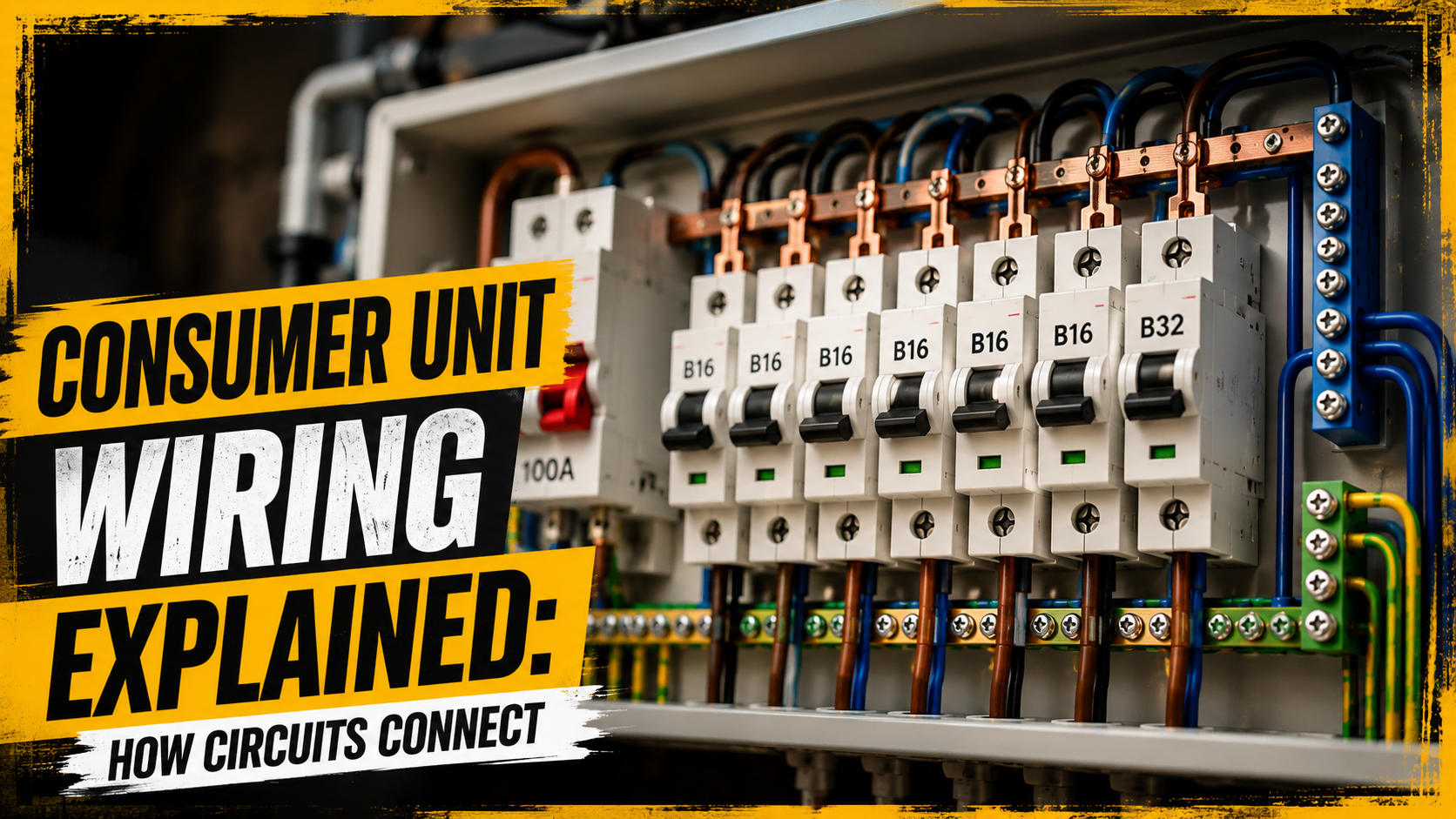

Every circuit in your home starts at the same place: the incoming electricity supply. From there, it passes through a main switch that can isolate the whole property in one movement, then onto a busbar that distributes power across the board. Each individual circuit lighting, sockets, the cooker branches off the busbar through its own dedicated breaker, which is what actually protects that specific circuit and nothing else.
How Power Flows Through Your Consumer Unit
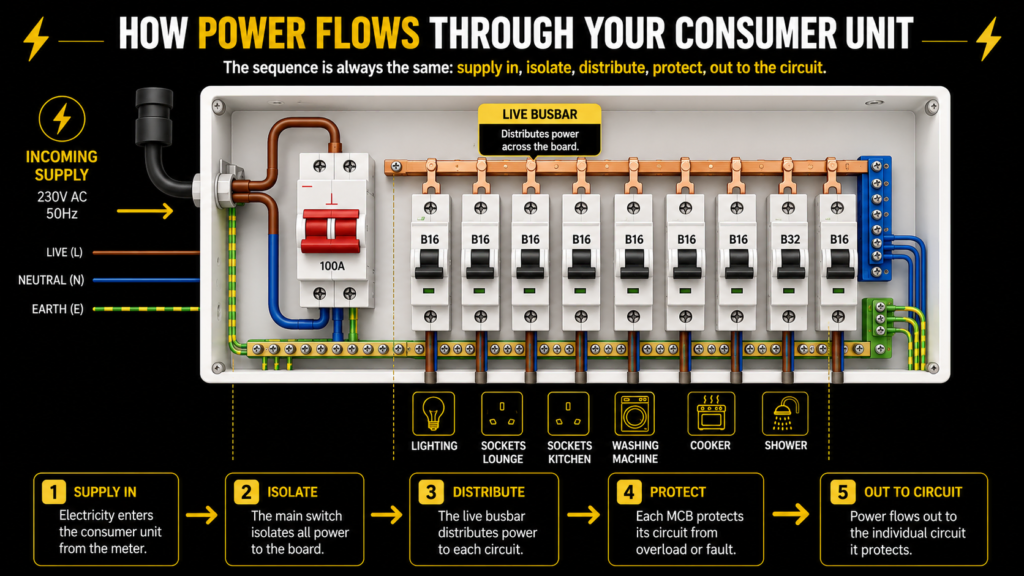
The diagram shows the sequence in its simplest form: supply in, isolated at the main switch, distributed across the busbar, then split out to individual, separately protected circuits. In practice, a typical home consumer unit might have anywhere from six to eighteen individual circuits branching off that busbar a two-bedroom flat sits at the lower end of that range, a larger house with a separate cooker circuit, an electric shower, and outdoor sockets sits toward the higher end.
What doesn’t change, regardless of how many circuits a property has, is the sequence itself: supply in, isolate, distribute, protect, out to the circuit. Once you can picture that flow, the rest of what’s inside a consumer unit the different types of breaker, the different board layouts makes a lot more sense, because it’s all variations on protecting that same basic structure.
For the wider picture of what’s inside a modern consumer unit beyond the wiring itself, our complete consumer unit guide covers the whole system.
Consumer Unit Wiring Diagram (UK)
Understanding a consumer unit is much easier when you see how the main components connect. Although layouts vary between manufacturers, most modern UK consumer units follow the same basic wiring arrangement.
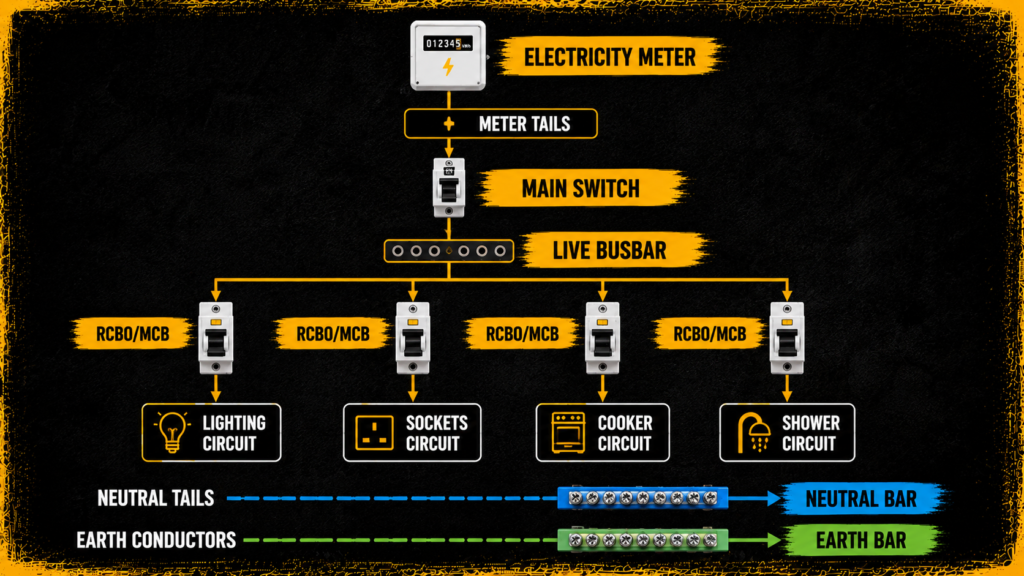
Note: This diagram shows the typical layout of a modern domestic consumer unit. The exact arrangement varies depending on whether the board uses RCBOs, dual RCDs, or another configuration, but the overall flow of electricity remains the same.
How to Read the Diagram
Electricity enters the consumer unit through the meter tails, which carry the incoming supply from the electricity meter. The supply first passes through the main switch, allowing the entire electrical installation to be isolated whenever maintenance or emergency work is required. From the main switch, power is distributed along the busbar. Rather than connecting each breaker individually to the incoming supply, the busbar safely distributes electricity to every protective device inside the consumer unit.
Each MCB or RCBO then protects a single circuit. Typical circuits include:
- Lighting
- Socket outlets
- Electric cooker
- Electric shower
- Garage or outbuilding supply
- Smoke alarms
- Immersion heater
The neutral conductors from each circuit terminate at the neutral bar, while all circuit protective conductors (earth wires) terminate at the earth bar. Together, these components complete the electrical circuit and provide fault protection in accordance with BS 7671.
Why Every Circuit Has Its Own Protective Device
Modern consumer units are designed so that each circuit can be protected independently.
For example:
- If a fault develops on the kitchen socket circuit, only that protective device should trip.
- The lighting, cooker, and other circuits can usually continue operating normally.
- This makes fault-finding easier and reduces unnecessary power interruptions throughout the property.
Many modern consumer units now use individual RCBOs, providing both overcurrent and residual current protection for each circuit. Older installations may instead use a combination of MCBs protected by one or two shared RCDs.
What Is a Circuit, Exactly?
A circuit is a complete loop, not just a single wire. Electricity flows out from the consumer unit along a live conductor, through whatever it’s powering a socket, a light fitting, an appliance and back to the consumer unit along a neutral conductor, completing the loop. A third conductor, the earth, provides a safe path for electricity to follow if something goes wrong, rather than through a person.
Every socket, light, and appliance circuit in your home works on this same basic principle. What differs between them is how much current they need to carry and how they’re protected, which is why a consumer unit doesn’t have just one big connection — it has several, each dedicated to a specific job.
What Is a Busbar?
The busbar is the strip inside the consumer unit that every circuit breaker connects to. Think of it as the point where the single incoming supply gets shared out power comes in once, through the main switch, and the busbar is what makes that power available to every circuit breaker sitting along the row. It’s a simple piece of engineering doing an important job. Without it, each circuit would need its own separate connection back to the meter, rather than sharing one properly protected distribution point.
What Is the Neutral Bar?
The neutral bar is the terminal strip inside a consumer unit where the neutral conductors from each circuit are connected. While the live conductor carries electricity from the consumer unit to sockets, lighting, and appliances, the neutral conductor completes the circuit by carrying current back towards the electricity supply. Each circuit has its own neutral conductor, and every one terminates at the neutral bar. This provides a secure and organised connection point, making the installation easier to test, inspect, and maintain. In modern consumer units fitted with RCBOs, each RCBO is paired with its corresponding neutral conductor. On older dual RCD boards, the neutral bars are often divided into separate sections so that each RCD only monitors the circuits assigned to it.
Although the neutral bar doesn’t normally contain protective devices, it’s a critical part of the electrical installation. Loose or incorrectly connected neutral conductors can lead to nuisance tripping, equipment malfunctions, or unsafe operating conditions.
What Is the Earth Bar?
The earth bar, sometimes called the earth terminal bar, is where all the circuit protective conductors (CPCs), commonly known as earth wires, are connected inside the consumer unit. Unlike the live and neutral conductors, the earth conductor doesn’t normally carry current during everyday operation. Its purpose is to provide a low-resistance path for fault current if a live conductor accidentally comes into contact with exposed metal parts of an appliance or electrical installation. If a fault occurs, the earth conductor allows sufficient fault current to flow so that the protective device—such as an MCB, RCD, or RCBO disconnects the circuit quickly, reducing the risk of electric shock and fire.
Every lighting circuit, socket circuit, cooker circuit, and other final circuit should have its earth conductor correctly terminated at the earth bar as part of the installation.
Neutral Bar vs Earth Bar
Although they sit close together inside a consumer unit, the neutral bar and earth bar perform very different functions.
| Feature | Neutral Bar | Earth Bar |
|---|---|---|
| Connected to | Neutral conductors | Earth (CPC) conductors |
| Carries current during normal operation | Yes | No (only during fault conditions) |
| Purpose | Completes the electrical circuit | Provides fault protection |
| Connected to every circuit | Yes | Yes |
Understanding this distinction makes it much easier to follow how electricity flows through a consumer unit and why modern protective devices operate correctly during both normal operation and fault conditions.
Why Does Every Circuit Get Its Own Breaker?
Separating circuits like this means a fault in one part of the house doesn’t have to affect the rest of it. If the breaker protecting your kitchen sockets trips, your upstairs lighting keeps working, because it’s on a completely separate circuit with its own protection.
Exactly how that protection works the difference between an MCB, an RCD, and an RCBO is covered in full in our consumer unit breakers guide. The short version here: modern consumer units increasingly give every circuit its own RCBO, which is why a fault today is far more likely to affect one room than the whole house.
Why Different Circuits Are Wired Differently
Not every circuit carries the same load, and the wiring reflects that. A circuit feeding an electric cooker or a shower draws far more current than a circuit feeding a few ceiling lights, so it needs thicker cable and a higher-rated breaker to match a lighting circuit might run on a 6A breaker, while a cooker circuit typically needs 32A or more. Get this wrong, undersized cable on a high-demand circuit, and you risk overheating, which is exactly what correctly rated breakers and cable are there to prevent.
This is also where a proper survey earns its keep. Working out the right cable size and breaker rating for each circuit in a specific property, especially one being extended or having new appliances added, isn’t a one-size-fits-all calculation. It depends on what’s already there, what’s being added, and how everything else on the board is loaded.
Can You Wire or Alter a Consumer Unit Yourself?
In England and Wales, installing, replacing, or making significant alterations to a consumer unit is notifiable work under Part P of the Building Regulations. That means it has to be carried out by someone registered with a government-approved competent person scheme, or separately inspected and signed off by your local authority’s Building Control.
This isn’t just a formality, and it’s not only tradespeople saying so. Even sources that walk through the wiring process step by step tend to land in the same place when asked directly one major UK electrical supplier’s own installation guide, after several thousand words of instructions, still answers “can I install a consumer unit myself?” with a recommendation to hire a qualified electrician. NICEIC, one of the two major UK competent person schemes, is more direct still: doing this work without a registered installer, or without separate approval, can put you on the wrong side of the law, not just the wrong side of best practice.
Using a registered electrician means the notification and sign-off happen as part of the job, and you’re left with the paperwork to prove it, which matters if you ever come to sell the property.
Every job we carry out is completed by ECS/JIB-certified, City & Guilds-qualified electricians, notified and certified correctly the first time.
Frequently Asked Questions
How is a consumer unit wired?
Power comes in through the main switch, which isolates the whole unit if needed, then feeds a busbar that distributes it to individual circuit breakers. Each breaker protects one specific circuit a room, a group of sockets, or a single high-demand appliance.
Can I install or wire a consumer unit myself?
Legally, no not without it being carried out by a registered competent person or separately signed off by Building Control. Installing or altering a consumer unit is notifiable work under Part P.
How do I install an MCB in a consumer unit?
This falls under the same Part P notifiable work, so it needs to be done or signed off by a registered electrician. Our breaker guide covers what MCBs actually do, if you want to understand the device itself first.
What is a busbar?
The strip inside a consumer unit that every circuit breaker connects to, allowing one incoming supply to be safely shared across multiple circuits.
What’s the difference between a circuit and a consumer unit?
A consumer unit is the board itself. A circuit is one of the individual loops of wiring lighting, sockets, a cooker that branches off it, each with its own dedicated protection.
Do I need a certificate after adding or altering a circuit?
Yes. Any notifiable electrical work should be followed by testing and the appropriate certification, along with notification under Part P.
Does “L1 and L2” apply to consumer unit wiring?
Not usually L1 and L2 more commonly refer to the terminals on a two-way light switch, not the consumer unit itself. If you’ve come across this term while researching consumer units, it’s likely a different part of the job.
Can I add a new circuit without rewiring the whole house?
Often, yes, provided the existing consumer unit has room and capacity for an additional breaker. This is exactly the kind of thing worth confirming during a survey rather than assuming.
Free Survey · Fixed Quote
Thinking About Adding or Altering a Circuit?
Whether it’s a straightforward consumer unit question or you’re planning something bigger, get in touch for a free survey and a clear, fixed-price quote.
Get Your Free Survey Free advice with no obligation to proceed.Book Online