


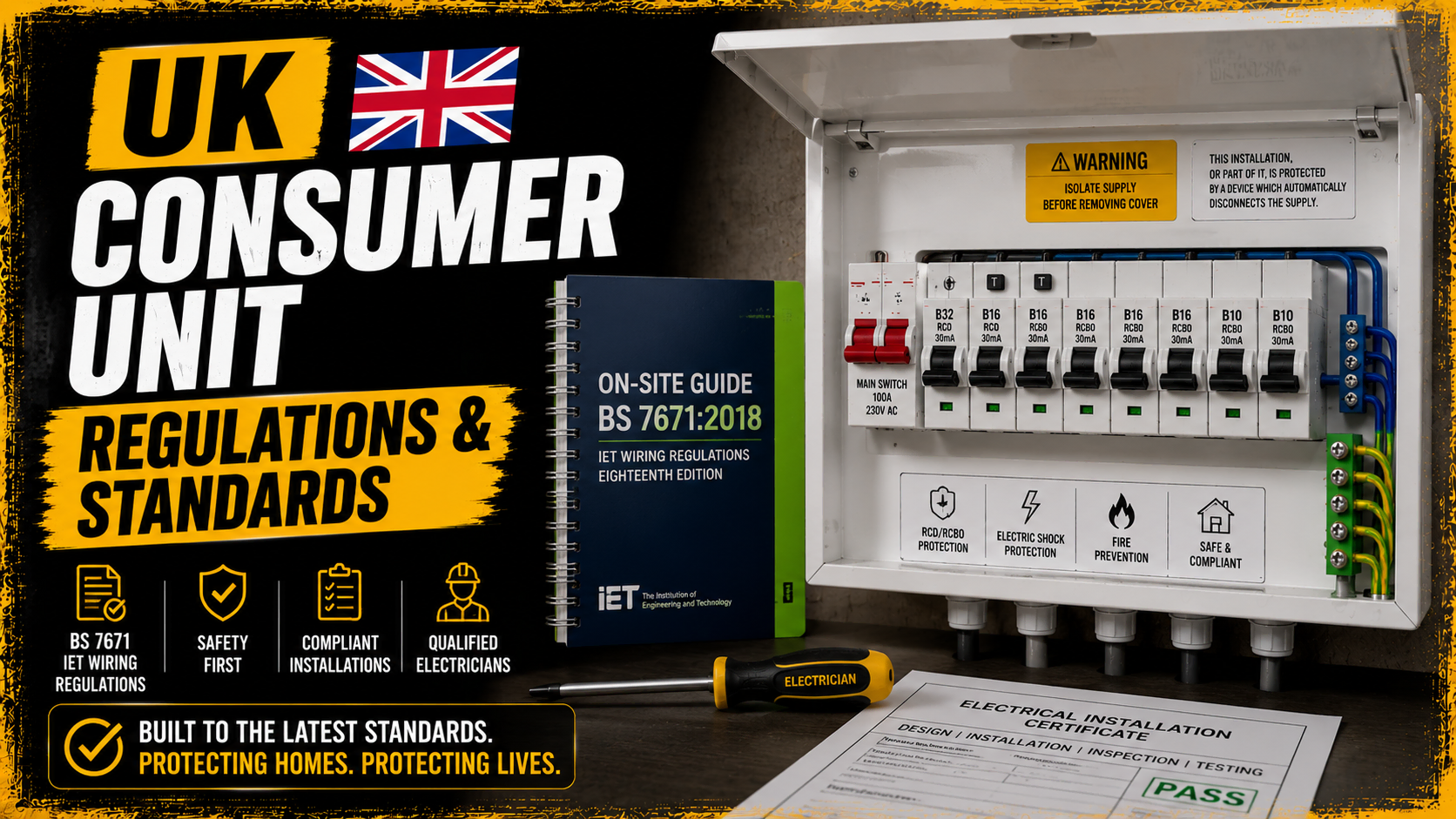

Every consumer unit installed or replaced in the UK today has to meet BS 7671, the current edition of the IET Wiring Regulations, be fitted in a non-combustible metal enclosure, and be notified under Part P of the Building Regulations. That’s the short version. The longer, more useful version explains why each of those requirements exists, what actually counts as “compliant,” and what it means for you specifically whether you’re a homeowner, a landlord, or getting ready to sell.
Is BS 7671 Actually the Law?
Not directly, and this trips a lot of people up. BS 7671 is a British Standard, published jointly by the IET and BSI, not an act of Parliament. On its own, it’s a recognised code of practice, not legislation.
Part P of the Building Regulations is different it became a genuine legal requirement in England and Wales in 2005, and non-compliance is, in principle, a criminal offence enforced by local authorities. Part P requires that electrical work in dwellings be designed, installed, and tested to protect people from fire and injury, and BS 7671 is the recognised standard used to demonstrate that you’ve done that. So the practical answer is: BS 7671 itself isn’t the law, but it’s the standard the law points to, and falling short of it usually means falling short of Part P, your insurance terms, or your obligations as a landlord all of which very much are enforceable.
Two Standards, Doing Two Different Jobs
There are actually two separate standards at play whenever a consumer unit gets installed, and conflating them is a common source of confusion.
BS 7671 governs the installation how the consumer unit is wired into your home, what protection each circuit needs, and how the whole system is tested and certified. BS EN 61439-3 governs the product itself the manufacturing standard the physical consumer unit has to be built and tested to before it’s ever fitted on a wall. One is about the job; the other is about the box. A consumer unit is only genuinely compliant when both are satisfied: a unit manufactured to the right standard, installed and wired to the right standard.
Why Metal Enclosures Became Mandatory
Since 1 January 2016, every new or replacement consumer unit in a UK home has had to be housed in a non-combustible enclosure, almost always metal, under Regulation 421.1.201 (Amendment 3 to BS 7671:2008).
The change followed a series of London Fire Brigade investigations into house fires involving consumer units. The underlying problem usually wasn’t the plastic itself it was substandard connections inside the unit overheating over time. In a metal enclosure, that heat stays contained. In a plastic one, the enclosure could catch fire and become part of the problem rather than containing it. Recorded fires involving consumer units had risen sharply in the years before the change, from roughly 70 a year to more than 250, which is what actually drove the regulation, not a general dislike of plastic as a material.
Worth being clear about what this doesn’t mean: a plastic consumer unit fitted before 2016 isn’t automatically illegal or unsafe, and you’re not legally required to replace one purely because of its age. The requirement applies to new work, not a blanket retrospective replacement order more on that below.
Part P and Notifiable Work
Installing, replacing, or significantly altering a consumer unit is notifiable work under Part P of the Building Regulations, meaning it has to be either carried out and self-certified by an electrician registered with a government-approved competent person scheme, or separately reported to and signed off by your local authority’s Building Control. Our wiring guide covers this in more detail if you’re weighing up doing any of the work yourself.
In practice, using a registered electrician means the notification happens as part of the job, not as a separate task you have to chase up afterwards, and you’re left with the paperwork to prove it.
What This Means If You’re a Landlord
Landlords have a firmer, more specific obligation than homeowners. Under the Electrical Safety Standards in the Private Rented Sector (England) Regulations 2020, every electrical installation in a rented property must be inspected and tested at least every five years, with the resulting EICR given to tenants within 28 days. Local authorities can fine landlords up to £30,000 for non-compliance.
An outdated or non-compliant consumer unit is one of the more common reasons an EICR comes back unsatisfactory, particularly a plastic-enclosed board or one without proper RCD protection. Given how much of Hounslow, Ealing, and Southall is rental property, this is worth planning for rather than discovering at short notice ahead of a tenancy renewal. Worth knowing too: these same obligations were extended to social housing landlords as recently as late 2025, with existing tenancies covered from May 2026, so the direction of travel here is toward more properties being covered, not fewer.
What About an Older, Still-Working Consumer Unit?
A consumer unit that was compliant when it was fitted doesn’t become illegal just because the regulations have moved on since. If it’s still passing inspection, working safely, and hasn’t been altered, there’s often no requirement to replace it purely to meet a newer standard.
Where this changes is if you’re adding circuits, carrying out other notifiable electrical work, letting the property, or an EICR flags a genuine issue at which point bringing the board up to current standards becomes part of that work, rather than an optional extra bolted on afterwards.
Every compliance check and upgrade we carry out is done by ECS/JIB-certified, City & Guilds-qualified electricians, fully insured and DBS-checked.
Frequently Asked Questions
Is BS 7671 a legal requirement?
Not directly it’s a British Standard rather than legislation. It becomes effectively mandatory through Part P of the Building Regulations, which is legally enforceable and uses BS 7671 as the recognised standard for compliance.
Are plastic consumer units illegal?
No. Plastic units fitted before 1 January 2016 aren’t automatically illegal or unsafe. New installations and replacements since then must use a non-combustible enclosure, almost always metal.
Do I need Building Control approval for a new consumer unit?
You need either a registered electrician to self-certify the work under a competent person scheme, or separate notification to your local authority’s Building Control. Most homeowners use a registered electrician specifically to avoid the second route.
How often does a landlord need an EICR?
At least every five years under the Electrical Safety Standards in the Private Rented Sector (England) Regulations 2020, or sooner if the previous report recommends it.
What’s the difference between BS 7671 and BS EN 61439-3?
BS 7671 governs how a consumer unit is installed and wired. BS EN 61439-3 is the separate manufacturing standard the physical unit itself must be built to before it’s fitted.
Can I keep my old consumer unit if it still works?
Often, yes, provided it’s passing inspection and nothing notifiable is being done to it. The metal-enclosure requirement applies to new work, not a mandatory retrospective replacement.
Will an old consumer unit fail an EICR?
Not automatically, but it’s one of the more common reasons a report comes back unsatisfactory, particularly a plastic enclosure or a lack of RCD protection.
Does a consumer unit upgrade need a certificate?
Yes. Compliant work should be followed by testing and an Electrical Installation Certificate, along with Part P notification.
Not Sure If Your Consumer Unit Is Compliant?
Book a quick compliance check a straightforward assessment against current regulations, with no obligation to book further work.
Book Online