


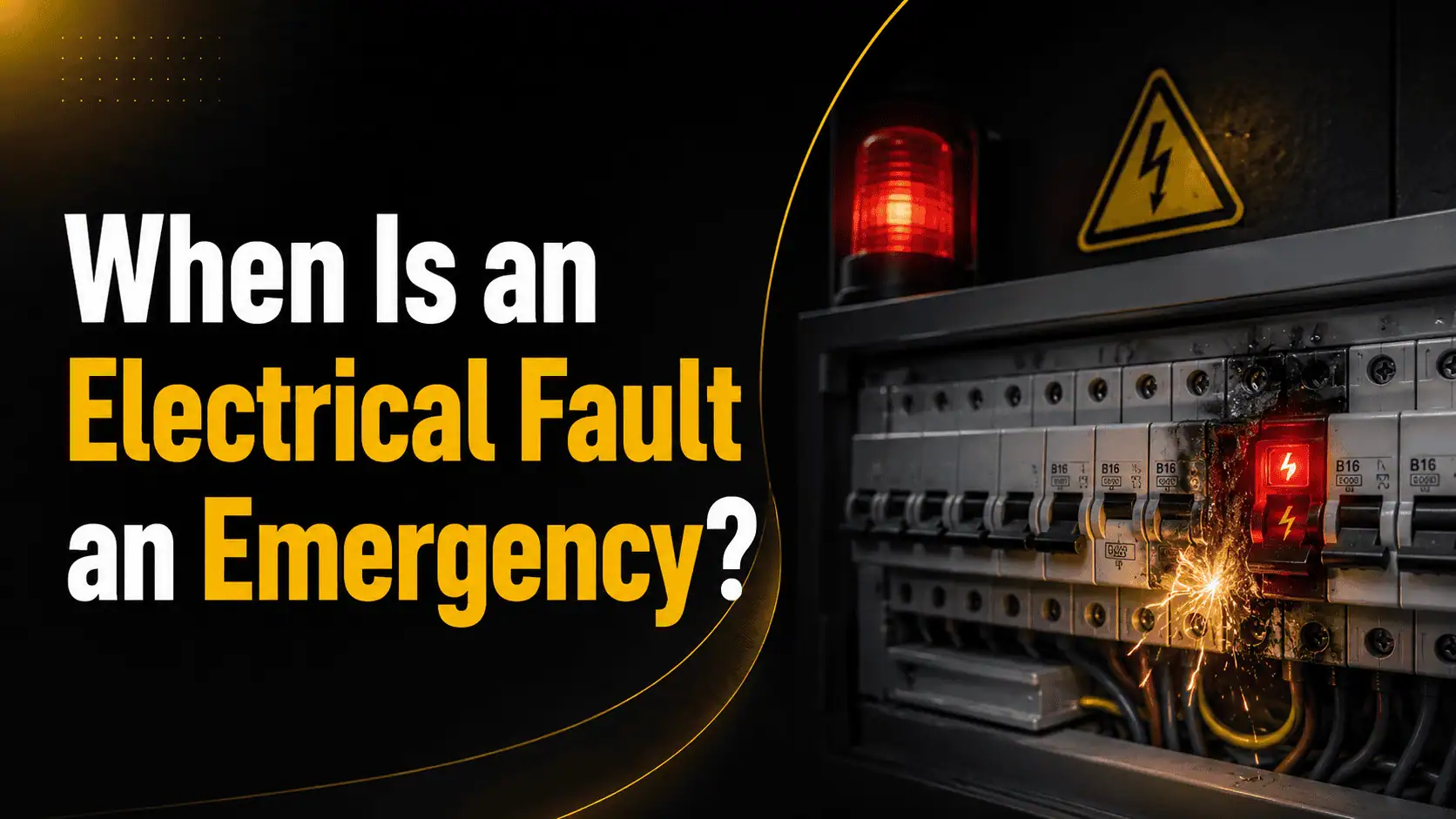

An electrical fault is an emergency when there is an immediate risk to people or property, such as fire, smoke, electric shock, dangerous overheating, exposed live parts or water affecting electrical equipment. Other faults still need investigation, but they do not all require 999 or an out-of-hours electrician. The first decision is therefore not simply:
“Is something wrong with my electrics?”
It is:
“How much danger is present, and who is the right person to call?”
NICEIC advises that not every electrical issue is an emergency, but warning signs such as burning smells, sparks and visible electrical damage should never be ignored. (Niceic)
What Counts as an Electrical Emergency?
An electrical problem becomes an emergency when delaying action could expose someone to electric shock, fire or another immediate electrical hazard. The urgency depends on the symptoms and conditions around the fault, not simply on whether something has stopped working. A dead socket, for example, is different from a socket that is hot, smoking or visibly sparking. Likewise, a circuit that can remain safely switched off until an electrician attends is different from exposed live wiring where people can reach it. Useful warning signs include:
- smoke or flames;
- a persistent electrical burning smell;
- visible sparks or arcing;
- unusual heat or scorching;
- electric shock;
- exposed live parts;
- water affecting electrical equipment;
- and repeated tripping accompanied by other danger signs.
Electrical Safety First specifically advises householders not to ignore burn marks, arcing sounds, circuit-breaker operation or plugs and sockets that become hot to touch.
How Urgent Is Your Electrical Fault?
The quickest way to decide what to do is to separate fire or medical emergencies, urgent electrical faults, network problems and faults that can remain safely isolated. The table below is a decision guide, not a substitute for professional assessment.
| What you notice | Urgency | What to do next |
| Flames, active fire or significant smoke | Immediate fire emergency | Leave the property, stay out and call 999 |
| Someone has received a serious electric shock, is not breathing, or has an electrical burn | Medical emergency | Make the situation safe without touching someone still connected to electricity; follow NHS emergency guidance |
| Burning smell, hot/scorched fitting, visible arcing, exposed live parts, water affecting electrics or a fault that cannot safely remain isolated | Urgent electrical fault | Keep clear, isolate only if safe and contact an emergency electrician |
| Wider/local-area power cut or suspected electricity-network problem | Network fault | Call 105 |
| Non-critical fault that has been safely isolated with no smoke, heat, sparks, shock, water or exposed live parts | Needs diagnosis, but not automatically an emergency call-out | Arrange professional electrical fault finding |
If a fire has started, London Fire Brigade advises people to get out, stay out and call 999 rather than attempting to tackle the fire themselves.
Is a Burning Smell, Smoke or Hot Socket an Emergency?
A burning electrical smell or unusually hot socket should be treated as an urgent warning sign, while visible smoke or fire moves the situation into a fire emergency. Stop using the affected equipment and do not wait for the damage to become more obvious. A hot-plastic smell, scorching or excessive heat can indicate that something is overheating. Electrical Safety First lists burning smells, burn marks, arcing sounds and excessive socket or plug temperature among signs that should not be ignored. If there is smoke or an active fire, leave the property and call 999. Do not remain inside trying to locate or repair the electrical fault. If there is no active fire but you notice heat, burning or crackling around an accessory, our guide explains what to do when a socket becomes hot, smells of burning or starts crackling.
Are Sparks, Buzzing or Crackling an Electrical Emergency?
Visible sparking or crackling from a socket, switch, consumer unit or other fixed electrical equipment deserves urgent attention. These symptoms can indicate arcing or another electrical fault and should not be treated as normal operation. Electrical Safety First specifically uses buzzing or crackling as examples of arcing sounds that householders should not ignore. Do not remove the socket front, open the consumer unit or touch damaged electrical parts to find the source. If it can be done without approaching the hazard, stop using the affected equipment and arrange professional help.
Is an Electric Shock an Electrical Emergency?
An electric shock can be a medical emergency as well as evidence of an electrical fault, so the person’s safety takes priority over diagnosing the installation. Do not touch somebody who is still in contact with the electrical supply until the current has been safely disconnected. NHS first-aid guidance says that if a person has received a domestic electric shock, the electrical current should be switched off to break contact if this can be done safely. If the person is not breathing after the supply has been disconnected, call 999. NHS guidance also states that burns caused by electricity require emergency hospital assessment. (nhs.uk)
Once the person’s immediate medical needs are dealt with, the electrical source of the shock should be investigated before the affected equipment or circuit returns to normal use.
Is Water Near Electrical Equipment an Emergency?
Water affecting a consumer unit, exposed wiring or other electrical equipment should be treated seriously because approaching or touching the affected area may itself create a hazard. Switch off the electrical supply only if you can reach the consumer unit safely without entering water or approaching damaged electrical equipment. Electrical Safety First advises professional help where water has entered a consumer unit or where there are signs of arcing or overheating. It also says to avoid exposed wiring and not to attempt electrical repairs yourself after water damage.
- Do not walk through standing water to reach a switch or consumer unit.
- Do not touch wet sockets, cables or accessories to see whether they are still live.
If the problem follows rain rather than an internal leak or flooding, see how moisture can cause outdoor electrical faults to appear after wet weather.
Is Repeated RCD or Circuit Breaker Tripping an Emergency?
Repeated tripping means a fault needs investigating, but every RCD or circuit-breaker operation is not automatically an out-of-hours emergency. The urgency increases if the device immediately trips again, will not remain reset, or the problem is accompanied by heat, burning, smoke, sparks, shock or water. Electrical Safety First says that an RCD which keeps tripping is likely to indicate a fault with either an appliance or the wiring that needs investigation.
NICEIC also makes the important distinction that not every electrical issue is an emergency. (Niceic)
If the affected circuit can safely remain off and there are no other danger signs, professional diagnosis may be more appropriate than repeatedly trying to restore it.
For the underlying causes, see what repeated RCD operation can tell you about an electrical fault or why a circuit breaker may keep operating.
Is a Complete Loss of Power an Electrical Emergency?
A total loss of electricity is not always an internal electrical emergency because the problem may be on the local electricity network. First establish whether you are dealing with a wider power cut or a problem specific to your property. For an unexpected UK power cut, 105 is the free number that connects you to the relevant Distribution Network Operator. If the network supply appears available but only your property has lost power, the cause may require investigation on the property side. The pattern also matters.
Whole street affected
→ investigate network outage.
Only one room or circuit affected
→ an internal circuit fault becomes more relevant.
Only your property affected and the fault keeps returning
→ property-specific supply or installation diagnosis may be required.
Our dedicated guide explains in more detail how to tell a power cut from an electrical fault inside your home.
Which Electrical Faults Are Not Always Emergencies?
Some electrical faults still need an electrician but may not require 999 or an immediate out-of-hours visit if the affected part of the installation can remain safely isolated. The absence of smoke, heat, sparks, shock, exposed live parts and water is an important part of that decision. Examples can include one failed light fitting, a single socket that has stopped working, or a known circuit that can safely remain switched off until it is inspected. That does not mean the problem should be ignored. It means:
fault present ≠ automatic emergency
NICEIC’s current householder guidance makes this same distinction while advising prompt action when warning signs such as burning, sparks or visible damage are present.
What Should You Do While Waiting for Help?
Keep people away from the affected area, stop using suspect equipment and isolate the electrical supply only if you can do so without approaching the hazard. Do not dismantle electrical equipment, repeatedly reset protection or attempt to prove the cause yourself. NICEIC advises householders, where safe, to switch off the supply at the consumer unit, unplug a suspected appliance and avoid damaged sockets or exposed wiring. It specifically advises against DIY electrical repairs. (Niceic)
While waiting, concentrate on observations you can safely give the electrician:
- what happened first;
- whether there was a smell, sound, heat, spark or smoke;
- which room or circuit was affected;
- whether an RCD or breaker operated;
- what equipment was running;
- whether water was involved;
- and whether the fault is still present.
Those details help establish the fault without putting you close to live electrical parts.
When Should You Call 999, 105 or an Emergency Electrician?
Call 999 for a fire or life-threatening medical emergency, 105 for a power cut or distribution-network problem, and an emergency electrician for an urgent fault within your property’s electrical installation. Choosing the right responder avoids delaying help or asking an electrician to repair equipment that belongs to the electricity network.
- Call 999 if there is an active fire or a life-threatening medical situation. London Fire Brigade advises people to leave a property where fire has started, stay outside and call 999.
- Call 105 if you have a power cut or suspect the problem lies with the electricity distribution network. The service connects you to your local DNO.
Call an emergency electrician when the fault appears to originate inside the property and there is an urgent electrical safety concern such as overheating, dangerous damage, repeated immediate tripping, exposed wiring or another fault that cannot safely be left until a routine appointment.
What Does an Electrician Do After the Immediate Danger Is Made Safe?
Once the immediate risk has been controlled, the next job is to establish what actually caused the electrical fault rather than simply restoring power. A systematic investigation can move from the symptom to the affected circuit or equipment, then through isolation, testing, diagnosis, repair and verification. The process can be viewed as:
Warning sign → Make safe → Identify affected circuit → Isolate → Test → Diagnose → Repair → Retest
This prevents an urgent attendance from becoming:
“The power is back on, so the problem must be fixed.”
The wider process of narrowing an electrical problem through isolation and professional testing is covered in our main fault-finding guide. That relationship is important for this supporting page:
Emergency symptom → Urgency decision → Make safe → Professional fault finding
Rather than duplicating the entire diagnostic pillar here.
What Experience Does Handy Electric Pro Have With Urgent Fault Diagnosis?
Handy Electric Pro has genuine customer evidence for prompt electrical attendance, troubleshooting and fault diagnosis, although the reviews supplied do not describe a specific electrical-fire emergency. We therefore use them as evidence of real electrical response and diagnostic work without inventing details that customers did not provide. One customer said Arif was:
“Professional, quick to diagnose the issue and fixed it safely.”
Another described Handy Electric Pro as providing:
“Great service to help troubleshoot an electrical issue we had.”
A separate customer reported that Arif responded quickly and “came round that evening to take a look.”
This is the kind of evidence we can genuinely stand behind:
Real customer problem → Real attendance → Professional diagnosis or Electrical work
without turning a short review into a fabricated emergency case study.
Do You Need Urgent Electrical Fault Help in Hounslow?
If an urgent electrical fault appears to be inside your property, Handy Electric Pro provides 24/7 electrical fault-finding support across Hounslow and West London. The aim is to make the situation safe, identify the cause and determine what electrical repair is actually required. Handy Electric Pro’s live fault-finding page currently states 24/7 emergency availability and lists sparks, burning smells and total power failure among situations for emergency attention.
- If there is an active fire or medical emergency, call 999 first.
- If it is an electricity-network problem, call 105.
For an urgent fault within your property, our electrical fault diagnosis service in Hounslow and West London can help identify the affected circuit, accessory or wiring fault.
Book Electrical Fault Diagnosis — 24/7 Emergency Availability
Handy Electric Pro provides electrical fault finding, electrical repairs, consumer-unit work, inspection and testing across Hounslow and West London. Customer evidence supplied for the business includes real feedback for diagnosis, troubleshooting and prompt electrical attendance.
Book Online