

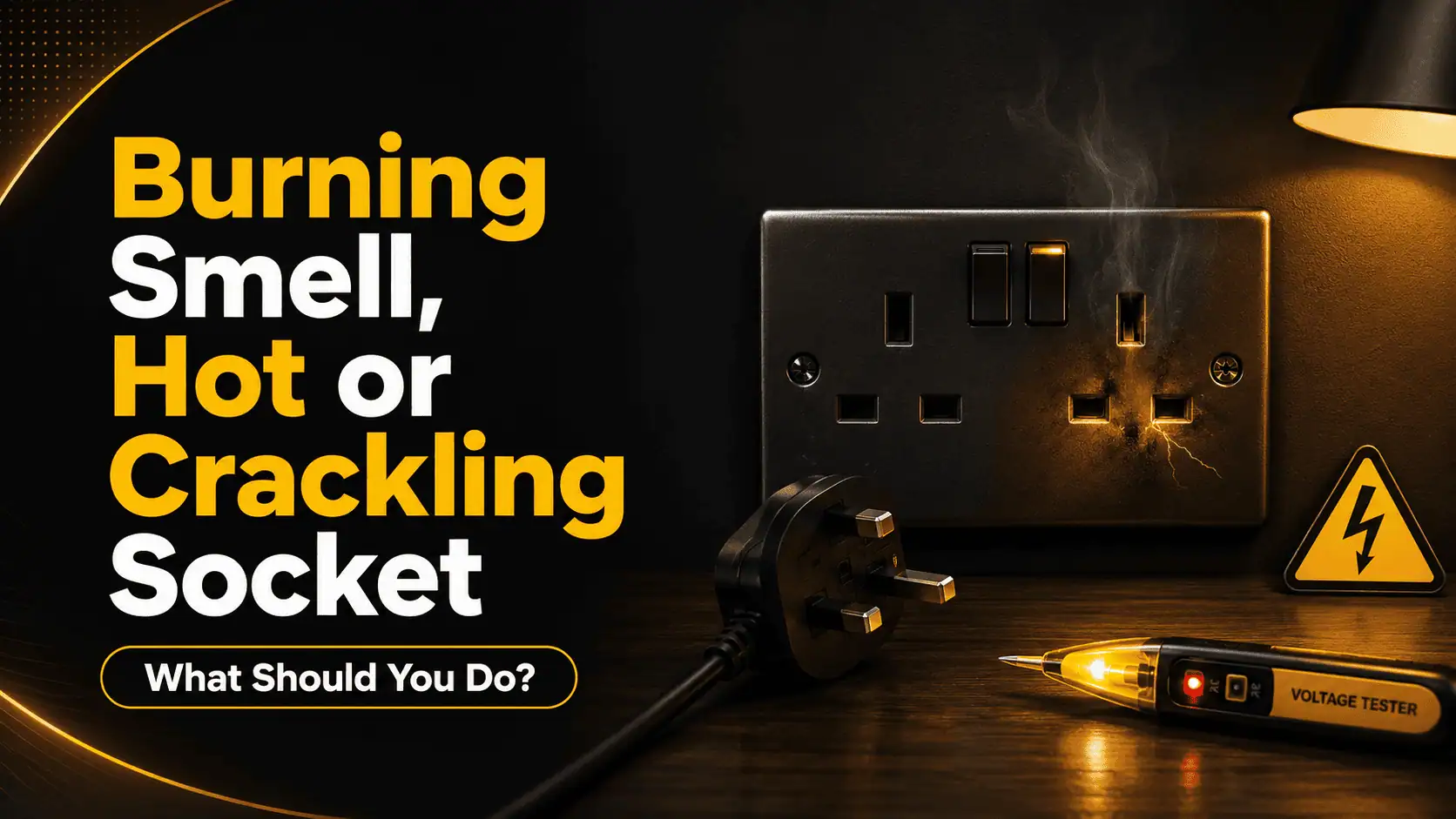

A burning smell from a socket, unusual heat, buzzing or crackling should not be ignored. These signs can be linked to overheating, damaged electrical components or arcing and may need prompt professional investigation. Electrical Safety First specifically lists burn marks, buzzing or crackling, breaker trips and sockets that feel hot as warning signs. The first priority is not working out the exact cause yourself. It is making sure the affected socket is no longer being used and recognising when the situation needs urgent help.
What Should You Do If a Socket Smells Burnt, Feels Hot or Crackles?
Stop using the affected socket and any equipment connected to it. If it is safe to do so and there is no smoke, active sparking or fire, unplug the connected item and arrange for the problem to be checked.
Do not:
- plug another appliance into the socket to “test” it;
- keep using it because the power still works;
- remove the socket faceplate;
- touch internal wiring;
- attempt to tighten connections yourself;
- or ignore the problem until it happens again.
If there is smoke or fire, get out, stay out and call 999 rather than trying to investigate or tackle the fire yourself. (London Fire Brigade)
Is a Hot, Burning or Crackling Socket Dangerous?
It can be. Heat, burning smells and crackling can indicate an electrical connection or component that is not operating normally, and poor connections can create local hotspots and arcing. That does not mean every warm plug socket is about to catch fire. It does mean the symptom should be taken seriously enough to stop using the affected socket until the cause is understood.
What Do Different Socket Warning Signs Mean?
Different symptoms can point the investigation in different directions, but the symptom alone does not confirm the fault. Electrical Safety First links hot sockets, burn marks and buzzing or crackling with electrical danger signs, while unusual fish-like smells and discolouration can also be associated with overheating electrical accessories.
| What you notice | What it may indicate | What to do |
| Socket feels unusually hot | Heat building at the plug, socket or connection | Stop using it and arrange a check |
| Burning or hot-plastic smell | Overheating electrical component, plug or connection | Stop using the socket promptly |
| Buzzing or crackling | Poor contact or electrical arcing may be occurring | Stop using it and get professional help |
| Brown, black or yellow discolouration | Previous or ongoing overheating may have damaged the accessory | Do not keep using it |
| Melted plastic | Significant heat damage | Stop using immediately |
| Plug sits unusually loose | Socket or plug contact may need investigation | Avoid continued use |
| Breaker or RCD also trips | A wider circuit or electrical fault may be involved | Fault diagnosis is required |
| Smoke or visible fire | Active emergency | Get out, stay out and call 999 |
Think of these signs as clues to the fault, not the diagnosis itself.
What Causes a Socket to Overheat, Smell Burnt or Crackle?
The problem can originate at the socket, plug, connection, connected appliance or elsewhere on the circuit. A good diagnosis identifies which component is responsible before anything is replaced.
A loose electrical connection
A loose or poorly made connection is one of the most important possibilities to rule out.
The IET explains that an electrical connection that is not tight enough can create hotspots and arcing. Electrical connections also need durable electrical continuity and adequate mechanical strength. (IET Electrical)
In homeowner terms:
Poor connection → Local heat/arcing → Burning, Buzzing, Crackling or Discolouration
The visible socket may therefore be where the symptom appears, while the exact failed connection still needs identifying.
A damaged or deteriorated socket
Cracks, looseness, discolouration, melted plastic or other visible damage can mean the socket accessory itself needs attention.
Electrical Safety First advises checking sockets and plugs for signs of overheating and says burn marks, arcing sounds and excessive heat should not be ignored.
A faulty plug or appliance
The wall socket is not always the source.
A damaged plug, cable, charger or connected appliance can overheat and may leave burn marks or melted plastic around the plug and socket area. Electrical Safety First advises stopping use when plugs, cables or equipment show overheating, burning smells or damage.
This is why an electrician may need to separate:
Socket fault
from
Plug/appliance fault
before recommending a repair.
An overloaded extension lead or adaptor
Overloading an extension lead, cable reel or adaptor can cause overheating at the extension equipment or the plug connected to the wall socket. Electrical Safety First warns that exceeding the equipment’s rated load can cause overheating and create a fire risk. This is different from assuming every hot socket means the fixed wiring is overloaded. The electrician still needs to establish where the heat is actually being generated.
Damaged wiring or another circuit fault
The problem can also sit behind the visible accessory.
Damaged conductors, deteriorated connections or other faults within the socket circuit may require professional investigation before the affected accessory can safely return to use.
Moisture around electrical equipment
Water or moisture can increase electrical risk and should not be ignored around plugs, sockets or connected equipment. Electrical Safety First advises keeping electrical equipment away from moisture and stopping use if plugs, wires or electrical products become wet or damaged.
Do not try to dry out and reuse a socket that you suspect has been affected internally by water.
Is It Normal for a Plug Socket to Feel Hot?
A wall socket that feels unusually hot to touch should not be treated as normal. Electrical Safety First specifically lists excessive socket or plug heat as a warning sign that should be investigated.
The important distinction is where the heat is coming from.
It may involve:
- the socket;
- the plug;
- an extension or adaptor;
- the connected appliance;
- or an electrical connection.
Avoid repeatedly touching the socket to see whether it is getting hotter. Stop using it and let the cause be established safely.
Why Does a Socket Crackle or Buzz When Something Is Plugged In?
Buzzing or crackling can be associated with electrical arcing or poor contact at a connection. The IET confirms that poor connections can create both hotspots and arcing, while Electrical Safety First specifically describes buzzing and crackling as signs of arcing that should not be ignored.
A brief sound should therefore not be dismissed simply because the appliance still switches on.
Do not remove the socket or attempt to tighten its terminals yourself. The source of the sound needs to be identified before the socket is used normally again.
Can a Socket Still Be Dangerous If It Works?
Yes. A socket can continue carrying current while a poor electrical connection is also producing unwanted heat or arcing, so continued operation is not proof that the accessory is safe. This follows from IET guidance showing that inadequate connections can produce hotspots and arcing even though an electrical connection is still present.
So:
“It still works” does not mean “nothing is wrong.”
If a socket powers an appliance but also smells burnt, crackles, buzzes or becomes unusually hot, stop using it and have the cause checked.
What Do Scorch Marks, Melting or a Fishy Smell From a Socket Mean?
Scorching, melted plastic or discolouration indicate that heat or electrical damage has affected the plug, socket or nearby equipment. A strong unusual or fish-like smell can also be associated with electrical plastic or accessories overheating. The smell cannot tell you exactly which component has failed.
An electrician still needs to establish whether the cause is:
- the socket accessory;
- a loose connection;
- the plug;
- connected equipment;
- or another part of the circuit.
Do not cover the smell with an air freshener and continue using the socket. Treat the change in smell as a reason to investigate the electrical source.
Can an Overheating Socket Cause a Fire?
Yes, electrical overheating can create a fire risk. Electrical Safety First warns that overloaded socket equipment can overheat and cause fire, while London Fire Brigade has documented a house fire believed to have started from an electrical fault inside a plug socket.
This does not mean every hot socket will start a fire.
It means warning signs such as:
Heat + Burning + Melting + Arcing + Smoke
should be acted on rather than watched to see if they get worse.
How Does an Electrician Find What Is Causing the Socket to Overheat?
An electrician works from the visible symptom towards the affected accessory, connection and circuit before deciding what needs repairing. The wider Handy Electric Pro fault-finding process follows the sequence of symptom, inspection, safe isolation, appropriate testing, diagnosis, repair and verification.
The investigation may include:
- understanding when the heat, smell or noise appears;
- checking the socket, plug and connected equipment;
- inspecting for heat damage, discolouration or loose components;
- identifying the socket circuit and relevant protective devices;
- safely isolating the affected circuit where required;
- checking connections and carrying out appropriate electrical tests;
- identifying whether the problem is local to the socket or wider in the circuit;
- repairing or replacing the confirmed defective part;
- and checking the affected work before normal use is restored.
This is one example of the broader process behind how electricians find electrical faults. The important principle is the same across the whole fault-finding cluster:
Symptom → Evidence → Diagnosis → Repair → Verification.
Experience From Handy Electric Pro
Handy Electric Pro’s customer feedback includes genuine socket-repair work. One Google customer specifically reported that Arif “fixed my lights and faulty socket”, providing real customer evidence that the business carries out socket and electrical repair work.
That review is not being presented as a burning or overheating socket case. The exact cause of every hot, burnt or crackling socket still needs to be established from the evidence at that property.
When Is a Hot or Burning Socket an Electrical Emergency?
Treat the situation as an emergency when there is smoke, active fire, significant sparking or an immediate danger to people in the property. In a fire, London Fire Brigade advises people to get out, stay out and call 999 rather than trying to tackle the fire themselves.
Seek prompt electrical help even without a visible fire if the socket has:
- a persistent burning smell;
- obvious melting or scorching;
- severe or increasing heat;
- crackling or arcing;
- visible sparks;
- water affecting it;
- repeated breaker or RCD trips;
- or caused an electric shock.
Electrical Safety First identifies several of these as warning signs that should not be ignored.
When Should You Call an Electrician?
Call an electrician when a socket repeatedly becomes hot, smells burnt, buzzes or crackles, shows heat damage or has stopped behaving normally. Professional fault finding is especially useful when the cause is not clearly limited to one plug or appliance.
You should also arrange professional help when:
- the problem returns after the socket has cooled;
- more than one socket is affected;
- a protective device is also tripping;
- the plug feels loose in the outlet;
- wiring or connections may be damaged;
- the accessory has been affected by water;
- or you are unsure whether the socket is safe to use.
Do not assume a single damaged socket means the whole property needs rewiring.
The purpose of fault finding is to identify the actual cause first, then recommend a repair that matches what has been found.
Need Help With a Hot, Burning or Crackling Socket in Hounslow?
Handy Electric Pro provides professional electrical fault finding in Hounslow and West London for electrical problems including burning smells, damaged sockets, tripping circuits and other unexplained faults. The service page states that the team diagnoses electrical faults, explains what has gone wrong and provides repair support across Hounslow and surrounding West London areas.
If a socket is showing signs of overheating or arcing, stop using it rather than waiting for the symptom to become worse.
Book Electrical Fault Diagnosis
Book Online