


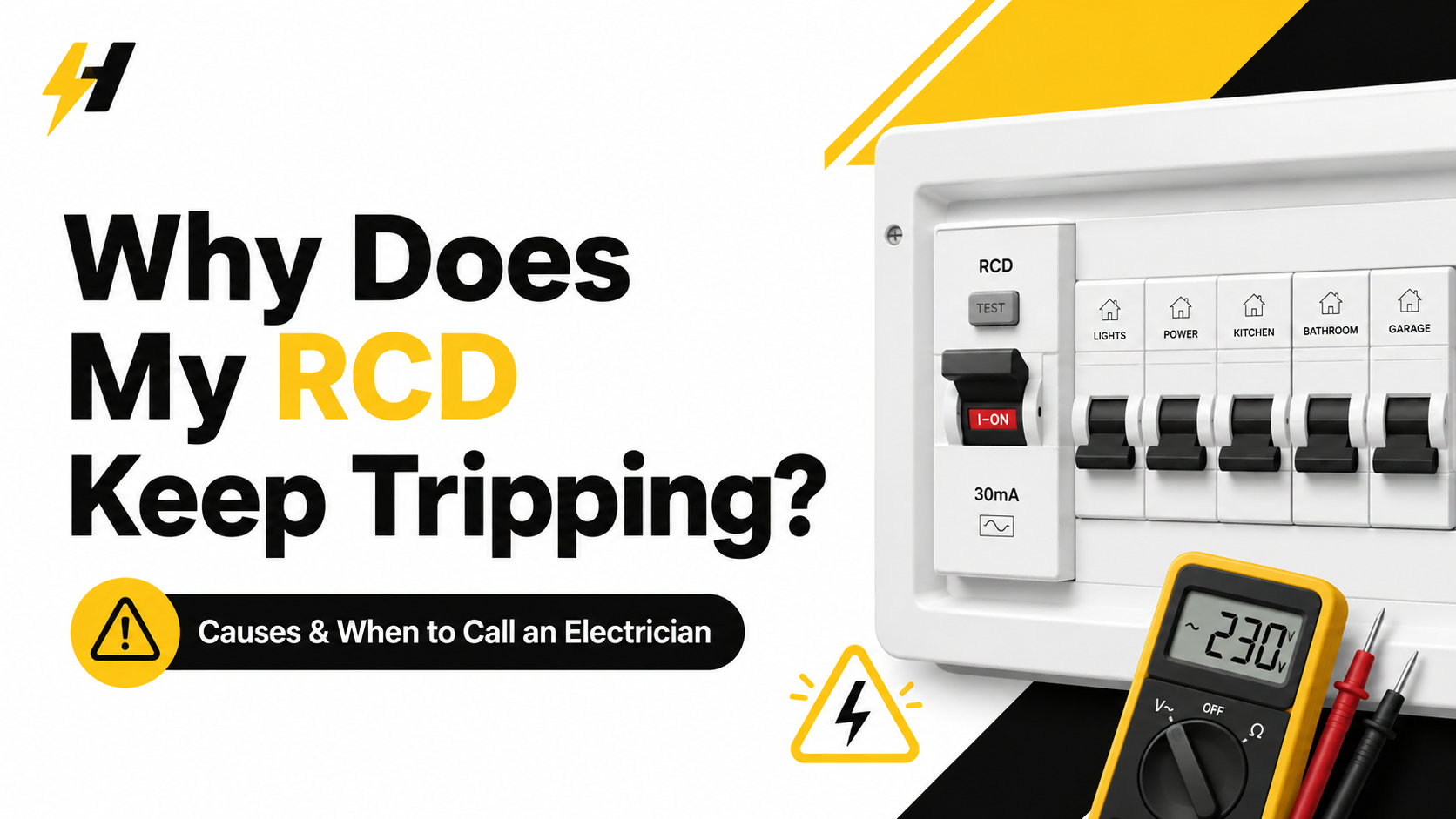

If your RCD keeps tripping, it usually means the device is detecting an electrical imbalance somewhere in the circuits it protects. The cause could be a faulty appliance, moisture, damaged wiring, earth leakage or another electrical fault that needs to be narrowed down.
Repeated tripping should not simply be treated as an annoying switch that needs resetting. Electrical Safety First advises that an RCD which repeatedly trips is likely responding to a fault in either an appliance or the wiring and should be investigated.
The way the RCD trips can also provide useful clues. Does it happen when you use one appliance? After heavy rain? During the night? Immediately after resetting? Those patterns do not prove the cause, but they help an electrician decide where to start.
What Does an RCD Do When It Trips?
An RCD, or Residual Current Device, monitors the electrical current flowing through the circuits it protects. If it detects current taking an unintended path, it disconnects the supply quickly to reduce the risk of electric shock. (Electrical Safety First)
This is different from the job of a standard MCB.
An MCB mainly protects wiring against excessive current caused by conditions such as overloads and short circuits. An RCD responds to residual current or leakage.
If you want the full distinction, Handy Electric Pro’s difference between an MCB, RCD and RCBO guide explains how each protective device works.
The important point here is:
A tripped RCD is a symptom. It does not tell you by itself where the fault is.
What Are the Most Common Reasons an RCD Keeps Tripping?
Repeated RCD tripping can be associated with connected appliances, moisture, deteriorated insulation, damaged wiring or leakage across the installation. The electrician still needs to establish which circuit or piece of equipment is responsible rather than assuming the cause from the trip alone.
A faulty appliance
A fault inside an appliance can allow current to flow where it should not. When that appliance is connected to an RCD-protected circuit, the RCD may operate.
Appliances containing motors, pumps or heating elements can develop faults over time, but the type of appliance alone does not prove it is responsible.
A useful clue is timing.
If the RCD repeatedly trips when the same appliance starts, heats up or reaches a particular part of its operating cycle, that appliance becomes an important part of the investigation.
Electrical Safety First advises stopping use of an electrical product if its operation repeatedly causes protective devices to trip.
Moisture or water ingress
Moisture can affect outdoor sockets, garden lighting, junctions, cables, outbuildings and other electrical equipment. If the RCD starts tripping during or after wet weather, that pattern is worth telling the electrician. It may help narrow the investigation towards circuits or equipment exposed to moisture. This is also why outdoor electrics tripping after rain will be covered separately in our dedicated guide.
Damaged wiring or insulation
A cable does not need to be visibly burnt or completely broken to create an electrical problem. Damage from building work, deterioration, moisture or another defect can affect insulation and create a leakage path that causes the RCD to operate. Because much of a home’s wiring is concealed, professional electrical testing may be needed to narrow down the affected circuit or section.
Leakage from several connected devices
Sometimes the investigation does not point to one dramatic appliance failure.
Electrical equipment can produce small amounts of normal protective-conductor or leakage current. When several loads share RCD protection, their combined leakage can become relevant to unwanted RCD operation. IET guidance specifically considers accumulated protective-conductor currents when designing RCD-protected circuits.
That is different from simply saying:
“Too many appliances overloaded the RCD.”
An ordinary RCCB/RCD does not provide overload protection by itself. An RCBO combines residual-current protection with overcurrent protection. (IET Wiring Regulations)
A fault with the RCD or protective arrangement
The RCD itself can also form part of the investigation.
An electrician should not assume the device is defective simply because it keeps tripping. The connected circuits and equipment need to be considered before replacing a protective device that may actually be responding correctly to another fault.
What Can the RCD Tripping Pattern Tell You?
The timing and conditions around an RCD trip can help narrow the investigation, but they cannot confirm the cause on their own. The most useful information is often what happened immediately before the power went off.
| What you notice | What it may suggest | What still needs establishing |
| RCD trips when one appliance operates | Appliance fault or leakage associated with its circuit | Whether the problem follows the appliance or the fixed installation |
| RCD trips immediately after reset | A fault may still be present | Which protected circuit, equipment or wiring is responsible |
| RCD trips after several minutes | Fault may appear as equipment heats, starts or changes operating state | What changes immediately before the trip |
| RCD trips after rain | Moisture may be affecting outdoor equipment or wiring | Which circuit, accessory or cable is affected |
| RCD trips randomly | Intermittent fault or changing leakage conditions | What load, temperature, moisture or timing pattern is involved |
| RCD trips at night | Timed or automatically cycling equipment may be relevant | What was actually operating when the trip occurred |
| RCD trips with nothing obviously plugged in | Fixed wiring or permanently connected equipment may still be involved | Which protected circuit contains the fault |
| RCD will not stay on | The fault may still be present | Whether the cause is equipment, wiring or the protective arrangement |
This is why good fault finding starts with the pattern rather than replacing components at random.
Why Does My RCD Trip With Nothing Plugged In?
An RCD can still trip when there appears to be nothing plugged into the sockets because socket appliances are only one part of the electrical installation. Fixed wiring, lighting, boilers, immersion heaters, outdoor equipment and other permanently connected loads may also be protected by the same RCD.
“Nobody has anything plugged in” therefore does not prove the RCD itself is faulty.
The electrician needs to establish:
- which circuits the RCD protects;
- whether permanently connected equipment is involved;
- whether the problem remains when particular sections are professionally isolated;
- and whether electrical testing points towards wiring, connected equipment or the protective device itself.
If the RCD repeatedly operates with no obvious plug-in appliance involved, professional fault finding becomes particularly useful because the cause may not be visible to the homeowner.
Why Does My RCD Trip Randomly or at Night?
Random or overnight RCD trips often require more attention to timing because the fault may not be present when somebody looks at the consumer unit. Equipment that switches automatically, changing moisture conditions or faults that appear only when something heats up can make the problem intermittent.
Instead of treating “random” as having no pattern, note:
- roughly what time it happens;
- whether heating or hot water was operating;
- whether a dishwasher, washing machine or other appliance was running;
- whether outdoor lighting was on;
- whether there had been rain;
- and whether the fault occurs more often under particular conditions.
Those observations can give the electrician a much better starting point.
Why Does an RCD Trip After a Few Minutes?
An RCD that holds initially and then trips several minutes later may be reacting to a condition that only appears once equipment changes state. Motors, pumps, heating elements and other equipment do not necessarily behave exactly the same way throughout their operating cycle.
For example, the relevant clue may be that the trip occurs when something begins heating rather than when it is first switched on.
That still does not prove which component has failed.
The useful information for the electrician is:
What starts, stops, heats up or changes immediately before the RCD operates?
Why Won’t My RCD Reset?
An RCD that will not remain reset may mean the electrical condition causing it to operate is still present. Continually forcing or repeatedly resetting it does not remove that underlying problem. Check only what you can observe safely. If there is a burning smell, visible damage, water near electrical equipment, unusual heat, buzzing or crackling, do not keep attempting to restore the supply.
Repeated operation is a reason to investigate the fault, not to bypass the protection.
Can I Safely Reset an RCD?
A single reset may restore supply after a one-off trip, but repeated operation should not simply be ignored. If the RCD immediately trips again or repeatedly operates, the cause needs to be established. Homeowners can safely provide useful information without dismantling electrical equipment.
You can note:
- which rooms lost power;
- what equipment was operating;
- whether one appliance consistently triggers the problem;
- whether the trip followed rain or a leak;
- whether there is any smell, heat or unusual noise;
- and whether the trip is immediate or intermittent.
If one plug-in appliance clearly causes the problem, stop using that appliance until it has been checked or replaced.
Do not remove socket fronts, open the consumer unit enclosure, probe wiring, bypass the RCD or attempt insulation-resistance or other professional electrical tests.
How Does an Electrician Find What Is Tripping an RCD?
An electrician normally works from the symptom towards the affected circuit, equipment or section of wiring. Inspection and electrical testing can then help rule out possible causes before a repair is recommended.
The process may include:
- understanding when the RCD trips;
- identifying which circuits it protects;
- checking for visible signs of damage or moisture;
- safely isolating relevant circuits or equipment;
- carrying out tests suited to the fault;
- narrowing the problem to a smaller area;
- identifying the likely cause;
- carrying out the agreed repair;
- and checking the affected circuit or equipment again afterwards.
The exact tests depend on what needs to be confirmed. For example, insulation-resistance testing may be relevant where damaged insulation or earth leakage is suspected. RCD testing can also help establish whether the protective device itself is operating as required.
This RCD investigation is one part of the wider process electricians use to diagnose electrical problems. Our guide to how electricians find electrical faults explains how symptoms, inspection, circuit isolation, testing and verification work together to identify the underlying cause.
Experience From Our Fault-Finding Work
Handy Electric Pro regularly investigates electrical problems where the cause is not obvious at first. Customer feedback reflects this diagnostic approach. One customer described Arif as “quick to diagnose the issue” before fixing it safely, while another said he quickly assessed a leakage problem and got it fixed.
That same approach applies when an RCD keeps tripping: the aim is to identify what is causing the protective device to operate before recommending the repair.
Is an RCD Trip the Same as a Circuit Breaker Trip?
No. An RCD and an MCB respond to different electrical conditions, while an RCBO combines both types of protection in one device. An RCCB/RCD by itself does not provide overcurrent protection. (IET Wiring Regulations)
That distinction matters when diagnosing a problem.
- If an MCB repeatedly operates, overload or fault current may be central to the investigation.
- If an RCD repeatedly operates, residual current or leakage becomes particularly relevant.
- If an RCBO trips, the electrician may need to establish which protective function caused the operation.
Our existing MCB vs RCD vs RCBO guide explains these devices in more detail without repeating the full comparison here.
Does a Tripping RCD Mean My House Needs Rewiring?
No. Repeated RCD tripping does not automatically mean the whole property needs rewiring because the fault may be limited to one appliance, accessory, cable or circuit.
The correct decision comes after diagnosis.
Sometimes the repair is targeted.
In other situations, testing may reveal wider deterioration that justifies additional remedial work. The point of fault finding is to establish the scale of the actual problem before recommending the solution.
Replacing large parts of an installation without first locating the fault can mean unnecessary cost and disruption.
How Often Should an RCD Be Tested?
Current IET guidance says the built-in RCD test button should normally be operated every six months. Older consumer units may still carry labels advising quarterly testing because earlier versions of BS 7671 used a shorter interval.
The test button checks that the RCD mechanism operates.
It does not diagnose why an RCD keeps tripping during normal use.
If repeated trips are already occurring, pressing the test button is not a substitute for investigating the underlying fault.
The current UK wiring standard is BS 7671:2018+A4:2026, published by the IET and BSI in April 2026.
When Should I Call an Electrician About a Tripping RCD?
Call an electrician when the RCD repeatedly trips, will not remain reset, operates without an obvious appliance trigger or is associated with other signs of an electrical fault. Electrical Safety First specifically recommends professional investigation when an RCD keeps tripping. Arrange help promptly if you notice:
- burning or unusual electrical smells;
- scorching or discolouration;
- buzzing or crackling;
- visible sparks;
- electrical equipment becoming unusually hot;
- signs of water entering electrical equipment;
- electric shock or tingling;
- repeated immediate trips;
- or significant unexplained power loss.
If there is smoke, fire or an immediate danger, move away from the hazard and contact the appropriate emergency service rather than attempting to investigate the electrical installation yourself.
Can Repeated RCD Tripping Damage the RCD?
Repeated trips should be treated primarily as a sign that something needs investigating rather than as proof the RCD has been damaged. An electrician can test the device and the circuits it protects to establish whether the RCD itself is operating correctly.
Replacing it without first identifying the underlying cause can leave the original fault unresolved.
That is another reason diagnosis should come before parts replacement.
Why Does Only One RCD Keep Tripping?
If your consumer unit contains more than one RCD, each device may protect a different group of circuits. One RCD repeatedly tripping therefore helps narrow the investigation to the circuits and equipment connected through that particular device.
The electrician can use the consumer-unit arrangement together with the fault pattern to reduce the search area.
This is also one advantage of understanding exactly what is fitted in your board rather than treating every switch as the same type of breaker.
Should I Ignore an RCD That Only Trips Occasionally?
No. An occasional trip may be harder to diagnose, but repeated intermittent operation still deserves attention because the underlying condition may only appear under certain circumstances.
Temperature, moisture, appliance operating cycles and changing electrical loads can all affect when an intermittent fault becomes visible.
Keep a simple note of when the trip happens.
That information may be more useful to the electrician than repeatedly resetting the device without recording the pattern.
Need Help With an RCD That Keeps Tripping in Hounslow?
If your RCD keeps tripping and the cause is not obvious, Handy Electric Pro provides professional electrical fault finding in Hounslow and West London.
Our electricians can investigate whether the problem is associated with an appliance, protected circuit, wiring, moisture or the protective arrangement itself. Once the cause is identified, we explain what has been found and what repair is required before carrying out the agreed work.
Repeated RCD tripping is often much easier to solve once the pattern and affected circuit have been properly identified.
Book Electrical Fault Diagnosis
Book Online