


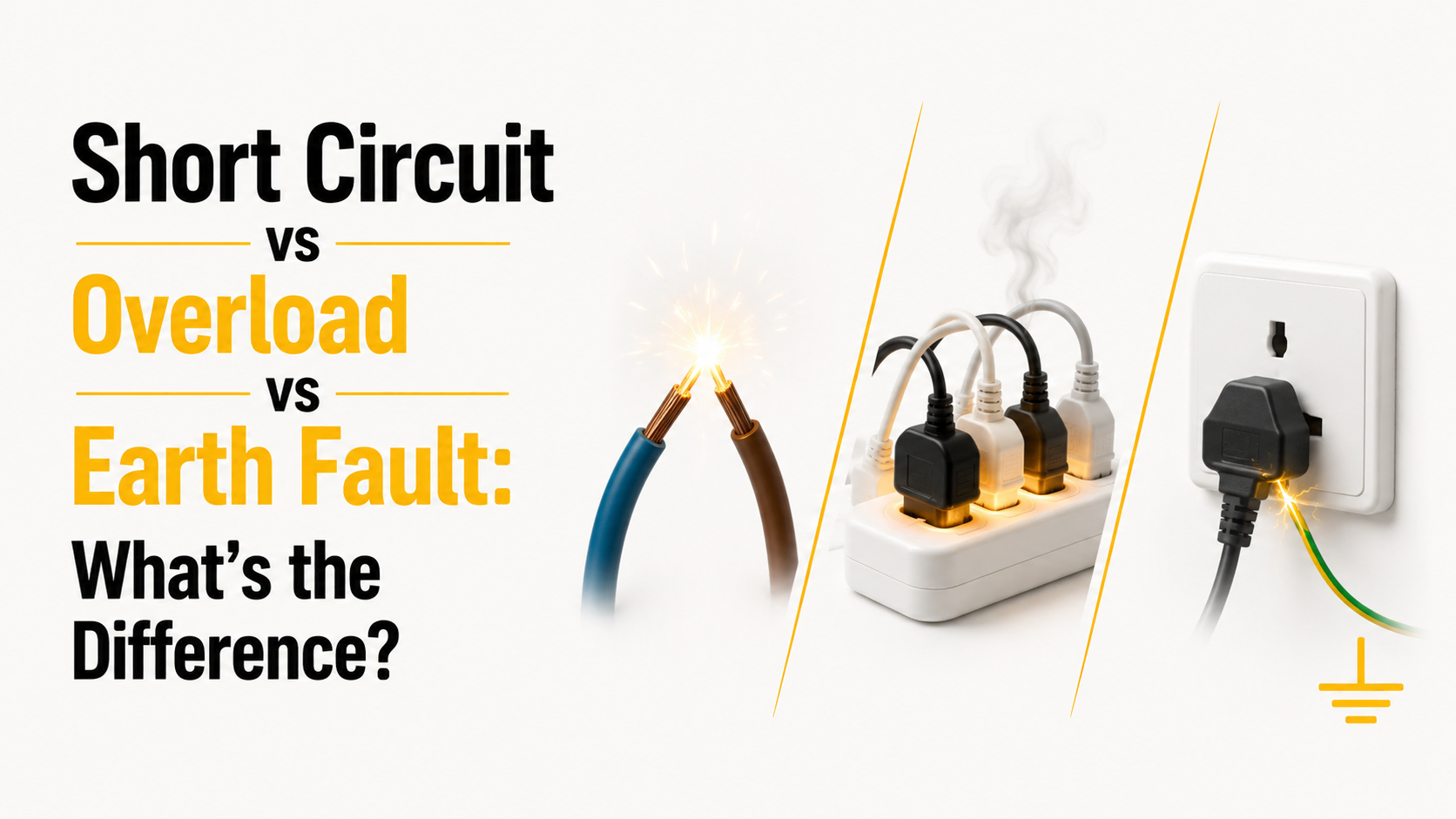

A short circuit, an overload and an earth fault are three different electrical problems, and your consumer unit reacts differently to each one. A short circuit trips a breaker instantly. An overload trips it gradually, after the circuit has been under heavy load for a while. An earth fault usually trips the RCD rather than the breaker, because it isn’t about too much current — it’s about current going somewhere it shouldn’t.
Knowing which one you’re dealing with starts with a simple question: which device tripped, and how fast?
Which Device Tripped, and How Fast?
This is the fastest way to work out what’s happened, and it doesn’t need any tools.
Look at your consumer unit. If a single MCB (the small switch labelled for one circuit) has tripped, you’re dealing with either a short circuit or an overload — the speed tells you which. If the trip happened the instant you turned something on, or the moment a fault occurred, that’s consistent with a short circuit. If the circuit had been running for a while, often under heavy load, before it tripped, that’s consistent with an overload.
If the RCD has tripped — usually a wider switch that cuts power to several circuits, or the whole board — that points to an earth fault, because the RCD is designed specifically to detect current leaking to earth, not excess current.
The table below sets this out clearly.
| Short Circuit | Overload | Earth Fault | |
| What’s happening | Live and neutral (or two lives) touch directly | Circuit is carrying more current than it’s rated for | Current is escaping to earth instead of returning through neutral |
| Which device trips | MCB | MCB | RCD (or RCBO) |
| How fast it trips | Instantly | Gradually, after sustained load | Fast, but a different mechanism to the MCB |
| Does it reset and hold? | Trips again immediately | Often resets fine once load is reduced | May trip again if the leakage is still present |
| Typical cause | Damaged cable, loose connection, faulty appliance | Too many high-draw appliances on one circuit | Damaged insulation, moisture, faulty appliance |
What Is a Short Circuit?
A short circuit happens when a live conductor touches a neutral conductor, or another live conductor, directly — creating a path with almost no resistance. Current surges to a very high level almost instantly, and the MCB’s magnetic trip mechanism reacts within milliseconds.
Common causes include a damaged cable where the insulation has failed, a loose connection that’s come into contact with another conductor, or a fault inside an appliance itself. Because the surge is so sudden, a short circuit sometimes trips with an audible pop, and occasionally a visible spark at the point of failure.
What Is an Overload?
An overload happens when a circuit is asked to carry more current than it’s designed for — usually because too many appliances are drawing power from the same circuit at once. Unlike a short circuit, there’s no direct contact between conductors. The circuit is simply working harder than it should.
The MCB’s thermal trip mechanism responds to this differently. It’s designed to tolerate short bursts of high current — the kind of surge you get when a kettle or a washing machine first switches on — without tripping unnecessarily. It only disconnects the circuit once the excess current has been sustained for a period, which is why an overload trip typically comes after the circuit has been under load for a while, not the instant you plug something in.
An overload isn’t always a fault in the electrical sense. Often it simply means the circuit has more demand on it than it was designed to handle, and the fix is redistributing appliances or adding capacity, not repairing damaged wiring.
What Is an Earth Fault?
An earth fault happens when current finds a path to earth instead of completing its intended circuit — through damaged cable insulation, a faulty appliance, or moisture creating an unintended connection.
This is a fundamentally different type of event to a short circuit or an overload, which is why a different device is responsible for catching it. Our guide to what earth leakage actually is covers this in more depth, including why a healthy installation always has a small, expected amount of leakage, and how that differs from a genuine fault.
Why Your MCB Catches Two of These, and Your RCD Catches the Third
This is the part that explains almost everything about how your consumer unit behaves.
An MCB has two separate trip mechanisms built into it. A thermal element reacts slowly to sustained overcurrent — this is what catches an overload. A magnetic element reacts almost instantly to a sudden, very large surge — this is what catches a short circuit. Both mechanisms are looking for the same basic thing: too much current flowing through that circuit.
An earth fault doesn’t necessarily involve excess current at all. A relatively small amount of current can leak to earth without the MCB noticing, because from the MCB’s point of view, nothing unusual is happening on the live or neutral conductor. This is exactly why the RCD exists as a separate device — it compares the current going out on live against the current coming back on neutral, and reacts to any meaningful difference between the two, regardless of the overall current level.
That’s the core distinction. MCBs protect against too much current. RCDs protect against current going to the wrong place. A fault can trigger one, the other, or occasionally both.
Does It Reset and Hold?
Once a breaker has tripped, what happens when you reset it tells you something too. If it resets and holds, the trip may have been a one-off a brief surge from an appliance starting up, or a transient overload that’s since cleared. This is common enough not to be immediately alarming.
If it trips again the moment you reset it, that’s a different situation. It usually means the fault is still present — the short is still there, the circuit is still overloaded, or the leakage hasn’t gone away. Resetting it repeatedly in the hope that it eventually holds isn’t a fix. Each reset briefly reconnects a fault that hasn’t been found or resolved, and that’s the point to stop and get it looked at rather than keep trying. If it won’t reset at all, that generally points to an active, ongoing fault rather than something transient.
Split-Load Boards vs RCBOs: What the Pattern Tells You
How much of your house loses power when something trips depends on how your consumer unit is arranged, and this is worth understanding before you start troubleshooting.
On an older-style split-load board, one RCD typically protects half the circuits in the property. If an earth fault occurs on any one of those circuits, every circuit sharing that RCD loses power which can make the problem look far bigger than it actually is, when in reality it’s confined to a single circuit.
On a board fitted with RCBOs, each circuit has its own individual protection combining both MCB and RCD functions. A fault on one circuit only affects that circuit. The rest of the house stays on.
If you regularly lose power to multiple rooms at once, it’s worth knowing which type of board you have — and if you don’t, our guide to MCBs, RCDs and RCBOs explains the difference and what each one actually protects.
Can More Than One Happen at Once?
Occasionally. A short circuit that involves a live conductor touching an earthed metal casing, rather than another live or neutral conductor, can trip both the MCB and the RCD at the same time, because it’s simultaneously an overcurrent event and a leakage event.
This is less common than a straightforward short circuit or earth fault on their own, but it’s worth knowing about if both devices have tripped together it doesn’t necessarily mean two unrelated faults have happened at once.
What Does Each One Mean for the Repair?
The three faults lead to different next steps, which is worth knowing before you call anyone.
A short circuit usually means there’s a specific point of damage to find — a section of cable, a connection, or a failed component inside an appliance. Fault finding narrows this down to the affected section, and the repair is typically a targeted fix at that point.
An overload often isn’t a repair at all. If testing confirms the circuit itself is sound and the issue is genuinely too much demand, the solution might be as simple as moving appliances onto a different circuit, or as involved as adding an additional circuit if the property’s load has outgrown its wiring.
An earth fault requires finding the source of the leakage which might be a section of damaged cable, a specific appliance, or a point where moisture has reached a connection. Our guide to electrical fault finding vs an EICR explains how this kind of diagnostic visit differs from a scheduled inspection, and what certificate you receive once the fault is resolved.
Consumer unit and fuse board work of this kind is the single most commonly mentioned job in our customer reviews — repairing, upgrading and correctly protecting circuits that have outgrown or outlasted their original wiring.
Is It Safe to Reset a Tripped Breaker?
Resetting a breaker once, after it’s tripped, is a reasonable first step — particularly if you can identify an obvious cause, like an appliance that was drawing unusually high current when it started up.
Resetting it repeatedly after it trips again immediately is not a safe long-term approach. That pattern points to a fault that’s still present, and continuing to reset it means the fault keeps briefly reconnecting rather than being found and fixed. If a breaker won’t hold after one or two attempts, that’s the point to stop and get it checked, rather than keep trying.
Frequently Asked Questions
What is the difference between a short circuit and an earth fault?
A short circuit is current taking a direct path between live and neutral conductors, causing a sudden, very high surge that trips the MCB instantly. An earth fault is current escaping to earth instead of completing its normal path, which is detected by the RCD rather than the MCB, and doesn’t always involve unusually high current.
What is the difference between a short circuit and an overload?
Both trip the MCB, but for different reasons. A short circuit is a direct, low-resistance connection between conductors causing an instant, very large surge. An overload is a circuit carrying more current than it’s rated for over a sustained period, usually because too many appliances are drawing power from it at once, and it trips more gradually as a result.
What are the main types of electrical fault? In a domestic UK installation, the three most common are a short circuit (direct contact between conductors), an overload (excess sustained current), and an earth fault (current leaking to earth). Each is detected differently — the first two by an MCB, the third by an RCD.
Is a short circuit the same as an earth fault?
No. They’re detected by different devices for different reasons. A short circuit is caught by the MCB because of the sheer amount of current involved. An earth fault is caught by the RCD because current is going somewhere it shouldn’t, which can happen without tripping the MCB at all.
Why did my breaker trip instantly?
An instant trip is more consistent with a short circuit than an overload. It suggests a sudden, direct fault such as damaged insulation or a loose connection making contact rather than a circuit that’s simply been under heavy load for a while.
Why did my RCD trip but not the MCB?
This is typical of an earth fault. The MCB only reacts to excess current on the live or neutral conductor, while the RCD reacts specifically to current leaking to earth, which can happen at a level the MCB wouldn’t consider unusual.
Can I tell the difference myself, or do I need an electrician?
You can often narrow it down using which device tripped and how quickly, as covered above. Confirming the exact cause and repairing it safely requires proper testing, since opening a consumer unit or investigating live circuits isn’t something to do without the right equipment and training.
Is it dangerous if my breaker keeps tripping?
A breaker that trips and won’t reliably hold is a sign of an active fault, and it’s protecting you by disconnecting the circuit. The device doing its job isn’t the danger continuing to reset it repeatedly without finding the cause is what turns a manageable fault into a bigger problem.
Need the Fault Identified in Hounslow or West London?
If your breaker or RCD keeps tripping and you’re not sure which of the three you’re dealing with, Handy Electric Pro provides electrical fault finding across Hounslow, Twickenham, Feltham, Isleworth, Richmond, Brentford and the wider West and South West London area.
Muhammad Arif is an ECS Gold Card qualified electrician and NAPIT-approved contractor, and all diagnostic work follows the same systematic process covered in our full guide to fault finding narrowing the problem down before anything is repaired or replaced.
Whether it’s your circuit breaker that keeps tripping or your RCD, contact us for a same-day or next-day diagnosis.
Call or WhatsApp: +44 7389 775236 Available 24/7 for urgent electrical faults.
Book Online