


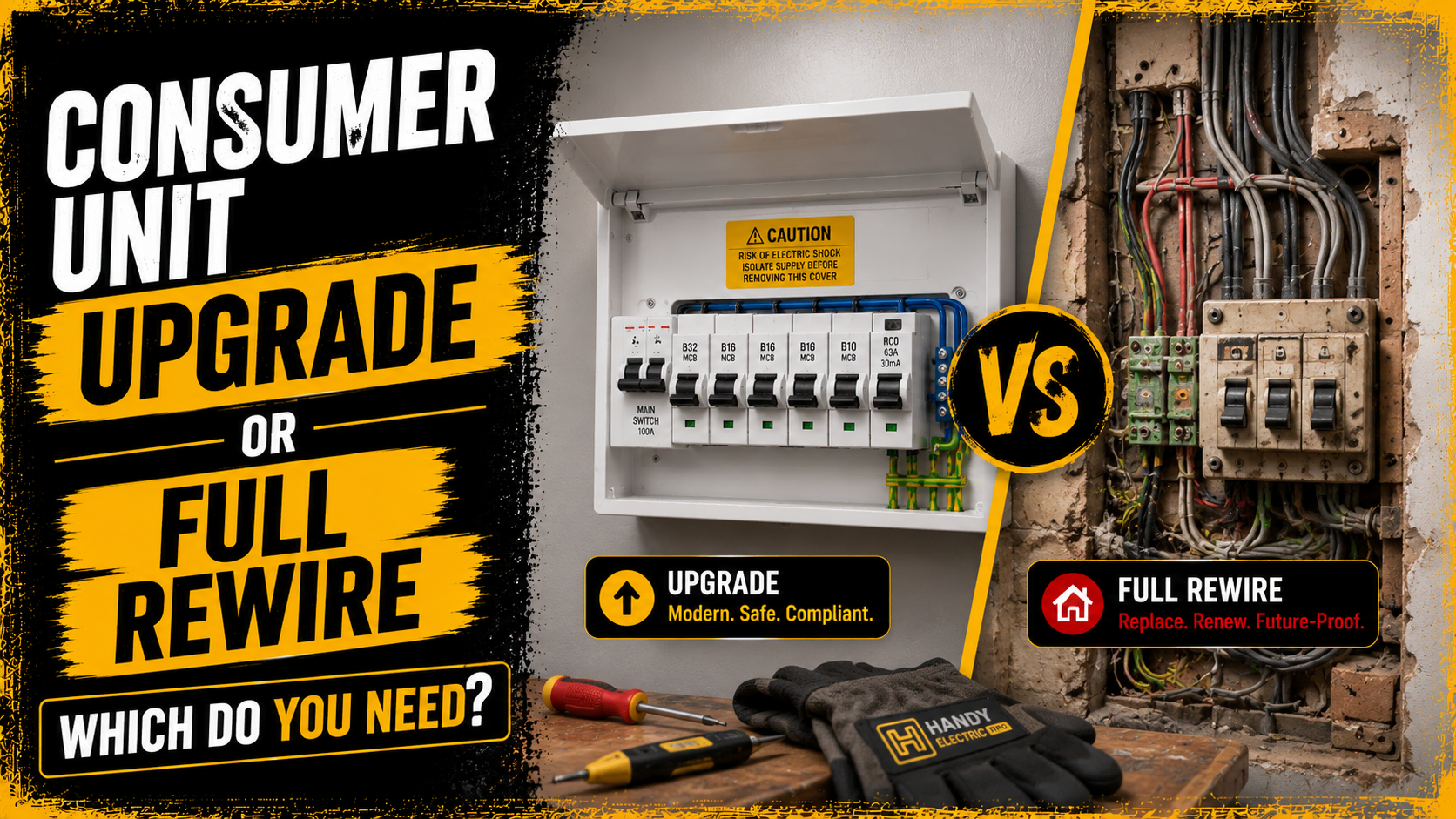

Most homes only need one of these, not both, and the two get confused constantly because they’re often carried out together. A consumer unit upgrade replaces the board on the wall. A rewire replaces the cabling behind the walls. Working out which one your property actually needs, rather than assuming the more expensive option or hoping the cheaper one will do, starts with understanding what each job actually solves.
What’s Actually Different Between the Two
A consumer unit upgrade swaps the board itself the part with the switches you can see for a modern, metal-enclosed unit with proper RCD or RCBO protection on every circuit. It doesn’t touch the cabling running through your walls and floors; it just replaces what that cabling connects to.
A rewire replaces the cabling itself, either throughout the property (a full rewire) or in specific rooms or circuits (a partial rewire). It’s a bigger, more disruptive job walls and floors typically need to be accessed and it solves a different problem: cabling that’s degraded, undersized, or missing an earth conductor altogether, none of which a new consumer unit can fix on its own.
Signs You Might Need a Rewire, Not Just a New Board
The clearest sign is the cable itself. Homes built or last rewired before the 1960s often still have VIR cable Vulcanised India Rubber insulation, recognisable by its thick, black or grey rubbery sheath. It was standard for decades, but the rubber becomes brittle with age, cracking and eventually exposing the copper conductor underneath. If you can see this kind of cable in your loft, under floorboards, or entering your current consumer unit, that’s a rewire conversation, not just a board swap.
Later cabling shows its age differently. Some PVC-insulated cable from the 1960s to 80s develops a sticky residue, sometimes called “green goo,” as the insulation itself starts to break down worth flagging even if the cable doesn’t look obviously damaged. A few other signs worth knowing: very few sockets per room, relying heavily on extension leads, or aluminium wiring, common in properties built or rewired during the copper shortage of the 1960s and early 70s, and prone to loosening at connections over time as it expands and contracts differently to copper.
Why This Sometimes Isn’t Your Choice to Make
Here’s the part most guides skip. If your property does have VIR cable, a straightforward consumer unit swap sometimes isn’t actually possible, whatever the original plan was. The cable has to be disconnected and reconnected at the new board, and cable that’s already brittle can crack or fail from that disturbance alone, even if it looked fine beforehand. In that situation, what started as a simple board upgrade can genuinely force at least a partial rewire not because anyone’s upselling you, but because the alternative is reconnecting a fault waiting to happen.
This is exactly why we check the condition of the existing cabling before quoting a straightforward upgrade, rather than assuming the wiring behind the wall is fine just because the board on it looks old.
When a Board Swap Is Genuinely Enough
If your property has modern PVC twin-and-earth cable in reasonable condition, and the only real problem is an outdated board, a consumer unit upgrade on its own is often exactly the right amount of work. This is a very common scenario, particularly in homes built or last rewired from the 1970s onward, and it’s a considerably smaller, faster, and less disruptive job than a rewire.
How to Find Out Which One You Actually Need
An Electrical Installation Condition Report is the honest way to answer this, rather than guessing from the age of the property alone. It assesses the condition of the wiring itself, not just the board, giving you a decision based on an actual inspection rather than an assumption either way. Both a rewire and a consumer unit upgrade fall under the same notifiable-work rules our regulations guide covers what that means in practice.
It’s also common for the two to get bundled together deliberately, particularly in older properties being renovated. Our old fuse box vs consumer unit guide covers more on when that pairing makes sense.
Every survey, upgrade, and rewire is carried out by ECS/JIB-certified, City & Guilds-qualified electricians, fully insured and DBS-checked and we’ll always tell you honestly which one you actually need, not just quote for whichever is easier to sell.
Frequently Asked Questions
How do I know if I need a rewire or just a new consumer unit?
The clearest indicator is the condition of your existing cabling, not the age of your consumer unit alone. An inspection is the reliable way to tell — old rubber-insulated (VIR) cable usually means a rewire is needed; modern cable in good condition often just needs a new board.
Can I upgrade my consumer unit without rewiring the house?
Often, yes, if the existing cabling is in good condition. If the property still has old rubber-insulated (VIR) cable, the physical process of reconnecting it at the new board can cause it to fail, which sometimes forces at least a partial rewire regardless of the original plan.
What is VIR cable, and why does it matter?
VIR (Vulcanised India Rubber) cable was standard UK wiring from the 1920s to the 1960s. The rubber insulation becomes brittle with age and can crack, exposing the conductor underneath — a genuine fire and shock risk, and a strong sign a rewire is needed.
How much more does a rewire cost than a consumer unit upgrade?
Significantly more, since it’s a bigger, more disruptive job involving walls and floors rather than just the board. Our consumer unit cost guide covers upgrade pricing specifically; a rewire quote depends heavily on the property and is best confirmed with a survey.
Do I need an EICR before deciding between the two?
It’s the most reliable way to decide. An EICR assesses the condition of your wiring, not just your consumer unit, giving you an evidence-based answer rather than a guess.
Can a partial rewire be combined with a consumer unit upgrade? Yes, this is common, particularly where only certain circuits or rooms have degraded cabling rather than the whole property.
Not Sure Which One You Need?
Book a survey that actually checks your wiring, not just your consumer unit — you’ll get an honest answer either way, with a fixed quote to match.
Book Online