


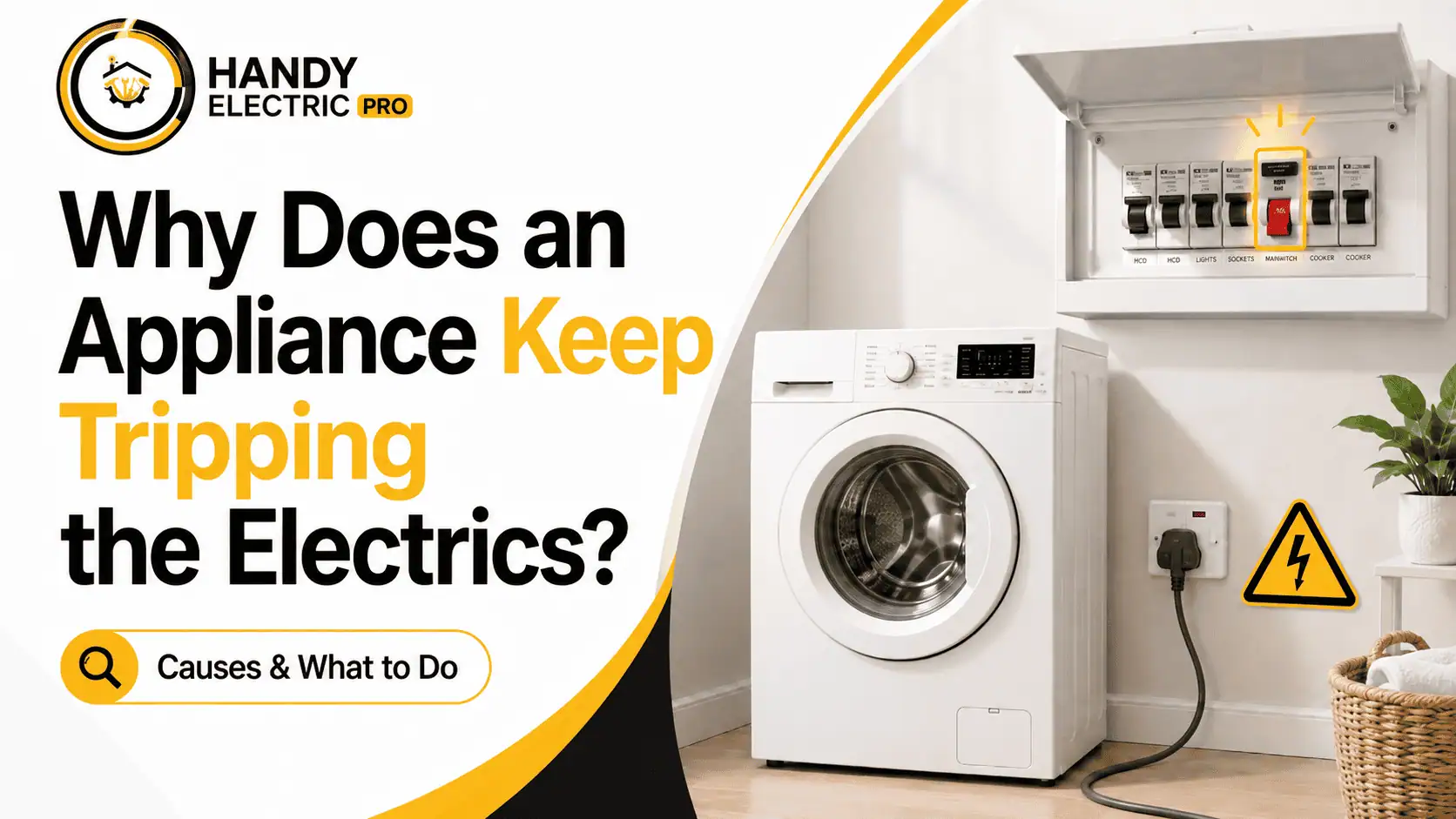

If an appliance keeps tripping the electrics, either the appliance itself or the electrical circuit supplying it may have a fault. The type of protective device that operates, and the point at which it trips, can help narrow down what needs checking. For example, an appliance that causes an RCD to operate presents a different fault pattern from one that trips an MCB. The problem may also appear only when the appliance heats up, starts a motor or reaches a certain stage of its cycle. The key is not to keep resetting the electrics. It is to establish whether the fault follows the appliance or sits within the electrical installation.
Why Does an Appliance Keep Tripping the Electrics?
An appliance can trip the electrics when a fault or abnormal electrical condition causes an RCD, MCB or RCBO to disconnect the supply. Possible causes include an internal appliance fault, insulation breakdown, excessive current, a damaged cable or a problem elsewhere on the circuit. Electrical Safety First says repeated RCD tripping can indicate a fault with either a particular appliance or the wiring itself. That distinction is important because replacing or repairing an appliance will not solve a fault that is actually inside the fixed installation. Likewise, electrical work on the house will not solve a defect contained entirely within the appliance.
Is the Appliance Faulty or Is There a Problem With the House Electrics?
If the problem repeatedly appears when one appliance operates, that appliance becomes an important part of the investigation. However, the tripping pattern alone does not prove that the appliance is responsible.
The IET notes that a protective device can operate because of a faulty connected appliance, but faults within the installation can also cause the same symptom. If the protection will not remain reset with connected equipment removed, professional testing of the installation is recommended. (IET Wiring Regulations)
An electrician may therefore need to separate:
Appliance → Plug/Flex/Internal components
from:
Socket → Final circuit → Fixed wiring → Protective device
before recommending the repair. That is much more reliable than assuming:
“It trips when I use the appliance, so the appliance must be broken.”
What Does the Tripping Pattern Tell You?
When the trip happens can provide useful diagnostic clues. The pattern helps narrow the investigation, but it does not confirm the fault on its own.
| What happens | What it may point towards | What still needs establishing |
| Trips as soon as the appliance is connected or operated | Plug, flex or internal electrical fault may be involved | Appliance fault or circuit fault |
| Trips when heating begins | Heating element or insulation problem becomes more relevant | Whether leakage or excessive current is present |
| Trips after several minutes | Fault may appear as a component warms or changes state | Which stage triggers the trip |
| Trips during one part of a wash/dry cycle | Heater, motor, pump or another operating component may be involved | Which component is active at the time |
| RCD trips | Residual current or earth leakage becomes relevant | Appliance or fixed installation |
| MCB/circuit breaker trips | Overcurrent or short-circuit conditions become more relevant | Appliance demand or circuit fault |
| Several appliances cause trips on the same circuit | Socket, circuit or installation becomes more suspicious | Whether the fault is shared by the circuit |
| Problem happens only occasionally | Temperature, moisture or operating stage may affect the fault | Conditions that reproduce it |
Bosch, for example, identifies motors, heaters, internal wiring and water reaching electrical parts among possible reasons a washing machine may trip the electrics. The useful information for an electrician is therefore not simply which appliance was running, but what the appliance was doing when the trip occurred.
What Appliance Faults Can Cause the Electrics to Trip?
Several internal appliance problems can cause protective devices to operate, but the exact fault depends on the appliance and the electrical condition being detected. Heating elements, damaged insulation, internal wiring, motors and moisture are examples that may need investigation.
Earth leakage or insulation breakdown
Electrical insulation is intended to keep current on its correct path. If insulation deteriorates and current begins flowing to earth, an RCD may detect the resulting imbalance and disconnect the supply. The IET defines an RCD as a device that operates when residual, or earth-leakage, current is detected. This can occur inside an appliance or elsewhere on the circuit.
Heating element fault
Heating appliances contain components that operate under high temperatures. A fault may become noticeable only when the heating element is energised or has warmed up.
Smeg’s own troubleshooting guidance notes that an oven that powers on normally but trips when heating can have a problem involving a heating element or another internal component. (Smeg Support) This type of behaviour can occur in appliances such as ovens, dishwashers, washing machines and tumble dryers, although the timing alone does not identify the failed component.
Internal wiring or component fault
A damaged conductor, component or connection inside an appliance can create an electrical fault when the appliance operates. Bosch lists internal wire shorting among possible causes of washing-machine tripping, while Smeg also identifies several internal components that may become relevant depending on when the fault appears. (Bosch Home)
Motor, pump or similar component
Some appliances change electrical behaviour as motors, pumps or compressors start and stop. If the trip always occurs at the same operating stage, that timing becomes useful evidence for whoever diagnoses the appliance.
Water or moisture
Appliances that handle water can develop faults where moisture reaches electrical components. Bosch specifically lists water leaking onto an electrical part as one possible reason a washing machine may trip the electrics. (Bosch Home)
Damaged plug or flex
The problem may be outside the appliance casing. A damaged plug, flexible cable or connection can also require attention. Electrical Safety First advises users not to ignore damaged plugs, overheating, arcing sounds or protective devices that repeatedly operate.
Why Does the Appliance Trip the Electrics Only After a Few Minutes?
A delayed trip can happen when the fault appears only after a component heats up, a motor starts, water moves through the appliance or another stage of operation begins. That makes the timing of the trip an important diagnostic clue. For example, an oven may initially switch on normally and then trip when a heating function starts. Smeg specifically identifies this pattern as one where heating elements or other operating components may need checking. A washing machine may behave normally during filling but trip during heating or another part of its programme. Instead of describing the problem as “random,” note:
- how long the appliance runs before the trip;
- what programme or setting is being used;
- whether heating has started;
- whether a motor or pump has just started;
- and whether the same pattern happens each time.
Those details can make professional diagnosis much more focused.
Why Does an Appliance Trip the RCD?
An appliance may trip an RCD when residual current is flowing away from its intended path, but the appliance is not automatically proven to be the source. The electrician may still need to distinguish an appliance insulation fault from leakage or another problem within the fixed installation. An RCD monitors residual current and disconnects the supply when the imbalance reaches its operating threshold. A standard RCCB/RCD does not provide overload protection; an RCBO combines residual-current and overcurrent protection. = If an RCD is the device that repeatedly operates, our guide to why an RCD keeps tripping explains the common causes. That article covers the wider RCD fault patterns without repeating them here.
Why Does an Appliance Trip the Circuit Breaker or MCB?
If an MCB or the overcurrent function of an RCBO operates, excessive current or a short-circuit condition becomes more relevant than it would be with a standard RCD. The cause can still sit inside the appliance or within the circuit supplying it.
For example, an appliance drawing abnormal current may cause the circuit’s overcurrent protection to operate. Smeg also notes that a combination of appliances operating on the same circuit can contribute to an overload condition. If it is the circuit breaker that keeps operating, there may be an underlying fault. Our guide to why a circuit breaker keeps tripping explains what could be causing it. Identifying which protective device has actually operated is therefore one of the most useful pieces of information you can give an electrician.
What Should You Do If One Appliance Keeps Tripping the Electrics?
Stop using the appliance if it repeatedly causes an RCD or circuit breaker to operate. Do not keep resetting the protection and restarting the appliance to see whether the problem has disappeared. Electrical Safety First advises unplugging electrical products that show warning signs such as circuit-breaker tripping, overheating or arcing and contacting the manufacturer, retailer or a qualified repair technician.
If it is safe to do so:
- switch the appliance off;
- unplug it if it has a normal accessible plug;
- stop using it;
- note which protective device operated;
- note exactly when the trip happened;
- and check the unplugged plug and flex for obvious external damage.
Do not:
- open the appliance casing;
- bypass an RCD or breaker;
- repeatedly reset the consumer unit;
- dismantle sockets;
- probe wiring;
- or carry out live electrical testing.
The IET also warns that repeatedly resetting a protective device while a fault remains present can damage the device.
Can You Keep Using an Appliance That Trips the Electrics?
No. An appliance that repeatedly causes protective devices to operate should not simply be put back into normal use until the cause has been established. Electrical Safety First advises unplugging equipment when circuit breakers repeatedly trip or other warning signs appear, then contacting the retailer, manufacturer or an appropriate repair professional. Repeated tripping is protective behaviour. Treating the trip as an inconvenience and repeatedly resetting the electrics can leave the underlying fault unresolved.
Should You Call an Electrician or an Appliance Repairer?
An appliance repairer may be the right choice when the problem has been confirmed inside the appliance, while an electrician is more appropriate when it is unclear whether the appliance or fixed installation is causing the trip. The safest choice depends on what has already been established. A manufacturer or qualified appliance repair technician may be appropriate when a product-specific fault has been identified. Electrical Safety First directs users with faulty electrical products towards the retailer, manufacturer or qualified repair technician.
Call an electrician when:
- different appliances cause the same circuit to trip;
- the protection still operates with suspect equipment removed;
- the socket or circuit may be involved;
- fixed wiring may be involved;
- a hard-wired appliance is involved and the fault location is unclear;
- or you cannot tell whether the problem is the appliance or the installation.
The aim is to send the fault to the right type of diagnosis, not replace parts at random.
How Does an Electrician Find Out What Is Tripping the Electrics?
An electrician starts by identifying the protective device that operated and the conditions that reproduce the fault. The investigation then separates the appliance from the fixed circuit before appropriate electrical testing is used to identify where the problem sits. The process may include:
- confirming when the appliance causes the trip;
- identifying whether an RCD, MCB or RCBO operated;
- checking the relevant socket and circuit;
- safely separating the appliance from the installation;
- carrying out testing appropriate to the suspected fault;
- determining whether the problem follows the appliance or remains with the circuit;
- identifying the confirmed cause;
- and recommending the appropriate electrical or appliance repair.
This is one example of the wider process used in how electricians find electrical faults. The broader fault-finding process moves from:
Symptom → Affected circuit/Equipment → Isolation → Testing → Diagnosis → Repair → Verification
rather than guessing from the first visible symptom.
Experience From Handy Electric Pro
Handy Electric Pro has been carrying out electrical work across Hounslow and West London since 2023. Our electrical team includes ECS/JIB and City & Guilds-qualified electricians, with fault finding, consumer-unit work, inspection, testing and electrical repairs forming part of our documented services. This experience also includes appliance-related electrical work. One customer said Arif “Fixed my washing machine. Perfect sparky and reasonable price,” while another described the service as “quick to diagnose the issue and fixed it safely.” Handy Electric Pro is rated 5.0 on Google from 140+ customer reviews, with feedback regularly highlighting professional service, quick response, clear communication and reliable electrical repairs.
When Does Appliance Tripping Need Urgent Attention?
Arrange prompt professional help when appliance tripping is accompanied by burning, unusual heat, buzzing, crackling, smoke, sparks, electric shock or visible damage. Those signs indicate more than an inconvenient loss of power and should not be ignored. Electrical Safety First specifically warns users about burn marks, arcing sounds, circuit-breaker trips and electrical products that become unusually hot. Stop using the equipment if you notice:
- a burning or unusual electrical smell;
- melted or discoloured plugs;
- damaged flexes;
- buzzing or crackling;
- unusual heat;
- visible sparks;
- smoke;
- electric shock or tingling;
- or repeated immediate tripping.
If there is smoke, fire or immediate danger, move away from the hazard and contact the appropriate emergency service.
Need Help When an Appliance Keeps Tripping the Electrics in Hounslow?
If you cannot tell whether the problem is the appliance or your electrical installation, professional fault finding can separate the two before unnecessary repairs are recommended. Handy Electric Pro provides electrical fault finding in Hounslow and nearby areas around 7 Miles of radius for tripping RCDs, circuit faults and other unexplained electrical problems. The aim is to identify whether the fault sits with the appliance, socket, protective device or fixed wiring and explain the next appropriate step.
Book Electrical Fault Diagnosis
Book Online