


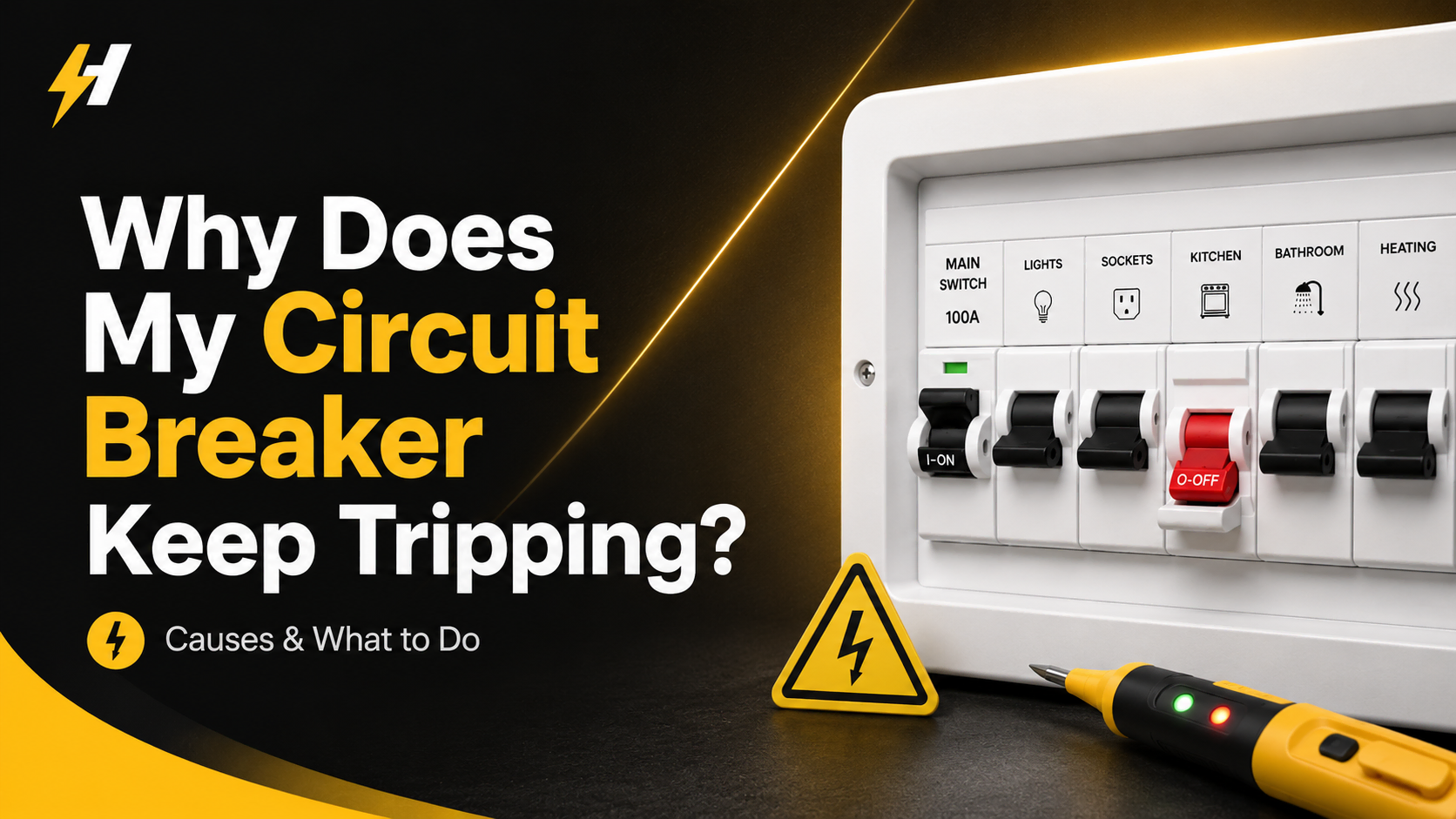

If your circuit breaker keeps tripping, it is usually reacting to excessive current or a fault on the circuit it protects. Common reasons include an overloaded circuit, a short circuit, faulty electrical equipment or a problem with the wiring.
A breaker that trips once may be responding exactly as designed. If it trips repeatedly, immediately after resetting or whenever the same equipment is used, the cause should be investigated rather than repeatedly switching it back on. Electrical Safety First advises getting regularly tripping circuit breakers checked by a registered electrician.
Why Does a Circuit Breaker Keep Tripping?
A circuit breaker trips to disconnect a circuit when it detects an electrical condition it is designed to protect against. For an MCB, that normally means excessive current caused by an overload or short circuit. The important point is that the trip tells you something happened on that circuit. It does not tell you the exact cause.
The timing often provides the first useful clue. A breaker that trips when several appliances are operating presents a different fault pattern from one that trips instantly with almost nothing in use.
What Actually Tripped: an MCB, RCD or RCBO?
Not every switch in a consumer unit does the same job, so identifying the protective device matters before interpreting why it operated. An MCB provides overcurrent protection, while an RCBO combines overcurrent and residual-current protection. (Hager)
If you are unsure what is fitted, our difference between an MCB, RCD and RCBO guide explains the devices in more detail.
If you have confirmed that the device operating is an RCD rather than a standard circuit breaker, see why an RCD keeps tripping instead. RCD tripping involves a different fault context and should not simply be treated as an overload problem.
What Are the Most Common Causes of a Circuit Breaker Tripping?
The most common fault contexts are an overloaded circuit, a short circuit or a problem involving equipment or wiring connected to that circuit. The breaker itself can also require investigation, but it should not automatically be blamed simply because it keeps operating.
Circuit overload
An overload happens when the current being drawn exceeds what the circuit and its protective device are intended to carry.
This may become noticeable when several higher-demand appliances or pieces of equipment operate on the same circuit. An MCB is designed to disconnect the supply when excessive current persists.
Short circuit
A short circuit can create a large fault current and may cause a breaker to operate very quickly.
If the breaker trips immediately after being reset, a short-circuit condition or another persistent circuit fault is one possibility that needs to be ruled out.
Faulty appliance or equipment
If the breaker repeatedly trips when one particular appliance starts, that appliance or the circuit supplying it becomes an important part of the investigation.
The pattern is useful, but it is not proof by itself. The fault still needs to be separated between the equipment, its connection and the fixed installation.
Damaged wiring, sockets or connections
Damaged wiring, accessories or electrical connections can also create fault conditions that cause protective devices to operate. Electrical Safety First advises homeowners not to ignore breaker trips alongside signs such as burn marks, heat, buzzing or crackling.
A problem with the breaker
A circuit breaker can form part of the investigation, but replacement should come after the protected circuit has been considered. Changing a breaker without identifying the actual cause can leave the original fault unresolved.
What Can the Tripping Pattern Tell You?
The pattern can help narrow the search, but it cannot diagnose the fault on its own. What matters is what was happening immediately before the breaker operated and which circuit lost power.
| What you notice | What it may point towards | What still needs checking |
| Breaker trips when several appliances run | Circuit loading may be too high | What is connected and how much current the circuit is carrying |
| Breaker trips immediately after reset | Persistent fault or short-circuit condition | Where the fault is on the protected circuit |
| Trips when one appliance starts | Appliance or associated circuit problem | Whether the fault follows the appliance or fixed installation |
| Trips with nothing plugged in | Fixed wiring or hard-wired equipment may be involved | Which part of the circuit contains the fault |
| Trips after several minutes | Fault may appear as equipment operates or load changes | What changes immediately before the trip |
| Only one room or area loses power | One protected circuit may be affected | Which wiring, accessories and equipment share that circuit |
| Breaker will not stay on | The fault may still be present | Whether the circuit, equipment or breaker is responsible |
Think of the pattern as evidence that guides the investigation, not the diagnosis itself.
Why Does the Breaker Trip Immediately After Resetting or With Nothing Plugged In?
A breaker that trips immediately may be responding to a fault that is still present on the circuit. If nothing obvious is plugged into the sockets, fixed wiring or permanently connected equipment can still be involved. Lighting, boilers, cookers, immersion heaters, extractors and other fixed equipment may be connected to circuits without being plugged into an ordinary wall socket.
That is why:
“Nothing is plugged in”
does not necessarily mean:
“Nothing is connected to the circuit.”
If the breaker will not remain on, repeatedly resetting it is unlikely to solve the underlying problem.
Can I Safely Reset a Tripped Circuit Breaker?
A circuit breaker is designed to be reset after the fault or overload that caused it to operate has been dealt with. Resetting it repeatedly while the cause remains unknown is not a repair and can hide an ongoing electrical problem.
Without dismantling anything, note which circuit has lost power and what was operating before the trip.
If one appliance clearly triggers the breaker every time it is used, stop using that equipment until the cause has been checked.
Do not remove the consumer-unit cover, open sockets, probe wiring or attempt professional electrical tests yourself. Electrical Safety First recommends leaving electrical work to competent professionals rather than following DIY electrical repair instructions.
If the breaker trips again immediately, it is generally better to leave the affected circuit off and arrange professional investigation rather than repeatedly forcing it back into service.
Is It Dangerous If a Circuit Breaker Keeps Tripping?
Repeated breaker operation should not be ignored because the device may be responding to a genuine fault or unsafe electrical condition. The urgency increases if tripping happens alongside heat, burning, arcing, smoke, sparks or electric shock.
Electrical Safety First specifically identifies circuit-breaker tripping, burn marks, buzzing or crackling and unusual heat as electrical warning signs that warrant attention. (Electrical Safety First)
Arrange prompt help if you notice a breaker repeatedly tripping together with scorching, a burning smell, unusual heat, buzzing, crackling, sparks or water affecting electrical equipment.
If there is smoke, fire or immediate danger, move away from the hazard and contact the appropriate emergency service rather than trying to investigate the wiring yourself.
How Does an Electrician Find Why the Breaker Keeps Tripping?
An electrician works from the tripping pattern towards the affected circuit, equipment or section of wiring, then uses appropriate inspection and testing to narrow down the cause. The aim is to prove what is wrong before recommending a repair.
That may involve confirming which protective device operated, understanding when it trips, checking the affected circuit, safely isolating relevant equipment and carrying out tests appropriate to the suspected fault.
The wider diagnostic method is explained in our guide to how electricians find electrical faults. It covers how symptoms, circuit isolation, testing, interpretation, repair and retesting fit together.
Experience From Handy Electric Pro
Handy Electric Pro’s customer feedback also reflects this diagnosis-first approach. One Google customer described Arif as “quick to diagnose the issue and fixed it safely,” rather than simply replacing parts without establishing the problem first.
That review is not being presented as a circuit-breaker-specific case; it supports the wider fault-finding approach used when the cause of an electrical problem is not immediately obvious.
When Should I Call an Electrician for a Tripping Breaker?
Call an electrician when the breaker trips repeatedly, will not stay on, operates immediately after reset or trips without an obvious temporary cause. You should also arrange help if the problem is accompanied by heat, burning, damaged accessories, unusual noises or other electrical warning signs.
Professional diagnosis is particularly useful when the fault appears intermittently or when hard-wired equipment and concealed wiring may be involved.
A tripping breaker does not automatically mean the property needs rewiring or a new consumer unit. Fault finding should establish the scale and location of the problem before a larger repair is recommended.
Need Help With a Circuit Breaker That Keeps Tripping in Hounslow?
If your circuit breaker keeps tripping and the cause is not obvious, Handy Electric Pro provides professional electrical fault finding in Hounslow and across West London.
Our electricians investigate the affected circuit, identify the cause where possible and explain what repair is required before the agreed work is carried out.
Book Online