


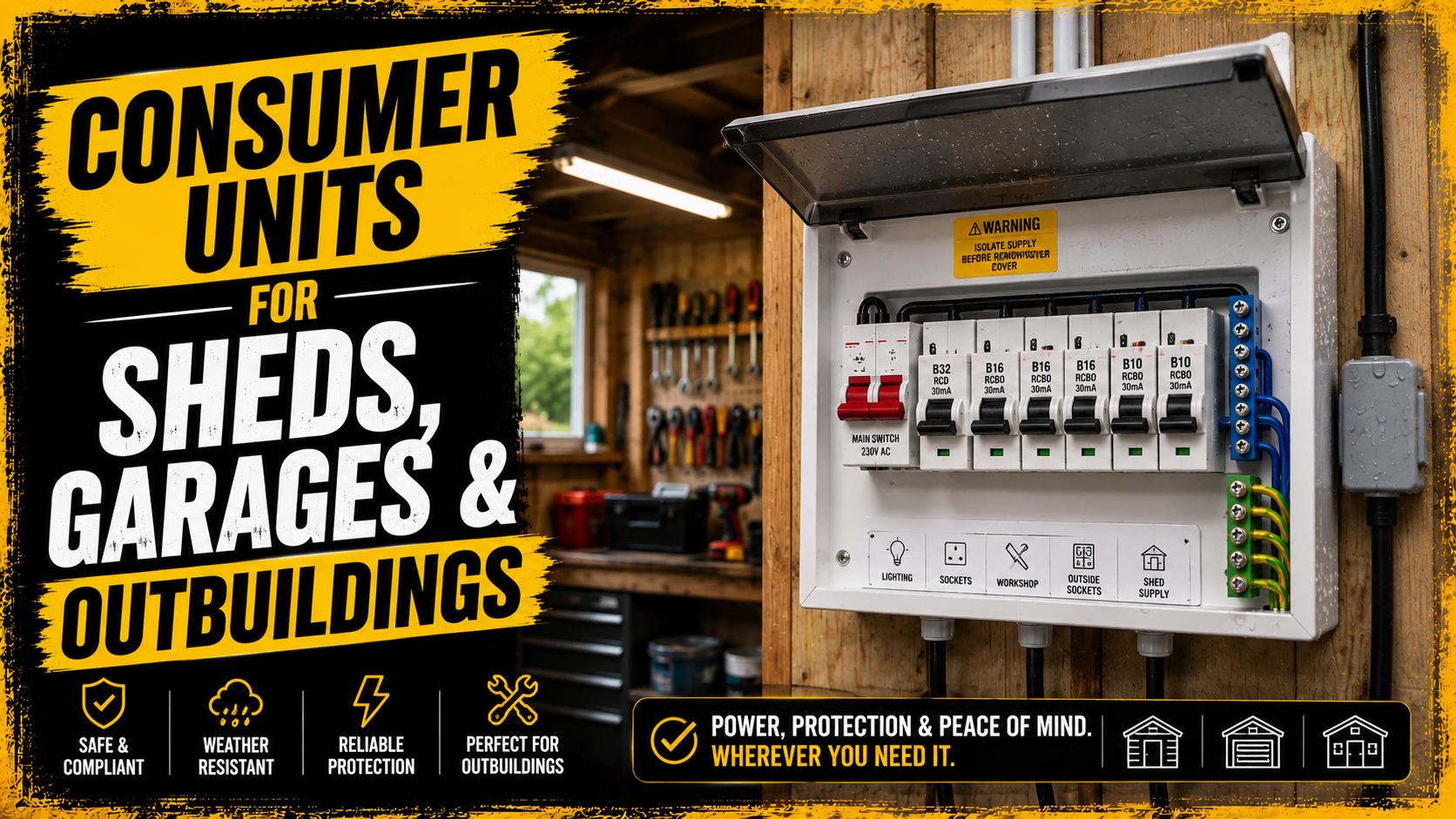

In most cases, a separate consumer unit for a shed, garage, or garden office is the safest and most practical solution if you’re installing more than one electrical circuit. A dedicated consumer unit allows you to run lighting, sockets, power tools, or heating independently from your home’s main electrical system while providing the correct circuit protection. If your outbuilding only needs a single light or one socket, extending an existing house circuit may be enough. However, if you’re powering a workshop, garden office, garage, or planning future additions such as an EV charger, installing a dedicated consumer unit is usually the better long-term option.
In this guide, you’ll learn: Typical installation costs and common mistakes to avoid Whether your shed or garage needs its own consumer unit, What size consumer unit to choose (2-way, 4-way, 6-way, or 8-way), Which cable should be used for an outbuilding supply, UK regulations for RCD protection and Part P compliance
What Consumer Unit Do I Need for a Shed or Garage?
| Outbuilding | Recommended Consumer Unit | Typical Use |
|---|---|---|
| Small shed | 2-way | One lighting circuit and one socket circuit |
| Medium shed | 4-way | Lighting, sockets, and room for future expansion |
| Workshop | 6-way | Multiple socket circuits, lighting, and power tools |
| Garage | 6-way or 8-way | Lighting, sockets, workshop equipment, EV charger |
| Garden office | 8-way | Lighting, sockets, heating, networking, and spare capacity |
As a general rule, choose the smallest consumer unit that comfortably accommodates your current circuits while leaving at least one or two spare ways for future additions. Installing a slightly larger consumer unit during the initial installation is usually more cost-effective than replacing it later when additional circuits are needed.
Do You Actually Need a Separate Consumer Unit?
The clearest way to think about it: a separate consumer unit gives you independent control and protection over the circuits in that building. If a fault develops in the garage, only the garage loses power, not the kitchen. If you want several distinct circuits out there lighting, sockets, and something higher-demand like a compressor or an EV charger a dedicated board lets each one be sized and protected individually.
If you genuinely just want one extra socket or a single light, extending an existing house circuit can sometimes be enough, and a full sub-board would be unnecessary cost. The moment you’re talking about multiple circuits, anything power-hungry, or a building any real distance from the house, a proper sub-main is the right call, not just the safer one.
What Size Consumer Unit Do I Need for a Shed or Garage?
Choosing the right consumer unit isn’t about buying the biggest board available—it’s about selecting one with enough ways for your current circuits while leaving capacity for future additions. A consumer unit that’s too small can limit future upgrades, while a slightly larger one often adds very little to the overall installation cost.
For most domestic outbuildings, a 2-way, 4-way, 6-way, or 8-way consumer unit is sufficient, depending on how the building will be used.
2-Way Consumer Unit
A 2-way consumer unit is suitable for small storage sheds with basic electrical requirements.
Typical applications include:
- One lighting circuit
- One socket circuit
- Battery charger
- Garden equipment storage
If the shed is only used occasionally and doesn’t contain high-power equipment, a 2-way consumer unit is usually all that’s required. However, there’s very little room for future expansion, so adding another circuit later may require replacing the consumer unit.
Best for: Small storage sheds with minimal electrical demand.
4-Way Consumer Unit
A 4-way consumer unit is one of the most popular choices for domestic sheds and small workshops because it provides extra capacity without significantly increasing installation costs.
It typically allows separate protection for:
- Lighting
- Socket outlets
- Outdoor power
- One spare way for future expansion
If you’re installing a new shed and expect your electrical needs to grow over time, a 4-way consumer unit is often the most practical option.
Best for: Sheds with lighting, sockets, and occasional power tool use.
6-Way Consumer Unit
A 6-way consumer unit is generally recommended for detached garages and larger workshops where several circuits are needed.
Typical circuits include:
- Lighting
- General-purpose sockets
- Dedicated workshop sockets
- Outdoor power
- Garage door opener
- Spare capacity for future upgrades
This size is ideal if you regularly use power tools such as compressors, mitre saws, or bench equipment and want each circuit protected independently.
Best for: Garages and home workshops.
8-Way Consumer Unit
An 8-way consumer unit provides the greatest flexibility for larger outbuildings and buildings expected to expand over time.
It’s commonly installed in:
- Garden offices
- Detached garages with EV chargers
- Workshops with multiple dedicated circuits
- Multi-purpose outbuildings
An 8-way board allows room for additional circuits such as:
- Heating
- Air conditioning
- Data cabinet or networking equipment
- External lighting
- EV charger
- Future extensions
Choosing an 8-way consumer unit during the initial installation can often be more economical than replacing a smaller board later if additional circuits are required.
Best for: Garden offices, larger garages, and future-proofed installations.
Recommended Consumer Unit Size
| Outbuilding | Typical Circuits | Recommended Consumer Unit |
|---|---|---|
| Storage shed | Light + socket | 2-way |
| Garden shed | Lighting + sockets + spare | 4-way |
| Workshop | Lighting + multiple sockets + tools | 6-way |
| Detached garage | Lighting + sockets + workshop equipment | 6-way |
| Garage with EV charger | Multiple circuits + EV charger | 8-way |
| Garden office | Lighting + sockets + heating + IT equipment | 8-way |
Tip: When installing a new consumer unit, it’s usually worth leaving at least one or two spare ways for future additions. The additional cost of a larger consumer unit is often small compared with the labour involved in replacing an undersized board later.
What’s a Sub-Main, and How Does It Work?
A sub-main is simply a dedicated circuit run from your main consumer unit to a second, smaller consumer unit in the outbuilding. That second board then splits into its own individual circuits, exactly the same way your main board does, just on a smaller scale.
Rather than every garage or shed circuit tracing all the way back to the main board’s own individual breakers, one properly sized and protected sub-main cable feeds a local board that does the actual distribution on-site. It’s the same principle behind the small consumer units covered in our sizing guide, applied specifically to a building that isn’t physically part of the house.
The Cable Matters More Than the Board
Whichever consumer unit ends up on the wall, the cable feeding it is doing most of the safety work, particularly if it’s running underground. Steel wire armoured (SWA) cable is the standard for this kind of supply, because the metal armour gives real mechanical protection against the cable being damaged by digging, tree roots, or ground movement something a standard twin-and-earth cable was never designed to survive underground.
Current guidance calls for a minimum burial depth of around 500mm in open ground, deeper or with additional protection under anything that gets walked or driven over. Getting this wrong isn’t a minor detail. It’s the difference between a supply that lasts decades and one that fails, or becomes genuinely dangerous, the first time someone puts a spade through it.
RCD Protection Isn’t Optional Here
Under BS 7671 (Regulation 411.3.3), socket outlets and most circuits supplying equipment outdoors need 30mA RCD protection. This isn’t a nice-to-have for an outbuilding supply it’s a standard requirement, precisely because outdoor and underground circuits carry a higher risk of an earth fault than something safely inside a dry house.
In practice, this means the RCD protection on your shed, garage, or garden office board isn’t an upgrade you can skip to save money. It’s built into doing the job properly in the first place.
Sheds, Garages & Garden Offices Different Projects, Different Needs
The right setup depends heavily on what the building’s actually for.
A shed used mainly for storage, with perhaps one light and a socket for a charger or a radio, is often the simplest job a short cable run, a small 2-way board, done in a day. Add power tools or anything more demanding, and it’s worth planning for more capacity than the bare minimum.
A garage is usually a bigger project. Lighting, multiple socket circuits, and increasingly an EV charger or a workshop’s worth of power tools mean a garage board is rarely just 2-way, and it’s exactly the kind of space where under-planning today means a second, more disruptive job in a year or two.
A garden office tends to be the most demanding of the three. Heating, internet, a desk full of electronics, sometimes a kettle or small fridge, all running for hours at a time rather than the occasional burst of a shed or garage. This is also where we’re seeing the most growth across Richmond, Chiswick, and the wider West London area, as more properties convert existing outbuildings or add new garden rooms. It’s worth wiring it properly the first time rather than treating it as an afterthought to a bigger renovation.
What Size Do You Need?
Sizing a sub-board follows the same logic as any small consumer unit: count what’s actually being wired, then leave a little spare capacity for whatever comes next. Our small consumer units guide covers exactly how to work that out, including a quick sizing calculator, if you want a sense of the size before booking a survey.
Planning an EV Charger in the Garage?
Garages are, by some distance, the most common place for a home EV charger to end up, and it changes the sizing conversation. An EV charger needs its own dedicated circuit, with its own protection, which means factoring that in from the start rather than discovering there’s no spare capacity once the charger’s already been bought. If this is on the horizon at all, it’s worth mentioning when you book a survey, even if you’re not ready to install the charger itself yet.
Every outbuilding supply we install is carried out by ECS/JIB-certified, City & Guilds-qualified electricians, fully insured and DBS-checked, with the cable route, board, and testing covered as one job rather than a box off a shelf.
Frequently Asked Questions
Do I need a separate consumer unit for my shed or garage?
If you want independent control over multiple circuits in that building, or if it’s any real distance from the house, yes. For a single extra socket or light, extending an existing house circuit can sometimes be enough.
Do I need a separate consumer unit for sheds, garages, and outbuildings, or can I run an extension lead?
A permanent extension lead isn’t a safe long-term solution for anything beyond very light, temporary use. A proper underground supply with its own protection is the correct way to power a shed, garage, or outbuilding permanently.
What size consumer unit does a garage need?
It depends on what’s being wired, but most garages fall somewhere between 4-way and 8-way once you account for lighting, sockets, and any power tools or an EV charger. Our small consumer units guide covers the full breakdown.
How much does a consumer unit for a shed or garage cost?
It varies with distance from the house, cable routing, and board size. Our consumer unit replacement cost guide covers the general cost factors, though an outbuilding supply typically also includes the cable run itself, not just the board.
What cable do I need to run power to a shed or garage?
Steel wire armoured (SWA) cable is the standard for any underground run, buried to a minimum depth of around 500mm, with additional protection wherever the route passes under a path or driveway.
Can I install a garage consumer unit myself?
Running a new circuit to an outbuilding is notifiable work under Part P of the Building Regulations, so it needs to be carried out or signed off by a registered electrician, the same as any other consumer unit installation.
Does a garden office need its own consumer unit?
In most cases, yes, particularly if it has heating, IT equipment, or anything else running for extended periods. A dedicated board gives you proper circuit separation and the right level of protection for a space that’s effectively being used as a room.
Is RCD protection required for outdoor circuits?
Yes. Under BS 7671, socket outlets and most circuits supplying equipment outdoors require 30mA RCD protection as standard, not as an optional extra.
Planning a Shed, Garage, or Garden Office Project?
Get a free electrical assessment for the whole project cable route, board sizing, and a fixed quote, not just a box off a shelf.
Book Online