


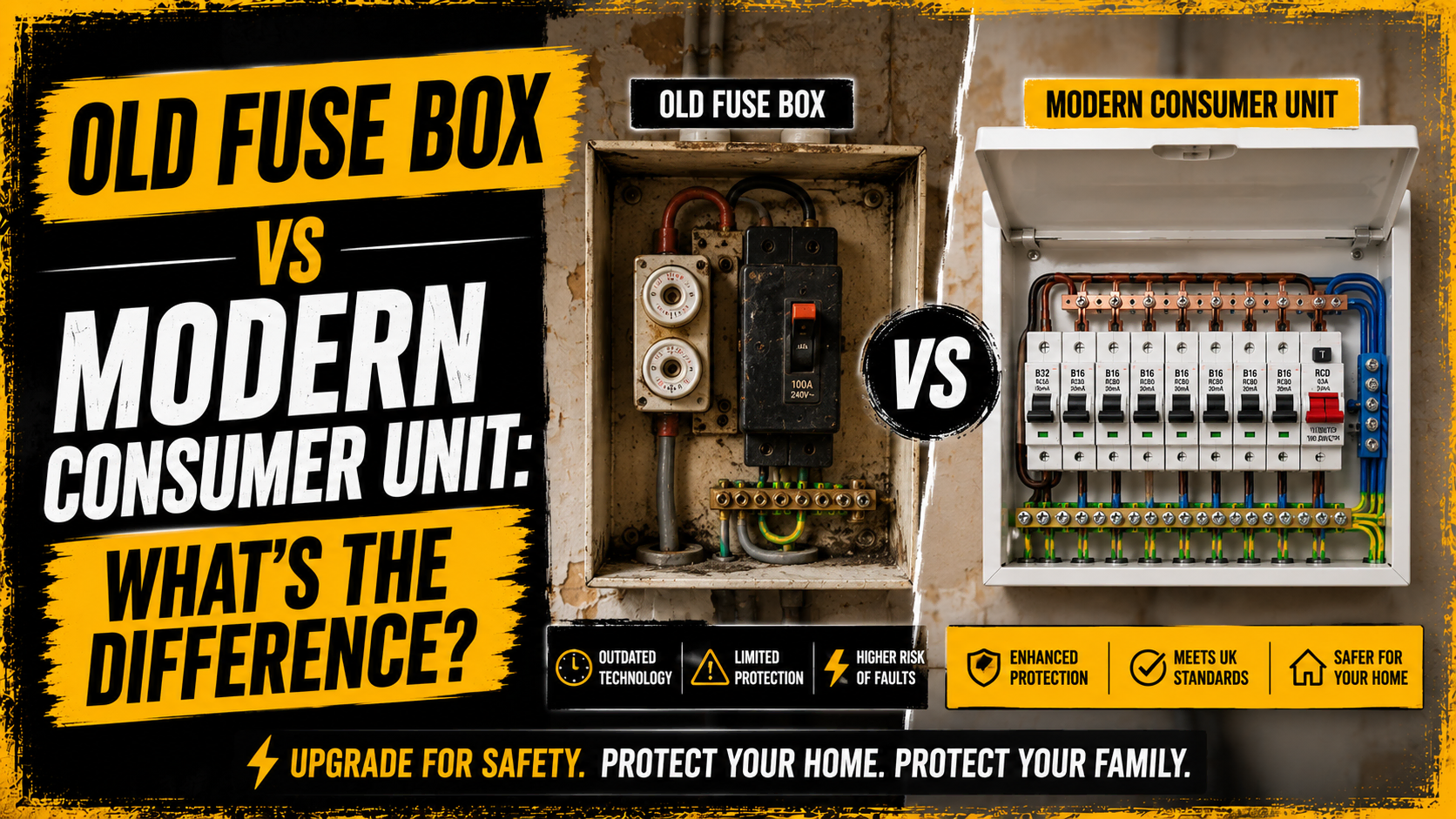

A fuse box is the older-style board that protects circuits using replaceable fuse wire or cartridge fuses, with little or no protection against electric shock. A consumer unit is the modern replacement circuit breakers and RCDs (or RCBOs) that trip and reset automatically, housed in a fire-resistant metal enclosure. The real difference isn’t cosmetic. It’s what happens the moment something actually goes wrong.
Key Differences
| Feature | Old Fuse Box | Modern Consumer Unit |
|---|---|---|
| Overcurrent protection | Rewirable or cartridge fuses | MCBs |
| Electric shock protection | Usually none | RCD or RCBO protection |
| Reset after a fault | Replace fuse wire or cartridge | Reset breaker |
| Fire resistance | Plastic, wood, or bakelite | Metal enclosure |
| Individual circuit protection | Limited | Yes |
| Surge protection | Rare | Optional SPD |
| Typical installation period | Before the early 2000s | Standard today |
| Building Regulations | Older standards | Designed to meet current BS 7671 requirements |
If your board matches the left-hand column, that doesn’t automatically make it dangerous plenty of old fuse boxes are still doing their job. What it actually means for you is covered below, not assumed.
Should You Replace an Old Fuse Box?
The short answer is not always but it’s often worth considering.
An old fuse box isn’t automatically unsafe simply because of its age. Many older installations continue to operate reliably when they’ve been properly maintained and regularly inspected. However, older fuse boxes usually lack the additional safety features found in modern consumer units, particularly 30mA RCD protection against electric shock and individual circuit protection using RCBOs.
Replacing an old fuse box is usually recommended if:
- Your installation still uses rewirable fuse wire.
- There is no RCD or RCBO protection.
- The consumer unit is being replaced as part of a renovation or extension.
- An EICR identifies C1 or C2 observations that require remedial work.
- You’re adding new circuits, installing an EV charger, or carrying out other significant electrical upgrades.
On the other hand, if the existing installation has been inspected, remains in good condition, and complies with current safety requirements for its intended use, immediate replacement may not always be necessary. The right decision depends on the overall condition of the electrical installation rather than the age of the fuse box alone.
Tip: If you’re unsure whether your fuse box should be replaced, an Electrical Installation Condition Report (EICR) is usually the best starting point. It identifies whether the existing installation remains satisfactory or whether safety improvements are recommended.
Fuse box, fuseboard, consumer unit, distribution board why so many names?
These four terms get used almost interchangeably, and that’s a real source of confusion, not just a quirk of language.
“Fuse box” is the original term, and it’s stuck around in everyday use even though most boards fitted since the 1980s haven’t actually used fuses at all electricians will often still say “fuse box” informally to mean “the box that controls your electrics,” whatever’s actually inside it. “Fuseboard” is the same thing, more common in trade and insurance paperwork. “Consumer unit” is the correct technical term for the modern board it’s what appears on your Electrical Installation Certificate. “Distribution board” describes the same basic idea but is usually reserved for commercial or industrial installations rather than a home.
Estate agents and mortgage surveyors tend to default to “old fuse board” regardless of what’s actually fitted, which is one reason the wording on a property listing or survey report doesn’t always match what an electrician would call the same thing.
What’s inside an old fuse box
Older boards use one of two systems. Rewirable fuses hold a thin strand of fuse wire that’s meant to melt and break the circuit if something draws too much current when it blows, you or an electrician rewire it by hand. Cartridge fuses work on the same principle but use a sealed, replaceable cartridge instead of loose wire, which is a little safer to handle.
Neither type includes RCD protection. A fuse can stop a circuit overloading or short-circuiting, but it does nothing to protect a person from an electric shock if a fault develops in an appliance or a cable. That’s a different kind of protection altogether, and it’s the single biggest gap between old and new.
What’s inside a modern consumer unit
A modern consumer unit replaces fuses with MCBs miniature circuit breakers that trip automatically on overload and reset with a flick, no rewiring required. Alongside the MCBs, circuits get RCD or RCBO protection: a device that detects the tiny current leak that happens when electricity finds an unintended path to earth, through a person for instance, and cuts the power in a fraction of a second.
RCBOs combine both jobs overload protection and shock protection into a single device per circuit, which is why they’re increasingly the default rather than sharing one RCD across several circuits. Some consumer units also include a surge protection device, which guards electronics against voltage spikes rather than protecting people; our complete consumer unit guide covers the different protection devices in more depth if you want the full breakdown.
Since 2015, all of this has to sit inside a metal enclosure rather than plastic or wood a change that followed evidence that some plastic units were contributing to house fires rather than containing them.
How to Identify Your Fuse Box or Consumer Unit
You don’t need to remove any covers to get a good idea of what’s fitted.
An old fuse box usually has a hinged lid in dark brown or black bakelite an early hard plastic sometimes a lighter cream or grey if it’s been partially updated. Open it and you’ll typically see a row of chunky ceramic or bakelite fuse holders, sometimes with fuse wire visibly wrapped around a peg, or cylindrical cartridge fuses that pull out like a plug. There’s no row of switches to look at if a fuse has gone, that section just stays dead until it’s rewired or the cartridge is replaced.
A modern consumer unit is a metal box, usually white or grey, with a row of switches you can see and physically move flick one up or down and you’ll feel it click. Look for one or two larger switches (RCDs or RCBOs) alongside several smaller ones (MCBs), usually labelled by circuit kitchen sockets, upstairs lighting, and so on. If you’ve ever lost power to part of the house and restored it yourself by flipping a switch back up, you have a modern board.
If you’re genuinely unsure, the safest way to find out is to have it looked at rather than guess, which is exactly what we check first on every enquiry.
A brief history why the switch happened
Rewirable fuse boxes were the standard for most of the 20th century, and they were still being fitted into new homes into the 1980s. The move toward what we’d recognise today as a consumer unit happened gradually: circuit breakers started replacing fuse wire through the 1980s and 90s, and RCD protection became genuinely common in UK homes only from the late 1990s and 2000s onward, as the wiring regulations were updated to require it more widely.
The most significant recent change came in 2015, when an amendment to the UK wiring regulations (BS 7671) required all new and replacement consumer units in homes to be fitted in a metal enclosure rather than the plastic or wooden cases used before. The change followed evidence that fires starting elsewhere in a property could sometimes be made worse, not contained, by a plastic consumer unit igniting.
None of this means a fuse box from the 1970s is about to fail. What’s changed is how much protection is now considered acceptable, not simply whether the board still technically works.
Can an old fuse box pass an EICR?
Sometimes, but it’s uncommon, and it depends on what an inspector finds rather than the age of the box alone.
An Electrical Installation Condition Report grades any issue using one of four codes. C1 means there’s a danger present right now, needing immediate action. C2 means the installation is potentially dangerous not an emergency, but enough to stop the report being marked satisfactory until it’s fixed. C3 is a recommendation for improvement and doesn’t fail the report on its own. FI means the inspector couldn’t fully assess something and it needs a closer look before a result can be given.
In practice, the most common finding on an old fuse box is a lack of RCD protection, which is typically coded C2 not an immediate emergency, but enough to make the overall report unsatisfactory until it’s addressed. That’s usually the point where a fuse box conversation turns into a consumer unit upgrade conversation, particularly for landlords, who are legally required to act on C1 and C2 findings within a set timeframe.
Does an Old Fuse Box Affect Home Insurance or Selling Your House?
Not automatically, but it can come up at a few points.
Some home insurers ask about the condition of your electrics when you take out or renew a policy, particularly on older properties, and a documented upgrade with a certificate can make that conversation more straightforward. If you’re selling, a buyer’s surveyor may flag an old fuse box in their report not as a legal barrier to the sale, but as something a cautious buyer might use to negotiate on price, or a lender might want addressed. Landlords have a firmer obligation: a satisfactory EICR is a legal requirement for rental properties, and a fuse box that fails on RCD protection won’t pass one.
None of this means every old fuse box needs replacing before a sale falls through. It’s worth knowing about before it becomes a surprise, rather than assuming it won’t come up at all.
Quick Signs You Might Need a Consumer Unit Upgrade
A few things worth a closer look rather than ignoring:
- No RCD or RCBO protection on any circuit
- Rewirable fuses or ceramic cartridge fuses rather than switches
- A wooden or plastic-cased board
- Frequent blown fuses rather than the odd one
- The board hasn’t been inspected in over ten years
Buzzing, a burning smell, or visible scorch marks are a different category entirely. Switch off at the main isolator if it’s safe to reach, and get it looked at straight away rather than waiting.
Getting a straight answer on your setup
Whether you actually need to upgrade depends on what’s inside your board, not just its age, which is exactly why we look before quoting rather than guessing over the phone. If cost is the main question on your mind, our consumer unit replacement cost guide breaks down what typically drives the price up or down. If you’d rather understand the whole system first, our complete consumer unit guide covers what’s inside a modern board and how to choose the right one.
Every survey and upgrade is carried out by ECS/JIB-certified, City & Guilds-qualified electricians, fully insured and DBS-checked.
Frequently asked questions
Is a fuse box the same as a consumer unit?
Not technically, but the terms are often used interchangeably in everyday conversation. A fuse box is the older type using fuse wire or cartridge fuses; a consumer unit is the modern replacement using circuit breakers and RCD or RCBO protection.
Why do electricians still call it a “fuse box”?
Mostly habit the phrase stuck around as a general term for “the box that controls your electrics,” even on boards that haven’t used an actual fuse in decades.
Are old fuse boxes illegal?
No. Having an old fuse box isn’t against the law on its own. It becomes a practical issue when it lacks RCD protection or fails an inspection, not because of its age alone.
Can an old fuse box pass an EICR?
It can, but it’s uncommon. Missing RCD protection a common feature of older boards is usually coded C2, which makes the overall report unsatisfactory until it’s addressed.
Can I sell my house with an old fuse box?
Yes, there’s no legal block on selling. A surveyor may flag it in their report, which can factor into a buyer’s decision or a lender’s requirements, but it doesn’t stop a sale outright.
Does an old fuse box affect my home insurance?
It can come up when you take out or renew a policy, particularly on older properties. Worth checking with your insurer directly rather than assuming either way.
Can I upgrade to a consumer unit without a full rewire?
In most cases, yes. A consumer unit upgrade replaces the board itself; a rewire replaces the cabling behind the walls. They’re often done together in older properties, but they’re separate jobs testing during the survey confirms whether your existing wiring is suitable to connect to a new board.
How do I know how old my fuse box is?
There’s no serial number that tells you outright, but the type of fuse holders, the casing material, and whether it has RCD protection are all good indicators covered in the identification section above.
Free Survey · Fixed Quote
Ready to Find Out Where You Stand?
If your consumer unit matches the description above and you’re deciding whether it’s time to act, get in touch for a free survey and a clear, fixed-price quote.
Get in touch for a free survey No obligation and no pressure to proceed.Book Online