


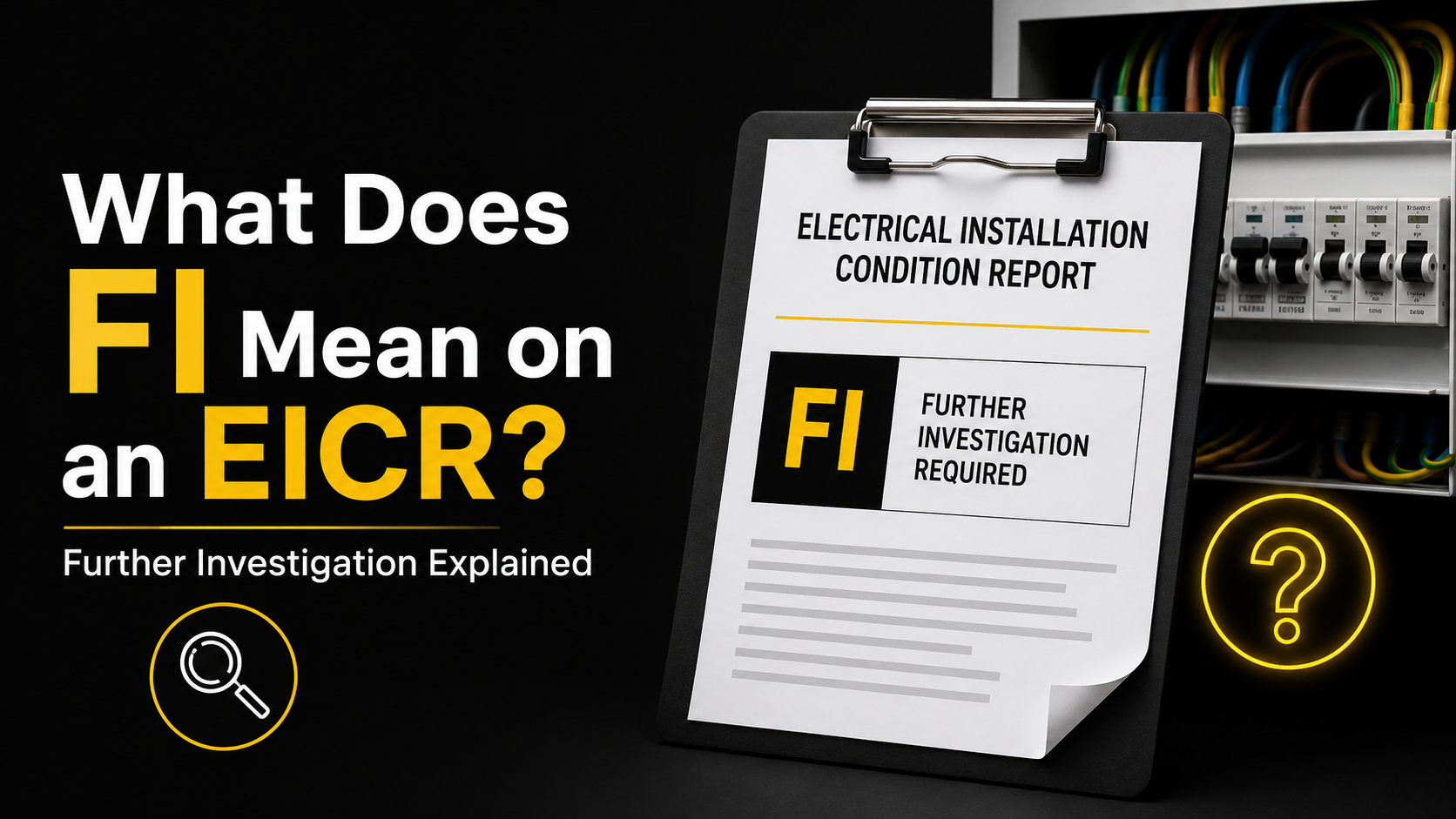

FI on an EICR stands for Further Investigation. It means the electrician found something during the inspection that couldn’t be fully assessed on the day, and it needs a closer look before the condition of that part of the installation can be confirmed. It isn’t a confirmed fault it’s an open question the report is flagging.
An FI still makes the report unsatisfactory, in the same way a C1 or C2 defect would. That surprises a lot of people, because it doesn’t necessarily mean anything is actually wrong. This guide explains why that’s the case, what usually causes it, what happens during the investigation, and what it means for your timeline if you’re a landlord.
Why Does FI Make the Report Unsatisfactory If Nothing’s Confirmed Wrong?
Because the report can’t confirm the installation is safe until the investigation is complete and an EICR is only allowed to say “satisfactory” when there’s nothing left unresolved.
The duty to act on an FI doesn’t actually come from the code itself. It comes from the fact that further investigative work is genuinely needed. Under the Electrical Safety Standards in the Private Rented Sector (England) Regulations 2020, that’s exactly what the law is built around: any time investigative or remedial work is necessary, the landlord’s 28-day duty applies whether the report recorded it as a C1, a C2 or an FI. The letter code is a way of describing the situation, not the source of the obligation.
That’s also why an FI can’t simply be left alone. Until the investigation happens, nobody not the tenant, the landlord, or the electrician who wrote the report actually knows whether there’s a defect there or not.
What Typically Triggers an FI Code?
FI codes tend to come from the same handful of situations, and most of them are about access rather than a visible problem.
Concealed cables and inaccessible wiring. If a section of the installation is boxed in, plastered over, or otherwise can’t be reached without disruption, the electrician may not be able to fully verify its condition during a routine inspection.
Circuits that couldn’t be tested because the property was occupied. Some tests require a circuit to be isolated. If furniture, stored items, or an occupied room prevent safe access on the day, that section gets flagged rather than skipped.
Readings that sit close to a threshold. A test result that’s within an acceptable range but close enough to the limit to warrant a second look, particularly if it’s inconsistent with a similar reading elsewhere in the property.
Evidence of leakage without a confirmed source. If testing shows earth leakage is present but the inspector can’t pin down exactly where it’s coming from during the visit, that becomes an FI rather than a guess.
Inaccessible bonding or earthing arrangements. Where the main bonding can’t be fully traced or confirmed, for example behind fitted units or under flooring.
None of these automatically mean there’s a fault. They mean the inspector didn’t have enough information on the day to say either way.
EICR Codes Compared: C1, C2, C3 and FI
| Code | Meaning | Makes report unsatisfactory? | Typical timeframe |
| C1 | Danger present immediate risk of injury | Yes | Immediate, sometimes same-day isolation |
| C2 | Potentially dangerous could become a risk if left | Yes | Within 28 days |
| C3 | Improvement recommended, no danger present | No | No fixed deadline |
| FI | Further investigation required not yet assessed | Yes | Within 28 days of the report |
A report with only C3 observations still passes as satisfactory. Any C1, C2 or FI makes it unsatisfactory, regardless of how many C3s are also listed.
What Happens During the Further Investigation?
This is the part most explanations skip, and it’s usually the question people actually want answered.
The investigation is, in practice, electrical fault finding targeted at the specific item the EICR flagged. The electrician returns, gains access to whatever couldn’t be reached on the first visit lifting a section of flooring, accessing behind a fitted unit, isolating a circuit that’s now available for testing and carries out the tests that were incomplete.
This is a separate visit from the EICR itself, and it’s priced separately. The EICR fee covers the inspection and the report; it doesn’t include the time needed to gain access to a concealed area or carry out follow-up testing once that access is available. Our guide to how electricians find electrical faults covers the systematic process behind this kind of targeted diagnosis working from the flagged item down to a confirmed result, rather than guessing.
What Are the Possible Outcomes?
Once the investigation is complete, one of three things happens.
The item is cleared. Testing confirms there’s no defect. That part of the report can now be marked satisfactory, and if it was the only FI on the report, the EICR as a whole can pass.
It’s downgraded to a C3. The investigation finds something worth improving, but nothing dangerous. This is a recommendation, not a requirement, and it doesn’t keep the report unsatisfactory.
It’s confirmed as a C1 or C2. The investigation finds an actual defect. This now needs remedial work within the same 28-day window that applied to the original FI the clock doesn’t restart, so this isn’t a case of the deadline resetting once the defect is found.
How Long Do You Have to Resolve an FI?
The same 28 days that apply to a C1 or C2 defect, counted from the date the report is received or sooner, if the inspector has specified a shorter period on the report itself. This is worth being clear on, because it’s easy to assume an FI is less urgent than a confirmed defect, given that nothing’s actually been found wrong yet. It isn’t treated that way under the Regulations. The obligation to investigate applies from day one, on the same timeline.
What Does an Unresolved FI Mean for Possession Now?
This is worth understanding if you’re a landlord, because the position changed in 2026. Since 1 May 2026, Section 21 “no-fault” notices have been abolished in England, and landlords seeking possession must go through Section 8, relying on a specific ground and proving it in court. Solicitors advising on possession claims now list a current, compliant EICR among the core documentation a landlord needs to have in order for that process to succeed — alongside things like the Gas Safety Record and the EPC.
An EICR sitting unsatisfactory because of an unresolved FI is not the same as having no EICR at all, but it isn’t the clean compliance position a landlord wants going into a possession claim either. If a dispute over the property’s condition or safety becomes relevant to the case, an outstanding FI is a loose end that’s better closed before it matters, not after.
This is a legal process, not an electrical one, and the specifics of any possession claim depend on the ground being relied on and the circumstances involved. If you’re navigating a possession case, that’s a conversation for a solicitor. What we can tell you, from the electrical side, is that resolving an FI promptly keeps your compliance paperwork clean which is worth doing regardless of whether a possession claim is ever on the horizon.
Do You Need a Whole New EICR After an FI Is Resolved?
Usually not. Once the investigation is complete and any necessary remedial work has been carried out, written confirmation of that work is normally what’s needed to move the report from unsatisfactory to resolved not a full repeat inspection of the entire property. Keep that written confirmation together with the original EICR. You’ll need to provide both to tenants and, if requested, to the local housing authority.
What If You’re a Homeowner, Not a Landlord?
The 28-day legal deadline is specific to private rented properties under the 2020 Regulations. If you own and live in the property yourself, there’s no statutory clock running. That doesn’t mean an FI is safe to ignore. It exists because part of your installation couldn’t be confirmed as sound, and that’s just as true whether or not you’re renting the property out. It’s worth resolving before selling, before any renovation work in the affected area, or simply for your own peace of mind but the timing is yours to decide.
Frequently Asked Questions
Does FI mean my EICR has failed?
It makes the report unsatisfactory, which functions the same way a fail would in terms of what you need to do next. But FI specifically means something couldn’t be assessed, not that a defect has been confirmed.
Does FI mean my EICR has failed?
No. Even though nothing has been confirmed wrong, the investigation is a legal requirement for landlords within 28 days, and it’s the only way to know whether there’s an actual issue.
Does FI mean my EICR has failed?
It’s billed separately from the EICR, since it involves gaining access and carrying out testing that wasn’t possible during the original inspection.
Is FI as serious as a C1 or C2?
It carries the same 28-day deadline as a C2, even though it isn’t a confirmed defect. A C1 is more urgent again, since that code means a danger is already present.
What’s the most common cause of an FI?
Inaccessible areas are the most frequent trigger — concealed cables, boxed-in wiring, or circuits that couldn’t be isolated because the property was occupied during the inspection.
Will the investigation always find something wrong?
No. A meaningful proportion of FI codes are cleared once access is gained and testing is completed, with no defect found.
Does an unresolved FI affect my ability to evict a tenant?
It can be relevant. Since Section 21 was abolished in May 2026, possession claims go through Section 8, and a current, satisfactory EICR is part of the documentation landlords are expected to have in order. This is a legal question best discussed with a solicitor if it applies to your situation.
Need an FI Investigated in Hounslow or West London?
If your EICR has come back with an FI code, Handy Electric Pro provides electrical fault finding services and electrical inspection and testing across Hounslow, Twickenham, Feltham, Isleworth, Richmond, Brentford and the wider West and South West London area. Muhammad Arif is an ECS Gold Card qualified electrician and NAPIT-approved contractor. All investigative work is carried out to BS 7671:2018, and written confirmation is issued once any necessary remedial work is complete. If you’re a landlord working against a 28-day deadline, contact us for a prompt investigation and straightforward advice on what needs doing.
Call or WhatsApp: +44 7389 775236 Available 24/7 for urgent electrical faults.
Book Online