



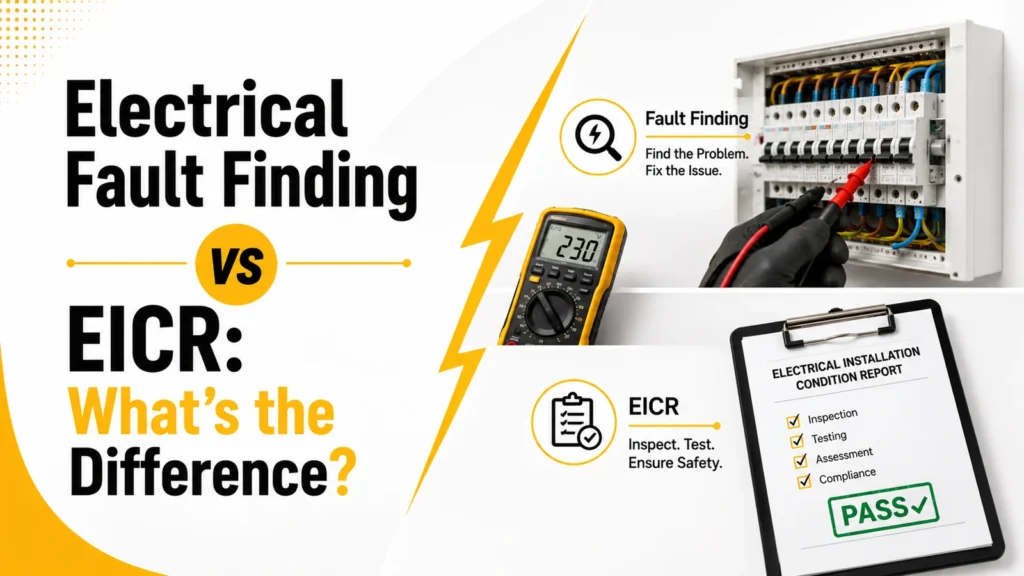
Electrical fault finding and an EICR are both carried out by a qualified electrician, and both involve testing. That is roughly where the similarity ends. Fault finding starts with a specific problem an RCD tripping, dead sockets, a circuit that keeps cutting out and works towards the cause. An EICR assesses the overall condition of an electrical installation whether or not anything has gone wrong. Booking the wrong one costs time and money, and it leaves the actual problem unsolved.
This article explains the difference between the two, when each one applies, what happens on the day, and what the paperwork means including the FI code that landlords often find sitting unexplained on their reports.
What Is Electrical Fault Finding?
Fault finding is a targeted investigation into a specific electrical problem. The electrician begins with a symptom something the homeowner, tenant or landlord has noticed and works systematically to establish what is causing it, where the fault is, and what repair is required.
The process follows a logical path: gather the fault history, inspect the affected area, identify which circuit is involved, isolate safely where needed, choose the appropriate tests, interpret the results, carry out the repair, and retest to confirm the problem has been resolved. It is reactive by nature. Nothing is booked until something is wrong.
Our guide to how electricians find electrical faults covers the full diagnostic process including how testing narrows a fault from property level down to a single circuit or component, and why interpreting a reading is a very different skill from simply owning a test instrument.
What Is an EICR?
An EICR Electrical Installation Condition Report is a scheduled inspection of an existing electrical installation. The electrician is not investigating a specific complaint. They are assessing the overall condition and safety of the fixed wiring, consumer unit, protective devices, sockets, switches and earthing arrangement across the property.
The inspection involves a combination of visual examination and electrical testing. At the end, the electrician issues a report coded as either Satisfactory or Unsatisfactory, with any observations classified using a standard coding system set out in BS 7671:
- C1 Danger present. Risk of injury. Immediate action required.
- C2 Potentially dangerous. Urgent remedial work required.
- C3 Improvement recommended. Does not make the report unsatisfactory.
- FI Further investigation required. More on this below.
A C1, C2 or FI code makes the report Unsatisfactory. A C3 alone does not. The EICR does not carry out repairs. It identifies what needs attention and produces a document recording the condition of the installation at the time of the inspection.
Electrical Fault Finding vs EICR
| Electrical Fault Finding | EICR | |
| What triggers it | A specific symptom or known problem | Scheduled inspection or legal requirement |
| Scope | One circuit or component | Whole installation |
| Starting point | Observable fault | Baseline condition assessment |
| Output document | Minor Works Certificate or EIC after repair | Electrical Installation Condition Report |
| Legally required | No but necessary when a fault exists | Yes, for private rental properties in England every 5 years |
| What it does not cover | General installation condition | Active faults that only appear under load or after rain |
Which Do You Need?
Book fault finding if:
- An RCD or circuit breaker keeps tripping
- Sockets have stopped working
- Lights flicker or dim, particularly under load
- Part of the property has lost power
- You can smell burning or a socket feels hot
- The fault comes and goes without explanation
- Outdoor electrics trip after rain
Book an EICR if:
- You are a landlord and the five-year inspection is due
- You are buying a property and want an independent condition assessment
- You are letting a property for the first time
- A previous EICR has expired
- You have received a notice from the local housing authority requiring one
- You want a documented baseline before undertaking renovation work
Book fault finding before the EICR if:
You have an active fault and an EICR is also due. An EICR on a property with an active intermittent fault will often produce an FI code which makes the report Unsatisfactory and requires a separate investigation visit anyway. Diagnosing and repairing the fault first means the EICR is carried out on a functioning installation and is more likely to reflect its true condition.
Can an EICR Find My Electrical Fault?
Sometimes but not always, and this distinction matters. An EICR is a snapshot taken at a fixed point in time. It can identify deterioration, non-compliant wiring, missing protection, and damage that is visible or measurable during the inspection. What it cannot reliably identify is a fault that only appears under specific conditions.
A circuit that trips when the shower runs and the cooker is on, an outdoor socket that trips after heavy rain, or a connection that fails only after the property has been occupied for a few hours these may test perfectly satisfactory on the day of the EICR. The fault is real. The inspection simply cannot reproduce the conditions that reveal it.
If you are experiencing a recurring electrical problem, an EICR may not resolve it. Fault finding, which starts from your symptom and attempts to reproduce and isolate the problem, is the appropriate service.
What the FI Code Actually Means and Why It Leads to Fault Finding
An FI Further Investigation code appears on an EICR when the inspector identifies something that could not be fully assessed during the inspection. It might be a circuit that could not be tested because the property was occupied, concealed wiring that testing suggests may be compromised, or a reading that is within tolerance but that the inspector has flagged for closer review.
An FI is not a borderline observation. It makes the report Unsatisfactory.
Under the Electrical Safety Standards in the Private Rented Sector (England) Regulations 2020, landlords must arrange for the investigation and any necessary remedial work to be completed within 28 days of receiving the report. That window applies to FI codes in the same way it applies to C1 and C2 defects.
The investigation that follows an FI code is, in practice, electrical fault finding. The electrician returns, accesses the relevant circuit or area, carries out the targeted testing the EICR flagged, establishes whether a defect exists and if it does determines its severity. That visit is separate from the EICR and is billed separately.
Earth leakage is one of the most common reasons an FI code appears. The EICR identifies that leakage is present on a circuit, but the source a deteriorating cable, a damaged accessory, moisture in an outdoor connection, or a connected appliance cannot always be confirmed during the inspection itself. A targeted investigation is then needed to find it. Tracy Pereira, one of our customers, described exactly this outcome: Arif quickly assessed the leakage situation and got it fixed. The assessment came first. The repair followed once the source was confirmed.
That sequence assess, confirm, repair is what separates a proper investigation from replacing parts until the problem stops. It also determines what gets certified at the end. Thuy M noted that the issue turned out to be more than expected, but Arif resolved it. That is not unusual in fault finding; the visible symptom and the underlying cause are often not the same thing, and the investigation occasionally reveals more than the original report flagged.
What Paperwork Do You Receive After Each?
After an EICR: You receive the Electrical Installation Condition Report. If the report is Satisfactory, that document stands. If remedial work is then carried out to address C1, C2 or FI items, the completed work should be certified separately.
After electrical fault finding and repair: The paperwork depends on the work carried out. Most repairs replacing a damaged socket, correcting a poor connection, repairing a section of cable are certified with a Minor Electrical Installation Works Certificate. If a new circuit is installed, or if the diagnosis leads to a consumer unit replacement, an Electrical Installation Certificate (EIC) is the appropriate document. Sadha Shivam, a customer in Hounslow, described exactly this: Arif changed the entire consumer unit, tested everything, and issued the EIC. An EICR is not issued for a repair visit the two documents record different things.
If you are a landlord: Keep the original Unsatisfactory EICR, the written confirmation of completed remedial work, and the certificate for that work together. You will need to provide copies to tenants within 28 days and make them available to the local authority if requested.
What About EIC vs EICR?
This catches people out because the names look similar.
An EIC Electrical Installation Certificate is issued when new electrical work is completed. A new circuit, a consumer unit replacement, a rewire these require an EIC confirming the work has been inspected and tested and meets the requirements of BS 7671 at the time of installation. The EIC is issued by the electrician who completed the work.
An EICR assesses work that already exists. It is not issued for new work. It is the ongoing health check for an existing installation.
If you are buying a property and the seller hands you an EIC for work completed three years ago, that tells you the work was compliant when it was done. It does not tell you the condition of the rest of the installation. For that, you need an EICR.
For Landlords: Two Separate Legal Duties
One thing that is consistently missing from EICR explanations: the inspection duty and the repair duty are legally separate.
The Electrical Safety Standards 2020 require landlords in England to have a valid EICR for private rented properties and to carry out required remedial work within 28 days. Complying with that inspection requirement does not discharge the obligation to keep the installation in repair and proper working order. Section 11 of the Landlord and Tenant Act 1985 requires landlords to keep installations for the supply of electricity in repair and proper working order throughout the tenancy.
If a tenant reports a tripping RCD or dead sockets during a tenancy, an in-date EICR does not make that report irrelevant. The landlord still has an obligation to investigate and repair the fault. That is where fault finding not another EICR is the appropriate response.
For landlords in Hounslow and West London requiring either an electrical inspection and testing or active fault diagnosis, Handy Electric Pro carries out both services.
What Affects the Cost of Each?
EICR: Cost is influenced by the size of the property, the number of circuits, the age of the installation, and accessibility. The fee covers the inspection and the report. It does not include remedial work, which is agreed and quoted separately if required.
Fault finding: Cost depends on how much diagnostic work is required. A straightforward, reproducible fault on a single circuit takes less time than a fault that only appears intermittently, affects multiple circuits, involves concealed wiring, or requires access to difficult areas. Once the cause is identified, any repair is agreed before work continues.
Both services involve a qualified electrician carrying out professional electrical work. Neither should be compared on price alone without understanding what is included.
Frequently Asked Questions
Does an EICR fix electrical faults?
No. An EICR identifies and documents issues, but it does not carry out repairs. If faults are found, remedial work is arranged separately and certified with the appropriate documentation.
If I have a valid EICR, do I still need fault finding?
Yes, if you have an active electrical problem. An in-date EICR records the condition of the installation at the time of inspection. It does not prevent faults from developing afterwards, and it cannot identify faults that only appear under specific conditions.
What happens after an FI code on my EICR?
The FI means the inspector could not complete their assessment of a specific item. The report is Unsatisfactory until the investigation is done. For landlords, that investigation must be arranged within 28 days. The outcome of the investigation either clears the item or results in a C1, C2 or C3 observation being recorded.
Which comes first fault finding or an EICR?
If you have an active fault, resolve it first. An EICR on a property with an undiagnosed fault is more likely to produce an FI code, which means a second visit anyway. Fix the fault, then book the EICR.
What certificate do I get after fault finding and repair?
Most repairs are certified with a Minor Electrical Installation Works Certificate. If the repair involves installing a new circuit, an Electrical Installation Certificate (EIC) is the appropriate document. An EICR is not issued for a repair visit.
Can an EICR find an intermittent fault?
Not reliably. Intermittent faults often require the fault to be present or reproducible to be identified and tested. An EICR inspection is a point-in-time assessment and cannot recreate conditions that only occur under load, after rain, or at certain times of day.
Is a PIR the same as an EICR?
Yes. Periodic Inspection Report is the older name for the same document. Both terms refer to the scheduled inspection of an existing electrical installation. EICR is the current terminology used in BS 7671 and by the regulatory bodies.
What does BS 7671 have to do with an EICR?
BS 7671 is the UK standard for electrical installations the IET Wiring Regulations. Both the inspection criteria and the observation coding system (C1, C2, C3, FI) used in an EICR are defined within it. Work to be certified must meet its requirements.
Need Fault Finding or an EICR in Hounslow or West London?
Handy Electric Pro provides Electrical fault diagnosis and repair across Hounslow, Twickenham, Feltham, Isleworth, Richmond, Brentford and the wider West and South West London area.
Muhammad Arif is an ECS Gold Card qualified electrician and electrical fault diagnosis and repair NAPIT-approved contractor. All work is carried out to BS 7671:2018, the team is fully insured and DBS-checked, and electrical certificates are issued for completed work.
If you have an active electrical problem an RCD that keeps tripping, circuits that cut out without explanation, or Intermittent faults that keep returning contact us for a same-day or next-day investigation.
Call or WhatsApp: +44 7389 775236 Available 24/7 for urgent electrical faults.
Book Online