


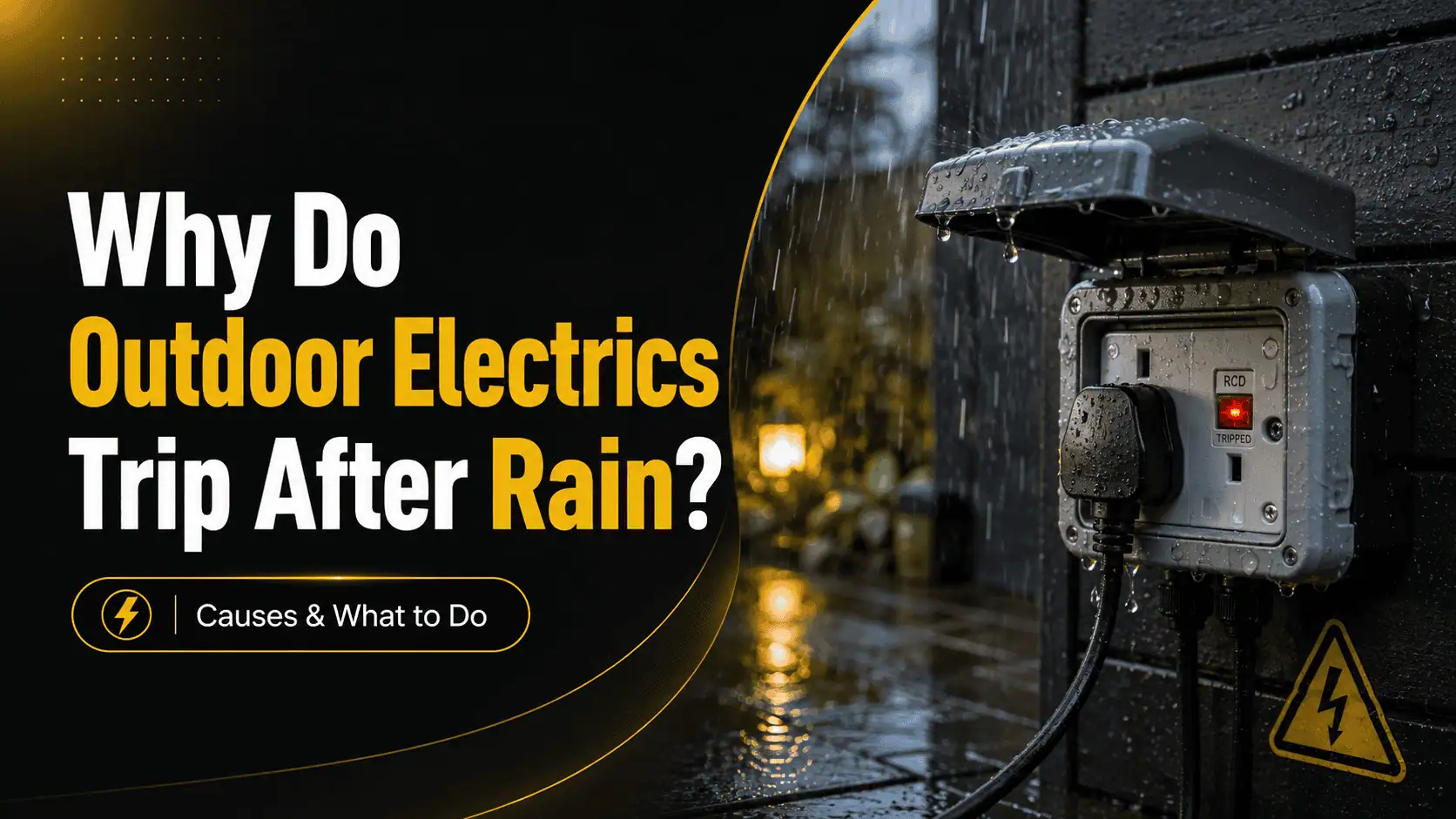

If your outdoor electrics trip after rain, moisture may be affecting an outdoor socket, light, cable, connection, shed circuit or connected piece of equipment. The rain is an important clue, but it does not tell you exactly where the electrical fault is. A circuit may trip while rain is falling, several hours later or only when a particular outdoor light or socket is used. Those patterns can help narrow the investigation without guessing at the cause. The important questions are what was affected, when the trip happened and which protective device operated.
Why Do Outdoor Electrics Trip When It Rains?
Outdoor electrics can trip when rain or damp affects electrical equipment, wiring or connections and creates a fault condition. The problem may be in the visible outdoor accessory, a cable or joint supplying it, equipment connected to the circuit, or another part of the installation exposed to moisture. The IET notes that dampness can affect the safety of an electrical installation, while Electrical Safety First advises that electrical equipment used outdoors should be kept away from wet conditions and protected appropriately. Possible fault locations include:
- outdoor sockets;
- garden and security lights;
- PIR sensors;
- cable joints and connection points;
- external or underground cables;
- shed or garage electrics;
- pond pumps and water features;
- outdoor appliances and extension leads.
The fact that a problem appears during wet weather makes these areas more relevant, but the symptom still needs to be traced to its actual source.
Why Does Moisture Make an RCD Trip?
An RCD can operate when current flows away from its intended path and creates residual current, sometimes called earth-leakage current. Moisture can contribute to this type of fault where it affects insulation, electrical connections or equipment. The IET defines an RCD as a device that operates when residual or earth-leakage current is detected. A standard RCCB does not provide overcurrent protection, while an RCBO combines residual-current and overcurrent protection. That is why it helps to know what actually switched off at the consumer unit. If it was an RCD, the electrician may investigate a residual-current or insulation-related problem. If an MCB operated instead, overcurrent or short-circuit conditions may require consideration.
If you are dealing with repeated RCD operation beyond wet-weather situations, our guide explains what can be behind an RCD that keeps tripping.
What Does the Timing of the Trip Tell You?
The timing can help an electrician decide which outdoor equipment or section of the circuit should be investigated first. It is a diagnostic clue rather than proof of a particular fault.
| What you notice | What becomes more relevant | What still needs confirming |
| Trips as soon as heavy rain begins | Exposed fitting, socket or connection affected quickly by water | Which accessory or circuit is actually affected |
| Trips only after prolonged rain | Slower moisture penetration or an existing weak point | Where water is entering |
| Garden lights cause the trip after rain | Light fitting, PIR, connection, cable or related equipment | Which part of the lighting circuit has the fault |
| Outdoor socket trips when something is plugged in | Socket, connected equipment or supply cable | Equipment fault or fixed-installation fault |
| Shed or garage loses power in wet weather | Supply cable, socket, light, equipment or damp within the outbuilding | Whether the fault is in the outbuilding or its supply |
| Everything works again after drying | Moisture-related intermittent behaviour becomes more likely | Whether the underlying defect remains |
| Several areas are affected | Fault may be wider than one obvious outdoor fitting | Which circuit and protective device are involved |
For diagnosis, the weather pattern and electrical pattern need to be considered together.
Saying “it trips sometimes” provides much less information than saying:
“The garden-lighting circuit usually trips after an hour of heavy rain.”
That does not diagnose the fault, but it gives the electrician a much stronger starting point.
Where Can Rain Get Into Outdoor Electrics?
Rain can affect visible outdoor accessories, but the actual fault may also be inside a connection, enclosure or cable that cannot be identified from the outside. An electrician therefore needs to consider the whole affected circuit rather than replacing the first wet-looking fitting.
Outdoor sockets
An outdoor socket depends on its enclosure, cover, cable entries and overall condition to protect the electrical parts inside. NICEIC advises that outdoor socket-outlets should be weatherproof, correctly IP rated and RCD protected. It also notes that IP66 is common among outdoor socket products, although equipment selection should suit the actual outdoor environment. NICEIC’s garden electrics guidance explains these requirements for householders. A problem can therefore involve more than the face of the socket. The cable entry, enclosure or connection supplying it may also need checking.
Garden and security lighting
Outdoor lights are exposed to rain, temperature changes and other weather conditions. The possible fault location can include:
Light fitting → PIR sensor → Driver or Control Equipment → Connection → Cable → Circuit
The visible light is not automatically the source. A fault inside a connection supplying several garden lights can produce the same customer symptom as water inside one fitting.
External or underground cables
Outdoor cables have to cope with environmental exposure and possible physical damage. NICEIC advises that cabling used outside should be suitable for outdoor conditions and that buried cables need protection from foreseeable damage such as garden tools.If a cable or connection has deteriorated or been damaged, wet weather may make the existing problem more noticeable.
Shed and garage electrics
A wet-weather trip involving a shed or garage can have several possible sources. The diagnostic path may include:
Supply Cable → Local Sockets → Lighting → Connections → Equipment inside the outbuilding
Damp entering through the building itself can also affect electrical accessories that would normally remain dry.
Outdoor electrical equipment
A pond pump, pressure washer, garden tool, decorative lighting or an extension lead can also be part of the fault pattern. Electrical Safety First recommends using cables and connectors designed for outdoor use, keeping them away from wet areas and not using electrical equipment outdoors until it is dry. (Electrical Safety First)
Why Do Garden Lights Keep Tripping After Rain?
Garden lighting may trip after rain if moisture is affecting a light fitting, PIR sensor, connection, control component, cable or another part of the lighting circuit. The fact that the lights are where you notice the problem does not prove the individual light fitting is the cause. One useful distinction is whether the RCD trips:
- before the garden lights are switched on;
- immediately when they are switched on;
- only after they have been running;
- or only following prolonged wet weather.
Each pattern changes what needs investigating. For example, a trip that occurs only when the lights switch on gives a different diagnostic starting point from an RCD that operates during rain even while those lights are not being used.
Handy Electric Pro has genuine experience with outdoor lighting installations. One customer specifically reported that Arif had “installed my outdoor motion sensor lights” alongside other electrical work.
That review confirms real outdoor-lighting work, but it does not state that the installation suffered a rain-related fault. We therefore do not present it as a wet-weather fault-finding case.
Why Does an Outdoor Socket Trip the RCD When It Rains?
An outdoor socket may be associated with RCD tripping if moisture has affected the socket, its connections, the cable supplying it or equipment plugged into it. The electrician still needs to distinguish a socket fault from a connected-equipment or wider circuit fault. This distinction matters.
Consider two different patterns:
Socket unused + RCD trips during rain
The fixed outdoor installation becomes particularly relevant. RCD trips only when garden equipment is plugged into that socket The socket, circuit and the connected equipment may all need consideration. Simply replacing the socket without establishing which side of that relationship is faulty can leave the original problem unresolved.
Why Do Shed or Garage Electrics Trip in Wet Weather?
Shed and garage circuits can trip in wet weather when moisture affects equipment or wiring within the outbuilding, or where the supply to the building has developed a fault. The source may therefore be inside the shed, along the external supply route or at one of its accessories. Useful observations include whether:
- the whole outbuilding loses power;
- only its lights stop working;
- only its sockets are affected;
- the trip occurs when particular equipment is used;
- there is visible damp inside;
- or the fault follows prolonged rain rather than a brief shower.
The electrician can then work from:
Property → Outbuilding Supply → Circuit → Accessory/Equipment → Fault
rather than assuming “shed electrics” is one single component.
Why Do the Electrics Work Again After the Rain Stops?
A wet-weather fault can appear to disappear as equipment and surrounding materials dry, allowing the circuit to operate again. That does not establish that the route allowing water or moisture to affect the electrics has been corrected.
Electrical Safety First advises that electrical installations and equipment affected by water should be assessed before being assumed safe, particularly where there are signs of water ingress or damage. Its guidance on water-damaged electrics also advises against DIY electrical repairs. So this pattern matters:
Rain → Trip → Dry Weather → Circuit Works → Next Rainfall → Trip Again
That is not a successful repair. It is an intermittent condition linked to moisture. Tell the electrician this history, even if the electrics happen to be working normally when they arrive.
Can an IP-Rated Outdoor Socket or Light Still Develop a Fault?
Yes. An appropriate IP rating describes the level of protection an enclosure is designed to provide against things such as water and solid objects, but the installation still has to remain suitable for its location and condition.
The IET states that electrical equipment and wiring systems should be suitable for the external influences at their location, including the presence of water. NICEIC similarly recommends selecting appropriately IP-rated outdoor sockets and lighting for wet and adverse conditions. An IP marking therefore should not lead to the assumption:
“It is outdoor rated, so water cannot possibly be involved.”
Condition still matters. So do the enclosure, installation, cable entries and suitability for the actual environment.
What If the Electrics Trip During Rain but You Have No Outdoor Sockets or Garden Lights?
Rain-related electrical faults are not limited to obvious garden accessories. Water entering a building or another electrical area can also affect wiring, sockets, switches or equipment that would normally be indoors. This becomes especially important if you can see water close to electrical equipment.
Electrical Safety First advises seeking professional help where water has entered a consumer unit or where electrical equipment or wiring has been affected by flooding or water damage. Possible context can include:
- a roof leak reaching electrical equipment;
- water entering around an external wall;
- an external electrical enclosure;
- wiring routed through an affected area;
- or another electrical accessory exposed to damp.
Do not assume that “no garden electrics” rules moisture out.
What Should You Do If Outdoor Electrics Keep Tripping After Rain?
Stop using suspect outdoor electrical equipment and avoid opening or dismantling wet electrical accessories yourself. Record the weather and tripping pattern, then arrange professional investigation if the fault repeats or the affected fixed installation cannot safely be ruled out. Electrical Safety First advises keeping outdoor electrical equipment away from wet conditions and switching equipment off and unplugging it before checking it. Useful information to note includes:
- whether it started during or after rain;
- whether light or heavy rain makes a difference;
- which area lost power;
- whether garden lights were operating;
- whether an outdoor socket was being used;
- whether shed or garage electrics were affected;
- whether portable outdoor equipment was connected;
- and which device appears to have operated at the consumer unit.
If portable equipment can be safely switched off and unplugged without approaching water or damaged electrical parts, stop using it.
Do not:
- remove outdoor socket covers;
- open lighting fittings;
- dismantle junction boxes;
- probe cables;
- carry out live electrical tests;
- bypass an RCD;
- or use a multimeter on wet electrical equipment.
Those steps move beyond safe homeowner observation into electrical fault diagnosis.
Should You Keep Resetting the RCD After Rain?
No. Repeatedly resetting an RCD while the underlying fault remains present is not a substitute for finding the cause. The IET specifically advises keeping repeated reset attempts to a minimum because repeatedly resetting a protective device onto a fault may damage the device. If protection will not remain reset after safe removal of connected plug-in equipment, its consumer guidance recommends consulting an electrical contractor.
How Does an Electrician Find a Rain-Related Electrical Fault?
An electrician uses the weather pattern, affected circuit and protective device to narrow down where the problem is occurring. Inspection, safe isolation and appropriate electrical testing can then separate the likely outdoor equipment or wiring until the actual fault is identified. The process may involve:
- confirming exactly when the fault appears;
- identifying whether an RCD, RCBO or circuit breaker operated;
- establishing which circuit is affected;
- checking exposed outdoor equipment and relevant connections;
- safely separating connected equipment from fixed wiring where appropriate;
- narrowing the circuit into smaller sections;
- carrying out tests appropriate to the suspected fault;
- identifying the affected accessory, cable, equipment or connection;
- carrying out or recommending the appropriate repair;
- and retesting before the affected work is returned to normal service.
The IET’s inspection-and-testing guidance covers insulation-resistance testing as one of the professional verification tests used on electrical circuits. Rain is therefore context for diagnosis, not the diagnosis itself. The wider process of moving from a symptom to an identified electrical fault is covered in our guide to inspection, isolation and electrical testing during fault diagnosis.
The relationship is:
Weather Pattern → Affected Circuit → Isolation → Testing → Fault Location → Repair → Verification
That is more reliable than replacing outdoor accessories until the tripping stops.
When Does a Wet-Weather Electrical Fault Need Urgent Attention?
Seek prompt professional help if wet-weather tripping is accompanied by smoke, burning, unusual heat, arcing, electric shock, exposed wiring or water inside electrical equipment such as the consumer unit. Avoid touching wet electrical equipment or exposed wiring and move away from any immediate electrical hazard. Electrical Safety First specifically advises seeking professional help if there is water inside the consumer unit, signs of arcing or overheating, and warns people not to touch exposed wiring after water damage. Treat the situation more urgently if you notice:
- water inside or around the consumer unit;
- smoke;
- visible arcing or sparking;
- a burning smell;
- unusual heat;
- melted or damaged electrical parts;
- electric shock or tingling;
- exposed conductors;
- or extensive water entering an area containing electrics.
If there is fire, smoke or immediate danger to people, keep away from the hazard and contact the appropriate emergency service.
Do You Need an Electrician for Outdoor Electrics Tripping After Rain in Hounslow?
If wet-weather tripping keeps returning or you cannot establish whether the fault is in an outdoor accessory, equipment or fixed wiring, professional fault finding can narrow down the affected circuit before repair is recommended. Handy Electric Pro provides electrical fault diagnosis across Hounslow and West London for RCD trips, outdoor electrical faults and other recurring installation problems. The aim is not simply to get the RCD to stay on. It is to identify why the protection is operating and which part of the installation actually needs attention.
If your garden lights, outdoor sockets, shed electrics or another circuit repeatedly trip in wet weather, our professional fault diagnosis service can help identify where the problem sits.
Book Electrical Fault Diagnosis
Handy Electric Pro provides electrical work across Hounslow and West London. Business materials supplied for this site document ECS/JIB and City & Guilds credentials, alongside real customer feedback for electrical fault diagnosis, repairs and outdoor-lighting work.
Book Online