


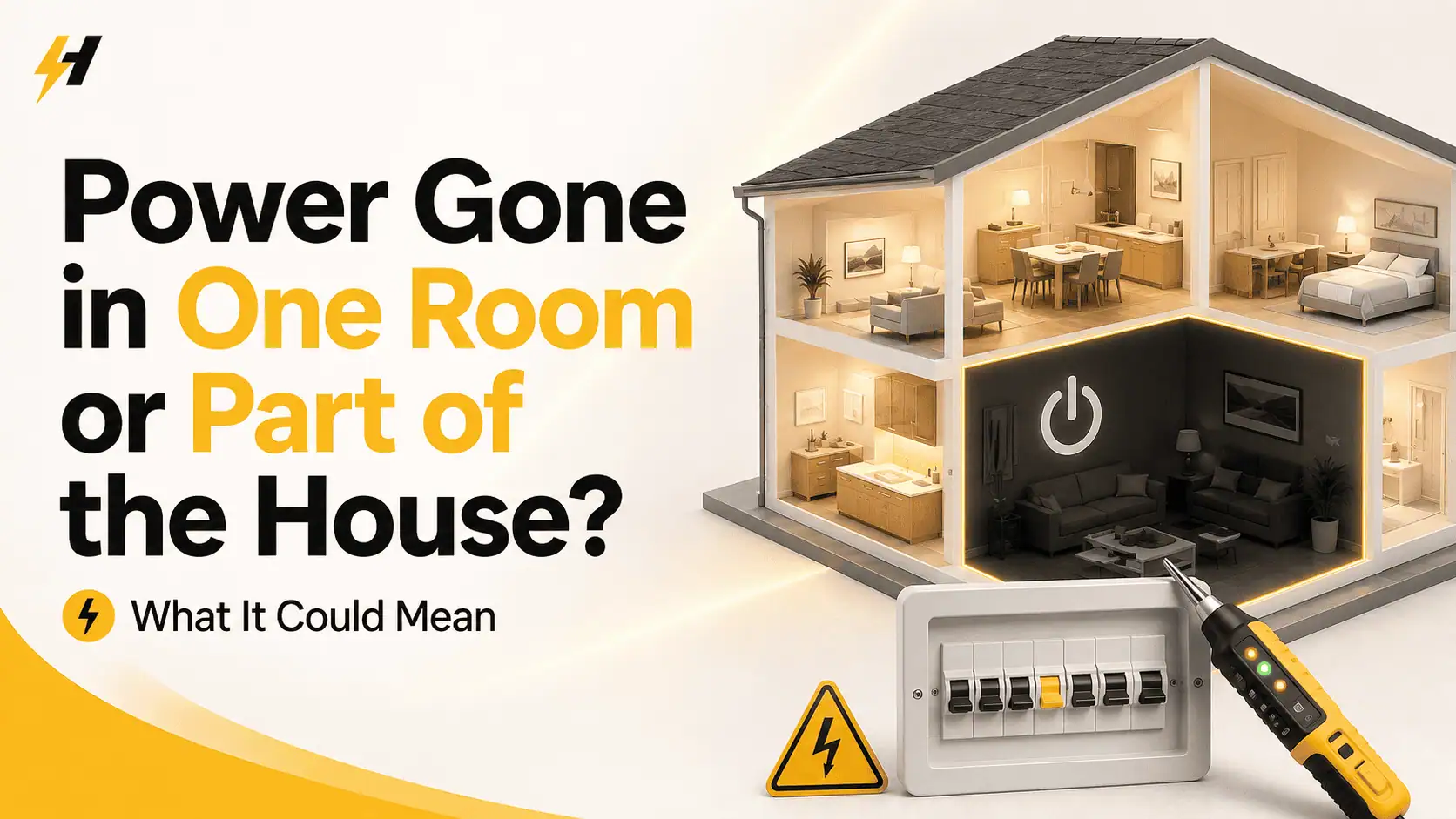

If the power has gone in one room or part of your house while other areas still work, the problem is more likely to involve a particular circuit, protective device, connected equipment or part of the electrical installation than a neighbourhood-wide power cut. The exact pattern matters. Lights going off while sockets still work points the investigation in a different direction from losing both lights and sockets across several rooms.
The good news is that partial power loss does not automatically mean your whole house needs rewiring. The first job is to establish what has actually lost power and why.
Why Has the Power Gone Out in Only One Room or Part of the House?
Power can disappear from one area when a circuit breaker, RCD or RCBO operates, when connected equipment develops a fault, or when there is a problem with wiring or an electrical connection. The affected room is only the place where you noticed the problem; it may not match the exact circuit that has failed.
A UK consumer unit distributes and protects separate final circuits for things such as lighting, sockets, cookers and showers. The IET explains that circuit breakers and other protective devices are installed to protect those individual circuits. (IET Wiring Regulations)
That means one electrical circuit can sometimes serve more than one room.
So an electrician will usually ask:
- Which rooms are affected?
- Have the lights stopped working?
- Have the sockets stopped working?
- Are both lights and sockets affected?
- Did a breaker or RCD trip?
- What was being used when the power went off?
- Did the power disappear suddenly or gradually?
- Has it happened before?
Those answers can narrow the problem much faster than simply saying, “the bedroom has no electricity.”
What Exactly Has Lost Power: Lights, Sockets or Both?
The most useful first clue is whether the outage affects lights, sockets, one appliance or several circuits. This does not diagnose the fault, but it helps identify which part of the installation needs investigation.
| What you notice | What it may point towards |
| Lights and sockets are both off | More than one circuit or shared protection may be involved |
| Sockets are off but lights still work | Socket circuit, protective device, connection or accessory issue |
| Lights are off but sockets still work | Lighting circuit, fitting, wiring or protective-device issue |
| One room and nearby areas are affected | The same circuit may serve more than the room first noticed |
| A large part of the house has no power | Several circuits or shared RCD protection may be involved |
| One appliance has stopped but everything else works | The problem may be with that appliance rather than the supply |
| Power disappeared and later returned | An intermittent electrical fault or changing condition may need investigation |
This distinction is important.
For example, sockets not working while the lights still work is a specific fault pattern. We will cover that separately rather than trying to turn this page into a complete socket-fault guide.
Is It a Power Cut or an Electrical Fault Inside the House?
If only one room or part of your property has lost electricity while the rest of the home and neighbouring properties still have power, an internal electrical problem becomes more likely. If your whole property and nearby homes are also without electricity, a wider network outage becomes more likely.
UK power-network guidance recommends checking whether neighbours or nearby properties are also affected before assuming the fault is inside your home. The free 105 service connects callers to their local electricity network operator for power-cut information. (Ofgem)
If your entire home has suddenly lost electricity, our guide to what to do when your home loses power suddenly covers that wider situation.
This page focuses on something different: one room, one area or only part of the property losing power.
What Are the Common Causes of Partial Power Loss?
Partial power loss is commonly linked to protective-device operation, connected equipment or a fault affecting one or more circuits. The actual cause should be established from the outage pattern rather than guessed from the room that went dark.
A circuit breaker has tripped
An MCB or circuit breaker can disconnect a circuit when excessive current or a short-circuit condition occurs. If that circuit serves the affected area, the rest of the house may continue working normally.
If the same device repeatedly operates, see our guide to why a circuit breaker keeps tripping.
An RCD or RCBO has operated
An RCD responds to residual current, while an RCBO combines residual-current and overcurrent protection. Depending on how the consumer unit is arranged, one RCD can protect several circuits, so its operation may remove power from more than one area.
If an RCD is the device that keeps operating, our guide explains why an RCD keeps tripping.
Faulty electrical equipment
A connected appliance or other electrical equipment can cause a protective device to operate.
The IET notes that faulty appliances are one possible reason for a breaker or RCD to trip. If one particular appliance repeatedly causes the problem, stop using it until the cause has been established. (IET Wiring Regulations)
A loose or damaged electrical connection
A poor connection can cause unreliable power, overheating or complete loss of supply to part of a circuit.
Because connections may be inside accessories, junctions or other parts of the fixed installation, the cause may not be visible from the room.
Damaged wiring or an accessory fault
Damage to a socket, switch, cable or another part of the circuit can also cause localised power loss.
The problem may follow recent building work, drilling, decorating or other changes around the property. The IET specifically notes that installation faults can occur following DIY work that damages concealed wiring.
What If No Circuit Breaker or RCD Looks Tripped?
No obvious tripped switch does not prove that the electrical installation is healthy. A failed connection, wiring fault, hard-wired equipment problem or another issue can still interrupt power without presenting as an obvious breaker in the off position.
This is particularly important when:
- only certain sockets or lights are affected;
- the circuit appears normal at the consumer unit;
- the fault started suddenly;
- power comes and goes;
- or the problem affects equipment that is permanently wired in.
At that point, repeatedly operating switches at the consumer unit is unlikely to identify the underlying cause.
An electrician may need to establish whether supply is reaching the affected circuit and then narrow the fault further through inspection and appropriate testing.
What If the Power Went Off and Then Came Back On?
Power returning by itself does not necessarily mean the problem has been resolved. An intermittent connection, changing electrical load or equipment that behaves differently during operation can make a fault appear and disappear.
Make a note of what happened before the outage.
Useful details include:
- the time it occurred;
- what appliances were operating;
- whether heating or hot water was running;
- whether lights flickered beforehand;
- whether anything felt unusually warm;
- whether there was buzzing or crackling;
- and how long the power remained off.
An electrician investigating an intermittent problem can often learn more from that pattern than from the fact that everything happens to be working when they arrive.
What Can You Safely Check When One Area Loses Power?
You can safely observe which areas and equipment are affected without dismantling electrical accessories or testing fixed wiring yourself. If there are warning signs such as burning, heat, sparks or damaged equipment, stop using the affected area and arrange professional help.
You can check:
- whether other rooms still have electricity;
- whether neighbours also have no power;
- whether lights, sockets or both are affected;
- whether a clearly visible breaker, RCD or RCBO has operated;
- what equipment was running immediately beforehand;
- and whether one appliance consistently triggers the problem.
If one plug-in appliance clearly causes a protective device to operate, stop using that appliance.
The IET advises that if a breaker or RCD will not remain reset after connected equipment has been removed, a registered electrical contractor should test the installation and diagnose the fault. It also warns against repeatedly attempting to reset a protective device while a fault remains present.
Do not:
- remove socket or switch fronts;
- remove the consumer-unit cover;
- probe cables or conductors;
- attempt insulation-resistance testing;
- or follow online instructions for testing live wiring.
The goal is to understand the pattern safely, not diagnose fixed wiring yourself.
How Does an Electrician Find the Cause of Partial Power Loss?
An electrician normally starts by identifying exactly what has stopped working and which circuits or protective devices are involved. Inspection and appropriate electrical testing can then narrow the problem from the affected circuit towards the equipment, connection, accessory or wiring causing the fault.
The process may involve:
- confirming the outage pattern;
- identifying the affected circuit;
- checking the relevant protective devices;
- inspecting accessible wiring and accessories;
- safely isolating relevant sections where required;
- carrying out tests appropriate to the suspected problem;
- narrowing down the fault;
- repairing the cause where agreed;
- and checking the affected work before restoring normal use.
Partial power loss is therefore one symptom within the wider process of how electricians find electrical faults.
That guide explains how symptoms, inspection, circuit isolation, electrical testing and verification work together when the cause of a problem is not immediately obvious.
Customer feedback for Handy Electric Pro also reflects this diagnosis-first approach. One customer described the service as helping to “troubleshoot an electrical issue”, while other reviews mention problems being assessed, explained and resolved rather than components simply being replaced at random.
When Is Partial Power Loss an Electrical Emergency?
Partial power loss needs more urgent attention when it appears alongside signs of overheating, arcing, smoke, electric shock or water affecting electrical equipment. Those warning signs can indicate something more serious than an inconvenient loss of power.
Seek professional help promptly if you notice:
- a burning or unusual electrical smell;
- scorch marks or discolouration;
- smoke;
- visible sparks;
- buzzing or crackling;
- a socket or switch becoming unusually hot;
- electric shock or tingling;
- water around affected electrical equipment;
- or protective devices repeatedly operating.
Electrical Safety First advises people not to ignore burn marks, arcing sounds, circuit-breaker trips or electrical accessories becoming unusually hot.
If there is fire, smoke or immediate danger, move away from the hazard and contact the appropriate emergency service rather than attempting to investigate the electrics.
When Should You Call an Electrician?
Call an electrician when the power remains off in one area, the problem keeps returning, a breaker or RCD will not stay on, or there is no obvious reason for the partial outage. Professional diagnosis is also appropriate when fixed wiring, concealed connections or permanently connected equipment may be involved.
You should arrange help sooner if there is:
- repeated tripping;
- unexplained intermittent power;
- heat or burning smells;
- buzzing or crackling;
- visible electrical damage;
- water involvement;
- or any concern that the installation may not be safe.
A partial outage does not automatically mean you need a new consumer unit or full rewire.
The purpose of fault finding is to identify what has actually failed first, then recommend the repair that matches the problem.
Need Help With Partial Power Loss in Hounslow?
If one room or part of your property has lost power and the cause is not obvious, Handy Electric Pro provides professional electrical fault finding in Hounslow and across West London.
We can investigate the affected circuits, identify the cause where possible and explain what needs repairing before the agreed work is carried out.
Book Electrical Fault Diagnosis
Book Online