


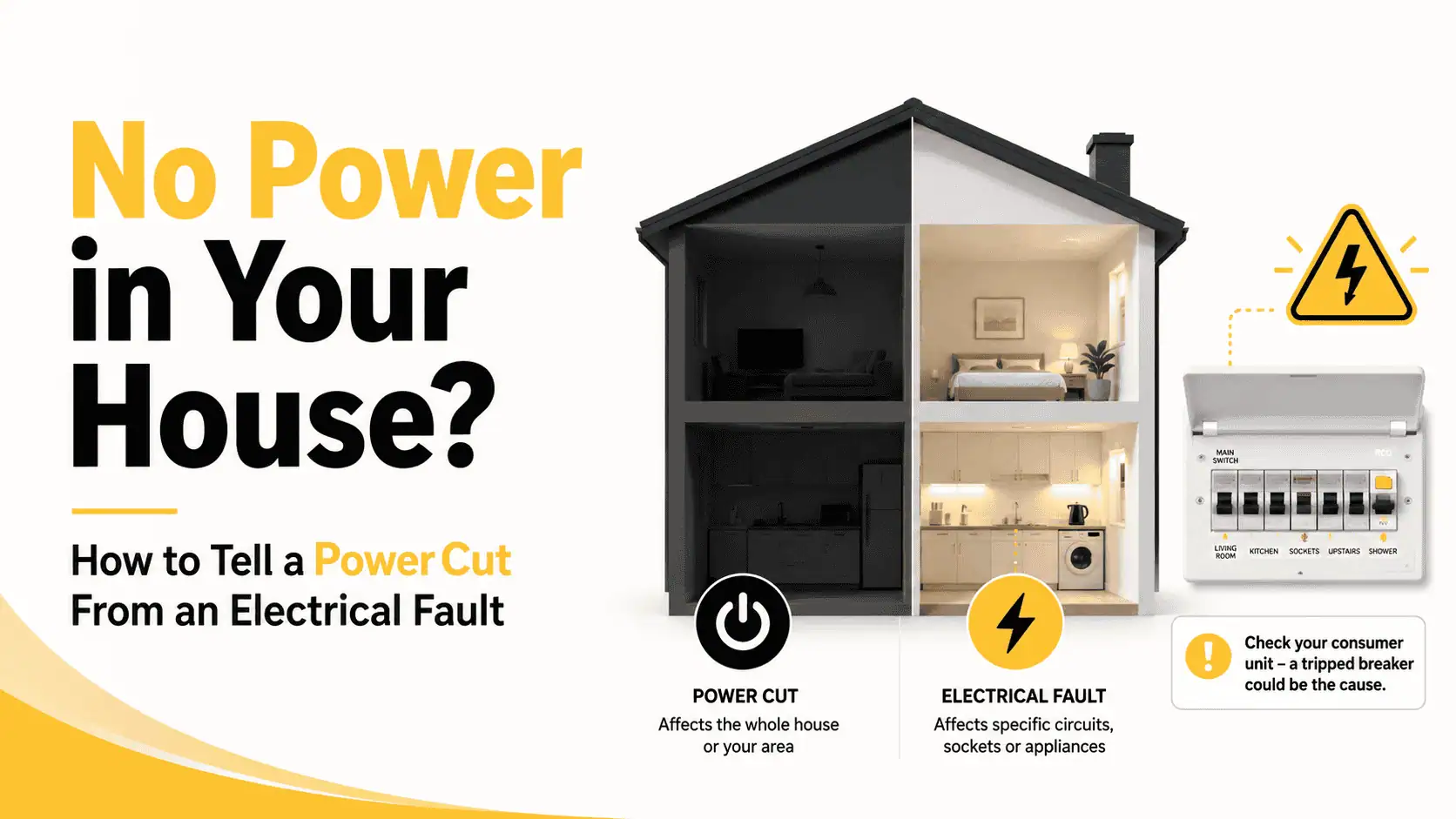

If you suddenly have no power in your house, first establish whether the problem affects only your property or the wider area. Neighbours losing power points towards a network outage, while electricity disappearing only inside your home can indicate a supply, meter, consumer-unit or internal electrical problem.
The pattern matters. Losing electricity across the whole house means something different from one room going off, an RCD repeatedly tripping or one circuit breaker refusing to stay on.
The goal is not to diagnose fixed wiring yourself. It is to work out who needs to deal with the problem and when an electrician is required.
What Should You Do First When Your House Loses Power?
First, check whether neighbouring properties or street lighting also appear to have lost electricity. Then look at your consumer unit from its normal user-accessible position and note whether an MCB, RCD, RCBO or main switch appears to have operated. Do not start removing covers or testing wiring.
Check the wider area. If nearby homes are also dark, a network power cut becomes more likely.
Check what has actually stopped working. Is the whole house off, or only certain lights, sockets or rooms?
Look for warning signs. Burning smells, unusual heat, buzzing, crackling, smoke or visible electrical damage change the situation from an ordinary outage to a potential safety issue. Electrical Safety First advises people not to ignore burn marks, arcing sounds, breaker trips or plugs and sockets becoming unusually hot.
Check the consumer unit without opening it. A protective device may have operated to disconnect a faulty circuit. The IET explains that consumer units distribute and protect the final circuits serving sockets, lighting and other electrical loads. (IET Wiring Regulations)
Is It a Power Cut or an Electrical Fault in Your Home?
A wider power cut normally affects more than one property, while an internal electrical fault may affect only your house or part of it. The pattern below helps identify the most sensible direction to investigate next.
|
What you notice |
More likely direction |
Sensible next step |
|
Neighbours or street also have no electricity |
Network power cut |
Check/report the outage through 105 |
|
Only your house has no power |
Property supply, meter or internal electrical issue |
Check consumer unit and network status |
|
One room or part of the house is off |
Internal circuit or connection fault |
Investigate the affected circuit |
|
RCD repeatedly trips |
Residual-current fault context |
Identify why the RCD is operating |
|
Circuit breaker repeatedly trips |
Overload, short circuit or circuit fault context |
Find the cause before resetting repeatedly |
|
Whole house is off but nothing looks tripped |
Network, incoming supply, meter or internal issue still needs separating |
Check network status, then the appropriate professional |
|
Power loss comes with burning, heat or crackling |
Electrical safety issue |
Stop using affected equipment and seek prompt help |
The key relationship is:
Power loss → Identify scope → Identify protection/supply involved → Determine network fault or installation fault
That is much more useful than assuming every loss of electricity is automatically a “power cut.”
What If Only Your House Has Lost Electricity?
If neighbouring properties still have power, the problem may be specific to your property’s supply or electrical installation. That does not automatically mean the fault is inside the house, because meter or incoming supply issues can also interrupt electricity to one property.
Start by checking whether there is a known network problem affecting your address.
If the network operator confirms the external supply is healthy, the investigation can move towards the property itself. Depending on the symptoms, that may include the meter, consumer unit, protective devices, circuits, wiring or connected equipment.
Do not assume the whole installation needs rewiring simply because all the power has disappeared. A proper diagnosis should establish where the electricity is being lost first.
What If the Fuse Box Hasn’t Tripped?
No visible trip at the consumer unit does not prove there is no electrical or supply problem. The fault may sit upstream of the consumer unit, involve the meter or incoming supply, or involve another connection that needs professional investigation.
This is an important search scenario because homeowners often report:
“The electricity has gone off, but nothing has tripped.”
First check whether the network operator knows about an outage.
If the network supply appears normal and your property still has no electricity, the problem needs to be narrowed further rather than repeatedly operating switches at the consumer unit.
If you have a known faulty electricity meter, Ofgem advises contacting your energy supplier rather than the network operator. (Ofgem)
What If Only Part of the House Has Lost Power?
If one room or part of the property has lost electricity while other areas still work, an internal circuit or protective-device problem becomes more likely than a neighbourhood power cut. The affected physical room does not necessarily match one electrical circuit, so what stopped working is often more useful than where you first noticed the outage.
For example, working lights with dead sockets points towards a different part of the installation from both lights and sockets disappearing together.
Our guide to power gone in one room or part of the house explains that partial-power pattern in more detail.
If only the sockets have stopped while the lighting remains normal, the narrower guide to sockets not working but lights still work is the better next step.
This separation is intentional:
- whole-house power loss → this page
- partial power loss → one-room guide
- socket-only power loss → socket guide
Each problem needs slightly different diagnostic reasoning.
What If the RCD or Circuit Breaker Keeps Tripping?
If the power disappears because an RCD, MCB or RCBO repeatedly operates, the protective device is giving you an important clue about the fault. The type of device matters because an MCB and an RCD respond to different electrical conditions.
An MCB or circuit breaker provides protection against overcurrent and short-circuit conditions. An RCD responds to residual current that may be associated with a fault in connected equipment or the electrical installation.
- If the RCD is the device operating, see why an RCD keeps tripping.
- If an MCB or breaker repeatedly operates, see why a circuit breaker keeps tripping.
The IET also warns that repeatedly trying to reset a protective device while a fault remains present can damage the device. If it will not remain reset, a registered electrical contractor should investigate the installation.
Who Should You Call: 105, Your Energy Supplier or an Electrician?
Call 105 for a network power cut, your energy supplier for certain meter-related problems, and an electrician when the external supply is available but an electrical problem appears to be inside the property. Knowing the difference can save time and prevent the wrong organisation being called. (National Energy System Operator (NESO))
Call 105 or your network operator
105 is free and connects you to your local distribution network operator, which is responsible for restoring network power. The network operator maintains the cables and equipment that bring electricity to homes and businesses. Use this route when several properties are affected or you need to check whether there is a known local outage.
Contact your energy supplier
Your energy supplier is the company you pay for electricity.
Ofgem advises contacting the supplier if the power loss is caused by a faulty energy meter. For a normal network power cut, the network operator is the correct organisation instead.
Call an electrician
An electrician becomes relevant when the network supply appears available but something within your property is preventing normal power.
That may involve a consumer unit, circuit breaker, RCD, RCBO, connection, fixed wiring or connected equipment.
This distinction is central to good fault finding:
- Network fault → Network operator
- Meter issue → Supplier
- Installation fault → Electrician
What Should You Do During a Confirmed Power Cut?
Once you know the outage is a wider network problem, focus on staying safe and protecting equipment rather than investigating your house wiring. Network operators recommend using safe lighting, protecting sensitive electrical equipment and checking on people who may need extra support.
Use a torch or battery-powered light rather than relying on candles. National Grid specifically recommends keeping a torch or lantern available because candles and paraffin lights can create additional fire risk.
Switch off or unplug sensitive electrical equipment where practical. National Grid advises doing this because restoration of supply can involve electrical surges that may affect digital equipment.
Keep fridge and freezer doors closed rather than repeatedly checking them, and check on neighbours or household members who may be elderly, unwell or dependent on electrical medical equipment.
That is enough for this article.
Detailed long-term blackout preparation, generators and emergency food planning are separate subjects and are not needed to diagnose whether your loss of electricity is an electrical fault.
When Does a Loss of Power Need an Electrician?
You need an electrician when the wider electricity network appears healthy but power inside your property remains off, keeps failing or is linked to repeated protective-device operation. Professional investigation is also appropriate where the problem affects only certain circuits or there are signs of damaged wiring, connections or electrical accessories. (IET Wiring Regulations)
Examples include a breaker or RCD that will not stay on, recurring power loss, part of the house repeatedly going dead, or electricity disappearing with no clear network outage.
You should not need to guess whether that means a new consumer unit, rewiring or a small targeted repair.
The point of professional electrical fault finding is to identify the cause before recommending the repair.
How Does an Electrician Find Why Your House Has Lost Power?
An electrician starts by establishing the scope of the outage and whether the incoming supply is available, then narrows the problem towards the relevant protective device, circuit, connection or equipment. Inspection and appropriate electrical testing can then establish where the fault sits before repairs are recommended. (IET Wiring Regulations)
The investigation may consider what lost power, what happened immediately beforehand, whether an MCB/RCD/RCBO operated, which circuits are affected and whether connected equipment is involved.
From there, appropriate isolation and testing can narrow the fault further. This is one example of the wider process behind how electricians find electrical faults. That pillar guide explains the relationship between:
Symptom → Circuit identification → Inspection → Testing → Diagnosis → Repair → Verification
rather than treating each electrical symptom as an isolated problem.
Experience From Handy Electric Pro
Handy Electric Pro’s customer feedback includes genuine power-restoration work. One Google customer wrote that the electrician “came on time and provide power to my house.”
That review does not tell us what caused the customer’s power loss, so it should not be presented as a technical case study. It does provide genuine customer evidence that Handy Electric Pro deals with real household power problems and restoration work.
When Is a Power Loss an Electrical Emergency?
Loss of power becomes more urgent when it is accompanied by burning, unusual heat, buzzing, crackling, sparks, smoke, electric shock or water affecting electrical equipment. Those symptoms can indicate an electrical safety problem rather than a simple network outage.
Do not keep resetting equipment or trying different appliances if there are obvious warning signs.
If there is smoke, fire or immediate danger to life or property, move away from the hazard and contact the emergency services. The national 105 service is for power-cut and network issues; immediate danger still requires the appropriate emergency response.
Need Help With No Power in Your Hounslow Home?
If the network supply is available but your home still has no power, professional fault finding can determine whether the problem is linked to a protective device, circuit, wiring, connection or connected equipment. Handy Electric Pro provides electrical fault finding in Hounslow and West London for unexplained power loss, recurring trips and other electrical faults.
The aim is to identify what has actually failed first, explain the findings clearly and then match the repair to the confirmed problem.
Book Electrical Fault Diagnosis
If you suddenly have no power in your house, first establish whether the problem affects only your property or the wider area. Neighbours losing power points towards a network outage, while electricity disappearing only inside your home can indicate a supply, meter, consumer-unit or internal electrical problem.
The pattern matters. Losing electricity across the whole house means something different from one room going off, an RCD repeatedly tripping or one circuit breaker refusing to stay on.
The goal is not to diagnose fixed wiring yourself. It is to work out who needs to deal with the problem and when an electrician is required.
First, check whether neighbouring properties or street lighting also appear to have lost electricity. Then look at your consumer unit from its normal user-accessible position and note whether an MCB, RCD, RCBO or main switch appears to have operated. Do not start removing covers or testing wiring.
Check the wider area. If nearby homes are also dark, a network power cut becomes more likely.
Check what has actually stopped working. Is the whole house off, or only certain lights, sockets or rooms?
Look for warning signs. Burning smells, unusual heat, buzzing, crackling, smoke or visible electrical damage change the situation from an ordinary outage to a potential safety issue. Electrical Safety First advises people not to ignore burn marks, arcing sounds, breaker trips or plugs and sockets becoming unusually hot.
Check the consumer unit without opening it. A protective device may have operated to disconnect a faulty circuit. The IET explains that consumer units distribute and protect the final circuits serving sockets, lighting and other electrical loads. (IET Wiring Regulations)
A wider power cut normally affects more than one property, while an internal electrical fault may affect only your house or part of it. The pattern below helps identify the most sensible direction to investigate next.
|
What you notice |
More likely direction |
Sensible next step |
|
Neighbours or street also have no electricity |
Network power cut |
Check/report the outage through 105 |
|
Only your house has no power |
Property supply, meter or internal electrical issue |
Check consumer unit and network status |
|
One room or part of the house is off |
Internal circuit or connection fault |
Investigate the affected circuit |
|
RCD repeatedly trips |
Residual-current fault context |
Identify why the RCD is operating |
|
Circuit breaker repeatedly trips |
Overload, short circuit or circuit fault context |
Find the cause before resetting repeatedly |
|
Whole house is off but nothing looks tripped |
Network, incoming supply, meter or internal issue still needs separating |
Check network status, then the appropriate professional |
|
Power loss comes with burning, heat or crackling |
Electrical safety issue |
Stop using affected equipment and seek prompt help |
The key relationship is:
Power loss → Identify scope → Identify protection/supply involved → Determine network fault or installation fault
That is much more useful than assuming every loss of electricity is automatically a “power cut.”
If neighbouring properties still have power, the problem may be specific to your property’s supply or electrical installation. That does not automatically mean the fault is inside the house, because meter or incoming supply issues can also interrupt electricity to one property.
Start by checking whether there is a known network problem affecting your address.
If the network operator confirms the external supply is healthy, the investigation can move towards the property itself. Depending on the symptoms, that may include the meter, consumer unit, protective devices, circuits, wiring or connected equipment.
Do not assume the whole installation needs rewiring simply because all the power has disappeared. A proper diagnosis should establish where the electricity is being lost first.
No visible trip at the consumer unit does not prove there is no electrical or supply problem. The fault may sit upstream of the consumer unit, involve the meter or incoming supply, or involve another connection that needs professional investigation.
This is an important search scenario because homeowners often report:
“The electricity has gone off, but nothing has tripped.”
First check whether the network operator knows about an outage.
If the network supply appears normal and your property still has no electricity, the problem needs to be narrowed further rather than repeatedly operating switches at the consumer unit.
If you have a known faulty electricity meter, Ofgem advises contacting your energy supplier rather than the network operator. (Ofgem)
If one room or part of the property has lost electricity while other areas still work, an internal circuit or protective-device problem becomes more likely than a neighbourhood power cut. The affected physical room does not necessarily match one electrical circuit, so what stopped working is often more useful than where you first noticed the outage.
For example, working lights with dead sockets points towards a different part of the installation from both lights and sockets disappearing together.
Our guide to power gone in one room or part of the house explains that partial-power pattern in more detail.
If only the sockets have stopped while the lighting remains normal, the narrower guide to sockets not working but lights still work is the better next step.
This separation is intentional:
- whole-house power loss → this page
- partial power loss → one-room guide
- socket-only power loss → socket guide
Each problem needs slightly different diagnostic reasoning.
If the power disappears because an RCD, MCB or RCBO repeatedly operates, the protective device is giving you an important clue about the fault. The type of device matters because an MCB and an RCD respond to different electrical conditions.
An MCB or circuit breaker provides protection against overcurrent and short-circuit conditions. An RCD responds to residual current that may be associated with a fault in connected equipment or the electrical installation.
- If the RCD is the device operating, see why an RCD keeps tripping.
- If an MCB or breaker repeatedly operates, see why a circuit breaker keeps tripping.
The IET also warns that repeatedly trying to reset a protective device while a fault remains present can damage the device. If it will not remain reset, a registered electrical contractor should investigate the installation.
Call 105 for a network power cut, your energy supplier for certain meter-related problems, and an electrician when the external supply is available but an electrical problem appears to be inside the property. Knowing the difference can save time and prevent the wrong organisation being called. (National Energy System Operator (NESO))
Call 105 or your network operator
105 is free and connects you to your local distribution network operator, which is responsible for restoring network power. The network operator maintains the cables and equipment that bring electricity to homes and businesses. Use this route when several properties are affected or you need to check whether there is a known local outage.
Contact your energy supplier
Your energy supplier is the company you pay for electricity.
Ofgem advises contacting the supplier if the power loss is caused by a faulty energy meter. For a normal network power cut, the network operator is the correct organisation instead.
Call an electrician
An electrician becomes relevant when the network supply appears available but something within your property is preventing normal power.
That may involve a consumer unit, circuit breaker, RCD, RCBO, connection, fixed wiring or connected equipment.
This distinction is central to good fault finding:
- Network fault → Network operator
- Meter issue → Supplier
- Installation fault → Electrician
Once you know the outage is a wider network problem, focus on staying safe and protecting equipment rather than investigating your house wiring. Network operators recommend using safe lighting, protecting sensitive electrical equipment and checking on people who may need extra support.
Use a torch or battery-powered light rather than relying on candles. National Grid specifically recommends keeping a torch or lantern available because candles and paraffin lights can create additional fire risk.
Switch off or unplug sensitive electrical equipment where practical. National Grid advises doing this because restoration of supply can involve electrical surges that may affect digital equipment.
Keep fridge and freezer doors closed rather than repeatedly checking them, and check on neighbours or household members who may be elderly, unwell or dependent on electrical medical equipment.
That is enough for this article.
Detailed long-term blackout preparation, generators and emergency food planning are separate subjects and are not needed to diagnose whether your loss of electricity is an electrical fault.
You need an electrician when the wider electricity network appears healthy but power inside your property remains off, keeps failing or is linked to repeated protective-device operation. Professional investigation is also appropriate where the problem affects only certain circuits or there are signs of damaged wiring, connections or electrical accessories. (IET Wiring Regulations)
Examples include a breaker or RCD that will not stay on, recurring power loss, part of the house repeatedly going dead, or electricity disappearing with no clear network outage.
You should not need to guess whether that means a new consumer unit, rewiring or a small targeted repair.
The point of professional electrical fault finding is to identify the cause before recommending the repair.
An electrician starts by establishing the scope of the outage and whether the incoming supply is available, then narrows the problem towards the relevant protective device, circuit, connection or equipment. Inspection and appropriate electrical testing can then establish where the fault sits before repairs are recommended. (IET Wiring Regulations)
The investigation may consider what lost power, what happened immediately beforehand, whether an MCB/RCD/RCBO operated, which circuits are affected and whether connected equipment is involved.
From there, appropriate isolation and testing can narrow the fault further. This is one example of the wider process behind how electricians find electrical faults. That pillar guide explains the relationship between:
Symptom → Circuit identification → Inspection → Testing → Diagnosis → Repair → Verification
rather than treating each electrical symptom as an isolated problem.
Experience From Handy Electric Pro
Handy Electric Pro’s customer feedback includes genuine power-restoration work. One Google customer wrote that the electrician “came on time and provide power to my house.”
That review does not tell us what caused the customer’s power loss, so it should not be presented as a technical case study. It does provide genuine customer evidence that Handy Electric Pro deals with real household power problems and restoration work.
Loss of power becomes more urgent when it is accompanied by burning, unusual heat, buzzing, crackling, sparks, smoke, electric shock or water affecting electrical equipment. Those symptoms can indicate an electrical safety problem rather than a simple network outage.
Do not keep resetting equipment or trying different appliances if there are obvious warning signs.
If there is smoke, fire or immediate danger to life or property, move away from the hazard and contact the emergency services. The national 105 service is for power-cut and network issues; immediate danger still requires the appropriate emergency response.
If the network supply is available but your home still has no power, professional fault finding can determine whether the problem is linked to a protective device, circuit, wiring, connection or connected equipment. Handy Electric Pro provides electrical fault finding in Hounslow and West London for unexplained power loss, recurring trips and other electrical faults.
The aim is to identify what has actually failed first, explain the findings clearly and then match the repair to the confirmed problem.
Book Electrical Fault Diagnosis